
When crops, houses, or property are damaged due to heavy rainfall (Ativrushti) or floods in Maharashtra, the State Government provides financial assistance (grant) to affected citizens based on the norms of the State Disaster Response Fund (SDRF) / National Disaster Response Fund (NDRF).
The application process for heavy rainfall compensation primarily involves reporting the damage and the subsequent ‘Panchnama’ (Spot Assessment) process.
1. Reporting Damage and the Panchnama Process
Farmers usually do not need to submit a separate application for compensation. However, it is mandatory to immediately report the damage and ensure the spot assessment is carried out.
| Step | Details |
|---|---|
| Step 1: Immediate Reporting | Report the damage to the concerned Talathi Office / Krishi Sahayak (Agriculture Assistant) / Gramsevak (Village Secretary) within 48 to 72 hours of the incident. |
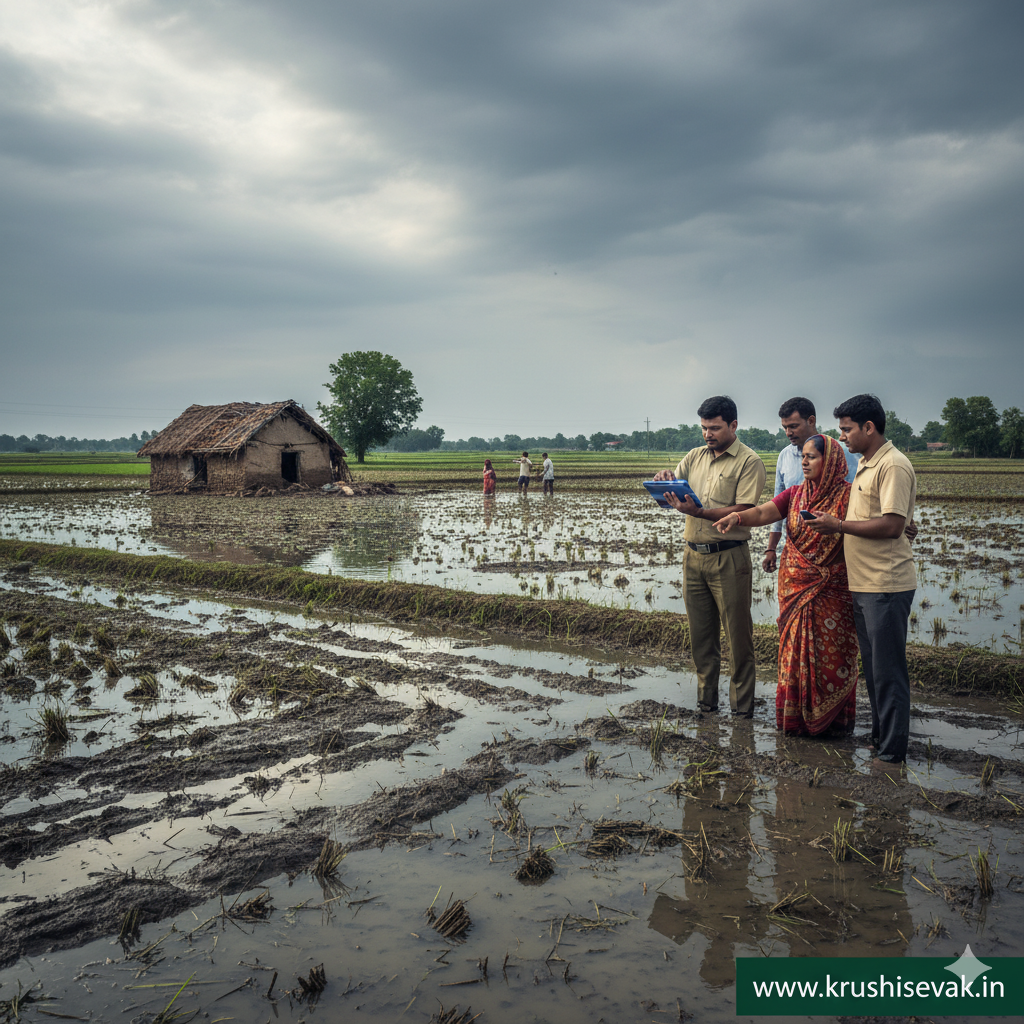
| Step 2: Spot Assessment (Panchnama) | A team of officials (Talathi, Agriculture Assistant, and others from the Tehsildar’s office) will visit the field to inspect the extent of the damage. This inspection is called the ‘Panchnama’. |
| Step 3: Digital Assessment (E-Panchnama) | Assessing officers will conduct an ‘E-Panchnama’ (Digital Assessment) on the spot using a tablet or mobile app, recording the GPS location and taking photographs of the damage. |
| Step 4: Signing the Report | The farmer must be present during the Panchnama, verify the recorded damage, and sign the assessment report. |
Important Note: If you have Crop Insurance (Pik Vima), you must also immediately inform the insurance company within 72 hours and file a separate claim. Government assistance and crop insurance claims are two distinct processes.
2. Required Documents (To be presented during Panchnama)
The following documents are essential during the assessment and for final submission for assistance:
- 7/12 (Saatbara) and 8A (Aath-A) Extract: Land record documents showing the damaged land.
- Aadhaar Card: Applicant’s identity proof.
- Bank Passbook Copy: The assistance amount is transferred directly via DBT (Direct Benefit Transfer), so the bank account must be Aadhaar-linked.
- Photographs of Damaged Crop: It’s helpful to have your own photos of the damage, which will be used in the Panchnama.
3. Compensation Rates (Grant)
As per the Government Resolution (GR) dated March 27, 2023, the compensation criteria for heavy rainfall damage in Maharashtra are as follows. (Assistance is capped at two hectares (2 ha) per affected farmer.)
| Type of Damage | Rate of Assistance (Per Hectare) |
|---|---|
| Jirayat Crops (Rainfed) | ₹8,500/- |
| Assured Irrigated Crops (Bagayat) | ₹17,000/- |
| Perennial Crops (Orchards/Horticulture) | ₹22,500/- |
| Farmland Damage (Silt/Sand Deposit >3 inches) | ₹18,000/- (Max. 2 ha) |
| Completely Destroyed House | Up to ₹1,20,000/- (for plain areas) |
4. Disbursement of Assistance
- Sanction: After the Panchnama, the list of affected farmers is sent by the Collector Office to the Government for sanctioning the relief fund.
- Verification: Once the funds are sanctioned, the beneficiary lists are published at the Taluka / Gram Panchayat level. You must verify your name on this list.
- Disbursement: The assistance amount is directly deposited into the beneficiary’s Aadhaar-linked bank account (DBT).