
Reducing maternal and neonatal mortality remains a cornerstone of India’s public health goals. Launched under the National Health Mission (NHM) by the Ministry of Health and Family Welfare, the Janani Suraksha Yojana (JSY) is a 100% centrally sponsored scheme designed to safeguard the lives of mothers and newborns. By integrating cash assistance directly with institutional delivery, the scheme incentivizes poor pregnant women to give birth in medical facilities rather than at home.Data from the National Family Health Survey-6 (NFHS-6) confirms that institutional deliveries in India have reached an impressive 90.6%, up from 88.6% in the previous survey cycle. Flagship schemes like JSY have been pivotal in driving this behavioral shift across rural, tribal, and economically disadvantaged landscapes.
If you or someone you know is expecting, this exhaustive, updated guide for 2026 outlines everything you need to know about the Janani Suraksha Yojana—including cash assistance amounts, eligibility rules, documentation, and a step-by-step application pipeline.
What is Janani Suraksha Yojana (JSY)?
Janani Suraksha Yojana is a safe motherhood intervention running under the umbrella of the National Health Mission. The primary mandate of the scheme is to bring down the Maternal Mortality Ratio (MMR) and the Infant Mortality Rate (IMR) by shifting deliveries from unsafe domestic setups to structured, clean, and professional health centers.
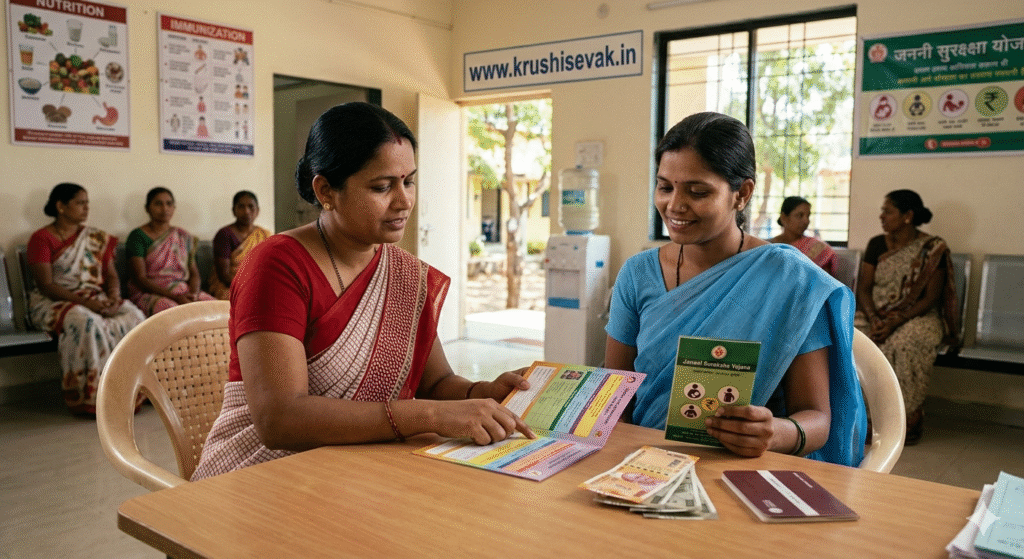
(Placeholder for illustrative mapping of maternal healthcare delivery chains under public health systems)
Strategic Pillars of the Scheme
- Targeted Financial Assistance: Direct benefit transfers to eligible pregnant women to mitigate the financial shock of childbirth.
- Focus on Low-Performing States (LPS): Special systemic attention and relaxation of caps for states with low institutional delivery rates.
- ASHA Integration: Empowering the Accredited Social Health Activist (ASHA) as an effective bridge between the community and the public healthcare apparatus.
- Complication Management: Providing additional financial backing for Cesarean sections and obstetric emergencies.
JSY Classification of States
To ensure funds and resources reach the regions that need them most, the Government of India has structurally classified states and Union Territories into two groups based on their institutional delivery performance:
High-Performing States (HPS): All other remaining states and Union Territories not listed under LPS.
Low-Performing States (LPS): These include the eight Empowered Action Group (EAG) states—Uttar Pradesh, Uttarakhand, Madhya Pradesh, Chhattisgarh, Rajasthan, Bihar, Jharkhand, and Odisha—along with Assam and Jammu & Kashmir.High-Performing States (HPS): All other remaining states and Union Territories not listed under LPS.Cash Incentives and Financial Benefits under JSY
The scale of financial packages varies based on whether the mother resides in a rural or urban setting and whether her state is classified as an LPS or HPS.
The Mother’s Financial Package
The direct cash incentive is designed to compensate for transport costs, immediate nutritional requirements, and clinical diagnostics. Below is the structured cash breakdown:
| State Classification | Rural Areas (Incentive to Mother) | Urban Areas (Incentive to Mother) |
|---|---|---|
| Low-Performing States (LPS) | ₹1,400 | ₹1,000 |
| High-Performing States (HPS) | ₹700 |
The ASHA Incentive Package
The scheme heavily rewards frontline workers (ASHAs) for tracking pregnancies, facilitating medical tests, and escorting mothers to institutions:
- In Rural LPS: ASHA receives ₹600 per delivery (split into ₹300 for transactional tracking/ANC services and ₹300 for escorting the mother).
- In Urban LPS: ASHA receives ₹400 per delivery.
- In HPS: ASHA packages are scaled based on specific state guidelines.
- C-Section / Obstetric Complications: If a public health facility lacks a resident specialist, a financial provision of up to ₹1,500 per case is made available to hire a private gynecologist or specialist to perform safe deliveries.
- Sterilization Compensation: If a beneficiary opts for voluntary sterilization immediately after delivery, a separate compensation of ₹1,500 is provided.
- The pregnant woman must be at least 19 years of age or older.
- The applicant must be legally married.
- In High-Performing States (HPS): The monetary benefit is limited up to two live births only.
- In Low-Performing States (LPS): The benefit is extended irrespective of the number of children, meaning a mother can claim the benefit for a third child or beyond, provided she delivers in a state-run health infrastructure.
- In LPS: All pregnant women delivering in government health centers, primary health centers (PHCs), community health centers (CHCs), or accredited private facilities are eligible.
- In HPS: Eligibility is confined to mothers belonging to Below Poverty Line (BPL) families or those from Scheduled Caste (SC) and Scheduled Tribe (ST) groups.
- Deliveries must occur in a Government Health Infrastructure (Sub-Centers, PHCs, CHCs, Sub-divisional/District Hospitals, or Medical Colleges).
- Deliveries are also eligible if they take place in a private clinic/hospital accredited by the State Government to provide JSY services.
Required Documentation for JSY 2026
To secure a seamless claim verification and fast-track your direct benefit bank transfer, the following documents must be kept ready:
- Identity Verification: Aadhaar Card or Voter ID Card.
- Address Proof: Ration Card, electricity bill, or residence certificate.
- JSY Card / MCP Card: The Maternal and Child Protection (MCP) card registered with an Anganwadi worker or an Auxiliary Nurse Midwife (ANM).
- Economic Category Proof: Valid BPL Ration Card or an income certificate issued by a competent local authority (mandatory for HPS).
- Social Group Certificate: SC/ST certificate (mandatory for HPS non-BPL claims).
- Bank Account Details: Passbook copy showing the Account Number, Bank Name, Branch, and IFSC Code. The bank account must be linked to the mother’s Aadhaar card.
- Delivery Certificate: Birth certificate or institutional delivery confirmation slip issued by the hospital.
Step-by-Step Application Process: How to Apply
While the primary mechanism of JSY operates through grassroot human infrastructure, tracking can be initiated both online and offline.
Method 1: Ground-Level Registration (Via ASHA/ANM) – Most Preferred
This remains the most secure and straightforward channel to claim benefits:
- Early Identification: As soon as a pregnancy is confirmed (ideally within the first trimester), contact the local ASHA worker, Anganwadi Worker (AWW), or ANM at the nearest Sub-Center.
- Procuring the MCP Card: The health worker will record the pregnancy in the official registers and issue an MCP (Maternal and Child Protection) Card.
- Birth Planning: At least 8 to 10 weeks before the expected date of delivery, the ASHA worker, in consultation with the Medical Officer (MO), will map out a birth plan and pre-determine the ideal government hospital or accredited private facility for delivery.
- Submission of Papers: Hand over copies of your Aadhaar Card, BPL Card, and Bank Passbook to the ASHA worker. They will compile your JSY physical application file.
Method 2: JSY 2026 Online Application Form Submission
The National Health Mission integrates delivery data via portals like JANANI (Journey of Antenatal, Natal and Neonatal Integrated Care) to monitor claims. Follow these digital tracking steps:
- Go to the official national health portal or your respective State Health Department’s website (e.g., myScheme.gov.in).
- Search for Janani Suraksha Yojana (JSY) in the search layout.
- Click on the download option for the JSY Application Form PDF, or choose the interactive digital form link if supported by your state.
- Carefully fill in the required details: Beneficiary Name, Age, Husband’s Name, Permanent Address, Category (BPL/SC/ST), Bank Account details, and MCP card registration number.
- Upload scanned copies of your valid identity proofs, BPL certifications, and bank passbook.
- Submit the digital application. Make sure to download or take a printout of the Acknowledgement Receipt containing your temporary reference number for tracking purposes.
Fund Disbursal Mechanism: How and When Is Money Paid?
The payment pipeline under Janani Suraksha Yojana is highly structured to prevent leakage and administrative delays:
- Public Facility Disbursal: If the delivery takes place inside a public health institution, the entire cash entitlement is processed and handed over to the mother in a single installment before or at the time of discharge from the facility.
- Accredited Private Facility Disbursal: If an accredited private facility is chosen, at least three-fourths (75%) of the cash assistance package must be cleared at the exact time of delivery, with the remainder settled post-verification.
- Direct Benefit Transfer (DBT): In compliance with digital financial regulations, funds are systematically transferred directly into the Aadhaar-linked bank account of the mother. Cash payouts are highly discouraged and only executed under emergency exemptions sanctioned by the District Medical Officer.
Sister Schemes Working with JSY
To provide end-to-end coverage, JSY runs in close convergence with several complementary healthcare programs:
1. Janani Shishu Suraksha Karyakram (JSSK)
While JSY gives cash incentives, JSSK ensures that absolutely zero out-of-pocket expenses are incurred. It guarantees:
- Free and cashless delivery (including C-sections).
- Free drugs, diagnostics, blood components, and consumables.
- Free transport from home to health facilities, between facilities during complications, and back home (via 102 / 108 ambulance networks).
2. Pradhan Mantri Matru Vandana Yojana (PMMVY)
A separate direct benefit transfer scheme that offers ₹5,000 in installments to pregnant and lactating mothers for their first child, focusing on partial wage compensation and nutritional intake.
Key Benefits and Impact of JSY
The continuous run of the Janani Suraksha Yojana has structurally altered rural health dynamics in India:
[Pregnancy Tracking] ──► [Antenatal Checkups] ──► [Safe Institutional Birth] ──► [Postnatal Care]
- Financial Safety Net: Shields ultra-poor families from medical debt incurred during childbirth.
- Access to Skilled Medical Staff: Reduces critical errors, infection risks, and birth traumas by ensuring births are handled by skilled midwives and doctors.
- Immediate Postnatal Care: Ensures mothers are monitored for critical conditions like Postpartum Hemorrhage (PPH) or Eclampsia within the critical 48-hour post-delivery window.
- Boost to Infant Immunization: Newborns receive their primary BCG, OPV, and Hepatitis B vaccine doses right at birth in the institutional ward.
Helpful Contact Details and Helplines
If you face delays in payment processing, or if an institution denies your JSY entry, you can reach out via these avenues:
- National Health Helpline Number: 104 (For health advice, registration follow-ups, and grievance redressal).
- National Ambulance Service: 102 / 108 (For free transport mapping).
- Local Action Point: Contact the Medical Officer (MO) of the concerned Primary Health Center (PHC) or the Chief Medical Officer (CMO) at your District Hospital.