
Banana (Musa paradisiaca) is one of the most popular, nutritious, and commercially viable fruit crops globally. In India, it holds a position of immense cultural and economic significance, often referred to as “Kalpataru” (a tree that fulfills all desires) due to its multifaceted utility.
Effective niyojan (strategic planning and management) is the cornerstone of a highly profitable banana orchard. Without meticulous planning regarding soil preparation, irrigation, nutrient scheduling, and pest management, growers often suffer losses from poor yield or low-quality fruit. This comprehensive guide details the step-by-step niyojan required for a successful banana plantation and harvesting enterprise.
1. SEO Optimization Metadata
To ensure this guide reaches farmers, agri-entrepreneurs, and students effectively, the following SEO parameters are established:
- Focus Keyphrase: Banana plantation and harvesting niyojan
- SEO Title: Banana Plantation and Harvesting Niyojan: The Ultimate Farming Guide
- Slug: banana-plantation-harvesting-niyojan-guide
- Meta Description: Master banana plantation and harvesting niyojan. Learn step-by-step techniques for soil prep, drip irrigation, tissue culture, pest control, and maximizing yield.
2. Agro-Climatic Requirements and Site Selection
The first phase of banana niyojan involves assessing whether your geographic location and natural resources align with the crop’s demands.
Climate and Temperature
Banana is a tropical crop that thrives in warm, humid conditions.
- Optimal Temperature Range: 15°C to 35°C is ideal. Growth slows down drastically below 10°C and stops completely above 40°C due to heat stress.
- Wind Conditions: Strong winds are a major threat to banana cultivation. High-velocity winds can tear leaves, reduce photosynthetic efficiency, or completely uproot the pseudostems. Selecting a site with natural windbreaks or planning to plant a border of tall trees (like Shevri or Casuarina) is a critical planning step.
Soil Requirements
Bananas are heavy feeders and require rich, well-drained soil.
- Soil Type: Fertile, deep, well-drained loamy soil is perfect. Alluvial and volcanic soils yield excellent results.
- Soil pH: The ideal pH range is between 6.5 and 7.5. Alkaline or highly acidic soils cause severe nutrient deficiencies.
- Drainage: Bananas love moisture but absolutely detest waterlogging. Poor drainage leads to root rot (Pythium spp.) and a complete collapse of the plantation within weeks.
3. Variety Selection and Propagation Material
Choosing the right variety depends heavily on your local market demand and export potential.
Popular Commercial Varieties
- Grand Naine (G-9): The undisputed king of commercial banana farming. It is highly demanded due to its uniform bunch size, long shelf life, and resistance to environmental stress.
- Robusta: A tall variety with large bunches, popular in Southern India.
- Dwarf Cavendish: Suited for windy areas due to its short stature.
- Rasthali / Silk: Known for its unique flavor, highly priced in local markets.
Sucker Selection vs. Tissue Culture
A crucial aspect of modern niyojan is opting for the right planting material.
| Feature | Traditional Suckers | Tissue Culture (TC) Plants |
|---|---|---|
| Uniformity | Low (variable growth rates) | Extremely High (simultaneous harvesting) |
| Pest/Disease Risk | High (nematodes/weevils carry over) | Disease-free certified starts |
| Yield Potential | Standard | 20% to 30% higher than suckers |
| Maturation Time | 12 to 14 months |
Strategic Note: For commercial success, Tissue Culture (TC) plants are highly recommended. While the initial investment is higher, the uniform maturity allows farmers to harvest the entire field within a narrow window, optimizing labor and transport costs.
4. Land Preparation and Field Layout
A well-prepared field lays the foundation for robust root development.
Primary Tillage
- Deep Ploughing: Use a disc plough to turn the soil up to a depth of 30–45 cm. This breaks hardpan layers and exposes soil-borne pathogens to direct sunlight.
- Harrowing: Pass a rotavator 2 to 3 times to break clods and achieve a fine tilth.
- Basal Organic Manure Application: Incorporate 25 to 30 tonnes of well-decomposed Farm Yard Manure (FYM) or green manure per hectare during the final harrowing.
Pit vs. Furrow Methods
Depending on your soil structure, choose the layout:
- Pit Method: Dig pits of size 45cm×45cm×45cm. Fill them with a mix of topsoil, 10 kg FYM, 250 grams of Neem Cake, and 20 grams of Carbofuran to deter soil insects.
- Furrow Method: Create deep furrows using a ridger. This is highly suitable for high-density planting combined with drip irrigation lines.
Spacing Matrix
Proper spacing ensures adequate sunlight penetration and air circulation.
- Standard Spacing (G-9): 1.82 m×1.52 m or 1.8 m×1.8 m.
- High-Density Planting (HDP): 1.2 m×1.2m(Requires intense nutrient management).
5. Water Management: The Power of Drip Irrigation
Banana is a water-loving plant requiring roughly 1,800 to 2,200 mm of water annually. However, surface flooding is highly inefficient and promotes fungal diseases.
Drip Irrigation Niyojan
Implementing a drip irrigation network is mandatory for competitive yields.
- Water Saving: Saves up to 40–50% of water compared to flood irrigation.
- Daily Scheduling: During winter, provide 15–20 liters of water per plant per day. In peak summer, scale this up to 30–35 liters per plant per day.
- System Layout: Install two lateral lines per row or an inline loop around the base of each pseudostem to ensure the root zone (which spreads horizontally) receives uniform moisture.
6. Nutrients and Fertigation Scheduling
Bananas have a massive appetite for nutrients, specifically Nitrogen (N) and Potassium (K). Fertigation—the process of delivering water-soluble fertilizers directly through the drip system—ensures maximum nutrient uptake efficiency.
Crop Requirement per Plant
A single healthy tissue-culture banana plant typically requires:
- Nitrogen (N): 200 grams
- Phosphorus (P_2O_5): 50 grams
- Potassium (K_2O): 300 grams
Fertigation Calendar (Growth Stage-Wise)
| Days After Planting (DAP) | Primary Target | Key Fertilizers | |
|---|---|---|---|
| Vegetative Phase | 1 to 120 Days | Root & Leaf Development | Urea, 19:19:19, Ammonium Sulphate |
| Flower Bud Initiation | 121 to 180 Days | Pseudostem Strength | 12:61:0 (MAP), Micronutrients (Zinc, Boron) |
| Shooting/Flowering | 181 to 240 Days | Bunch Emergence | 13:0:45, Calcium Nitrate |
| Fruit Development | 241 to 300 Days | Finger Filling & Sweetness |
Pro Tip: Stop all Nitrogen applications after the bunch emerges completely. Continued Nitrogen application at late stages renders the fruit soft, decreasing its shelf life during transport.
7. Intercultural Operations (Orchard Maintenance)
To ensure the energy of the plant is entirely directed toward fruit production, several manual maintenance steps must be planned (niyojan).
Desuckering
The mother banana plant continuously produces side shoots (suckers). If left unchecked, these suckers compete for nutrients, delaying the main crop’s maturity and reducing bunch weight.
- Action: Cut the suckers at ground level every 15–20 days. Pour a drop of kerosene or apply a dollop of common salt on the cut heart of the sucker to prevent it from resprouting.
- Exception: Retain one strong sucker (follower plant) when the main crop reaches 7–8 months of age if you plan to keep a ratoon crop.
Earthing Up
Keep the soil mounded around the base of the stem up to a height of 20–30 cm. This provides structural stability, prevents the plant from tilting, and ensures the shallow root system remains covered.
Propping
As the banana bunch grows, its weight can exceed 25–40 kg. The pseudostem is not made of wood; it is a bundle of tightly packed leaf sheaths. Therefore, it can buckle under heavy weight or wind pressure.
- Action: Use sturdy bamboo sticks or synthetic ropes tied to a central support system to brace the flowering stem. Form a “Y” shape with two bamboo poles to support the neck of the bunch.
Denaveling and Male Bud Removal
Once all the female hands (the actual bananas) have opened up on the bunch, a long tail with a dark purple male bud continues to hang down.
- Action: Chop off this male bud cleanly at a distance of 10–15 cm from the last hand. This saves nutrients and redirects carbohydrates into filling the fruit fingers.
Bunch Spraying and Sleeving
To protect the skin of the banana fingers from scratches, birds, thrips, and sunburn:
- Spray: Apply a mild solution of fungicide and systemic insecticide immediately after the bunch opens.
- Sleeving: Cover the entire bunch with a perforated, transparent or blue polyethylene bag (6% ventilation holes). This micro-climate inside the bag increases bunch weight by 10–15% and ensures spotless, premium-quality fruit.
8. Integrated Pest and Disease Management
Bananas are susceptible to several destructive pests and diseases. A proactive containment plan is essential.
Major Pests
- Banana Pseudostem Weevil (Odoiporus longicollis): The larvae bore holes into the stem, weakening it until it snaps.
- Management: Maintain strict orchard sanitation. Inject the pseudostem with a solution of Beauveria bassiana or insert aluminum phosphide tablets into the boreholes.
- Thrips and Aphids: These insects suck sap and act as vectors for viral diseases.
- Management: Spray Neem oil (10,000 ppm) or Dimethoate at bi-weekly intervals.
Major Diseases
- Panama Wilt (Fusarium oxysporum f. sp. cubense): A catastrophic soil-borne fungus causing leaves to turn yellow, hang down like a skirt, and split the pseudostem lengthwise.
- Management: Grow resistant varieties like G-9. Drench the soil with Carbendazim (0.2%) or apply Trichoderma viride mixed with FYM to the soil.
- Sigatoka Leaf Spot: Characterized by dark brown, elongated spots running parallel to leaf veins. It destroys the green leaf area, causing premature ripening of small bunches.
- Management: Prune and burn infected leaves. Spray Propiconazole (0.1%) or copper oxychloride alternatively.
- Banana Bunchy Top Virus (BBTV): Transmitted by aphids. Leaves become stunted, bunched up at the top with a rosette appearance, and the plant bears no fruit.
- Management: There is no cure for BBTV. Infected plants must be uprooted, chopped, and buried or burned away from the field immediately to prevent spread.
9. Harvesting Niyojan
The culmination of 11 to 12 months of hard work depends heavily on precise harvesting execution. Premature harvesting results in thin, sour fingers, while delayed harvesting leads to fruit splitting and rapid spoilage during transport.
Determining Maturity Indices
Look for the following physical indicators to confirm the fruit is ready for harvest:
- Angular to Round: The sharp ridges/angles on the banana fingers turn smooth and round.
- Color Transition: The deep green color fades to a lighter green or yellowish-green tint.
- Dried Floral Ends: The dried remains of the flowers at the tip of the fingers fall off easily when brushed.
- Drying of Leaves: The top leaves start showing signs of yellowing naturally.
Harvest Window Matrix by Destination
| Target Market | Maturity Level | Estimated Days from Flowering |
|---|---|---|
| Long-Distance Export | 75% to 80% Mature (Guards against ripening in transit) | 90 to 105 Days |
| Local Markets | 90% to 95% Mature (Full size, high starch accumulation) |
Harvesting Execution Protocol
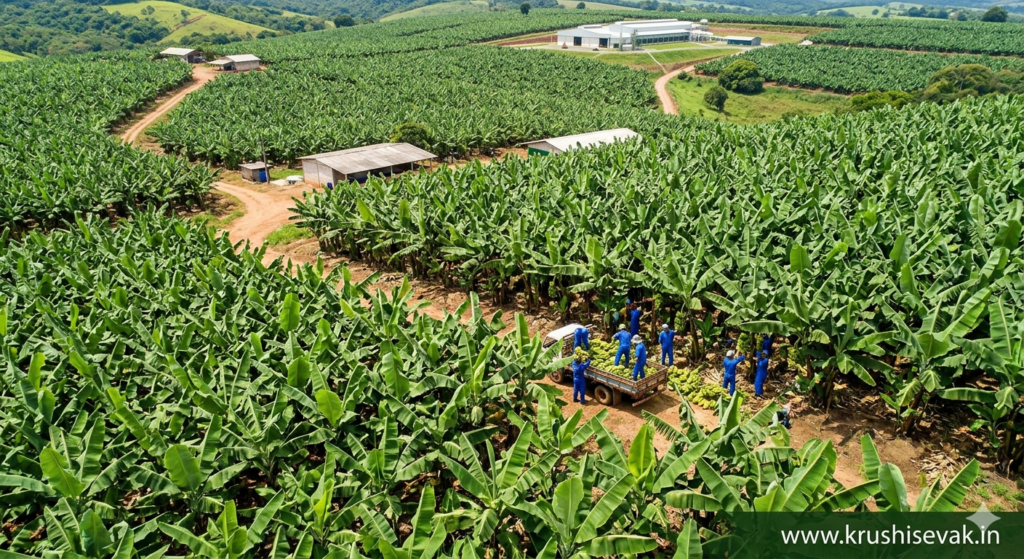
Harvesting should always be done during the cooler parts of the day—either early morning or late evening—to avoid field heat buildup in the fruit.
- The Two-Person Team: Harvesting requires two people. Person A makes a clean, slanted cut halfway through the pseudostem to cause the plant to slowly bend under the weight of the bunch.
- The Catch: As the bunch lowers, Person B catches the bunch on their padded shoulder to avoid any contact with the bare ground. A single drop or scratch can cause black bruises, ruining market value.
- The Stem Cut: Person A cleanly cuts the peduncle (bunch stem), leaving a 30 cm handle. This handle is crucial for handling and hanging the bunch during processing.
- Post-Harvest De-Trashing: Cut down the remaining mother pseudostem down to ground level. Chop this vegetative waste and spread it between the rows as organic mulch to conserve soil moisture.
10. Post-Harvest Handling and Market Logistics
Once harvested, the clock starts ticking. Proper handling maintains the cold chain and aesthetic quality.
Washing and De-Handing
- Transport the bunches carefully to a shaded packing shed.
- Cut the bunch into individual “hands” using a sharp de-handing knife.
- Immerse the hands immediately in a clean water tank filled with Alum (0.1%) or a mild chlorine solution. This washes away dirt and stops the sticky, milky latex from bleeding over the fruit skin, which causes black staining.
Sorting and Grading
- Grade A: Spotless, uniform fingers, correct length (typically >18 cm for commercial export), free from mechanical damage.
- Grade B: Minor cosmetic blemishes, slightly smaller sizing, destined for nearby local markets.
- Rejects: Deformed fingers, split skins, or pest-damaged fruit. These are redirected to processing units for banana powder, chips, or cattle feed.
Packing and Cold Storage
- Air-dry the washed hands completely using fans to prevent fungal mold growth.
- Treat the cut crown with a permissible anti-fungal paste or wax to prevent crown rot.
- Pack the hands in corrugated fiberboard (CFB) boxes lined with perforated polyethylene sheets. Standard boxes hold 13 kg or 18 kg of fruit.
- Storage Conditions: Maintain a temperature of 13°C to 14°C with a relative humidity of 85–90%.
- Land Preparation & Organic Manuring: ₹35,000
- Tissue Culture Plants (~3,000 plants @ ₹16/plant): ₹48,000
- Drip Irrigation Setup (Subsidies applicable separately): ₹75,000
- Fertilizers, Water-Soluble Nutrients & Fertigation Management: ₹85,000
- Plant Protection Chemicals (Pesticides/Fungicides): ₹25,000
- Labor (Planting, Desuckering, Propping, Sleeving, Harvesting): ₹60,000
- Miscellaneous Overhead Costs: ₹22,000
- Total Investment: ₹3,50,000
- Average Bunch Weight: 25 kg per plant
- Total Survival/Productive Plants: ~2,800 plants out of 3,000
- Total Yield: 2,800 × 25 kg= 70,000 kg (70 Tonnes)
- Average Farm Gate Price: ₹12 per kg
- Gross Income: 70,000 ×12 = ₹8,40,000
Net Profit Calculation
Net Profit= Gross Income- Total Cost Net Profit = ₹8,40,000 – ₹3,50,000 = ₹4,90,000 per Hectare
Note: In the subsequent ratoon crop (second year), the production cost drops drastically by roughly 40% because the drip system, field layout, and planting material costs are neutralized, resulting in an even higher net profit margin.
12. Conclusion
Banana plantation and harvesting niyojan is not merely about planting suckers and waiting for fruit. It is a highly precise science requiring meticulous attention to details: from selecting disease-free tissue culture starts, adhering to daily micro-irrigation protocols, using calculated fertigation tables, protecting bunches with sleeves, to exercising care during harvesting to avoid physical bruising.
By executing this systematic blueprint, modern farmers can transform banana cultivation into a resilient, high-yielding commercial asset that delivers consistent, lucrative returns year after year.