
Agriculture is undergoing a massive paradigm shift. For decades, the standard approach to pest management followed a “blanket coverage” philosophy—spraying entire fields at scheduled intervals regardless of the actual pest density or localized pressure. While this method historically secured food production volumes, it created significant economic and environmental challenges, including pest resistance, soil degradation, chemical runoff, and inflated input costs.
Today, modern farming demands a transition to smart and precise pesticide application. Precision crop protection marries agronomy with cutting-edge technology, ensuring that crop protection products are applied only when necessary, precisely where needed, and in the exact dosage required. This approach treats pesticides not as a default insurance policy, but as a highly targeted, strategic intervention. By optimizing pesticide efficiency, farmers can protect their bottom lines, satisfy stringent regulatory standards, and meet the growing consumer demand for sustainably grown food.
Integrated Pest Management (IPM) as the Foundation
You cannot achieve smart and precise pesticide application without a robust Integrated Pest Management (IPM) framework. IPM shifts the focus from eradication to management, viewing the field as an ecosystem. It uses a combination of biological, cultural, physical, and chemical tools to minimize economic damage while reducing reliance on chemical treatments.
Economic Injury Level (EIL) and Economic Threshold (ET)
The backbone of any smart pesticide decision is understanding the mathematical relationship between pest populations and financial loss.
- Economic Injury Level (EIL): This is the lowest pest population density that will cause economic damage equal to the cost of applying a control management practice.
- Economic Threshold (ET): Also known as the “action threshold,” this is the pest density at which control measures should be initiated to prevent an increasing pest population from reaching the EIL.
By applying pesticides only when scouting reports confirm that a pest population has crossed the ET, farmers avoid unnecessary sprays, preserving beneficial predator populations and saving thousands of dollars in chemical inputs.
Cultural and Biological Controls
Before reaching for the spray rig, precise pest management leverages preventative cultural practices. These include strategic crop rotation to break pest life cycles, selecting pest-resistant or BT crop varieties, managing planting dates to avoid peak pest emergence windows, and maintaining optimal soil health to ensure crops can naturally withstand minor pest pressures. Concurrently, conserving native biological control agents—such as ladybugs, lacewings, and parasitic wasps—acts as a continuous, zero-cost pest suppression system that reduces the need for synthetic interventions.
Advanced Scouting and Pest Detection Technologies
Implementing a smart and precise pesticide application workflow relies entirely on accurate, real-time data. You cannot precisely treat what you have not accurately mapped. Traditional field walking remains essential, but it is now augmented by high-tech diagnostic tools that pinpoint pest hot spots before they spread across an entire field.
Remote Sensing and Drone Surveillance
Unmanned Aerial Vehicles (UAVs) and satellite imagery equipped with multispectral and hyperspectral sensors have revolutionized crop scouting. These sensors capture data beyond the visible light spectrum, measuring changes in canopy reflectance.
By tracking indexes like the Normalized Difference Vegetation Index (NDVI), algorithms can detect early signs of crop stress caused by insects, fungi, or weeds days before the human eye can see them. This allows farmers to generate prescription maps for localized, spot-treatment applications rather than spraying the entire field.
AI-Powered Image Recognition and Smart Traps
Automated pheromone traps equipped with internal cameras and machine learning algorithms can now identify, count, and track specific pest species in real time. These smart traps send daily alerts to a farmer’s smartphone, noting exactly when a pest influx occurs. Furthermore, mobile applications powered by computer vision allow field scouts to snap a picture of a damaged leaf or an unknown insect and instantly receive an accurate identification along with tailored, precise treatment recommendations.
Precision Application Machinery and Spray Technology
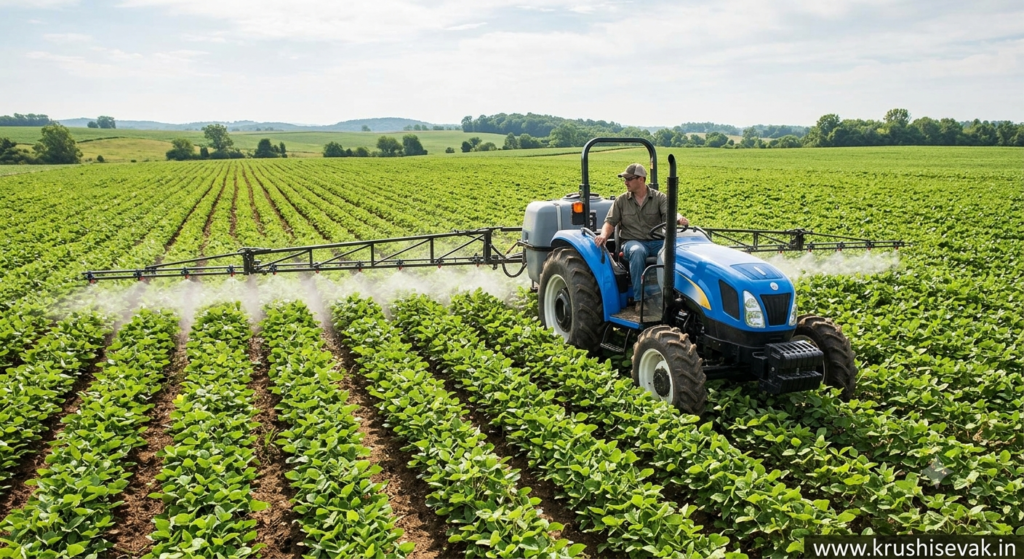
Once a pest threat is identified and mapped, the focus shifts to delivery. Modern spray equipment is engineered to eliminate waste, maximize target canopy penetration, and ensure that every micro-drop of chemical works efficiently to support smart and precise pesticide application.
Variable Rate Application (VRA) and Direct Injection
Variable Rate Application technology integrates GPS/GNSS systems with prescription maps generated during the scouting phase. As the sprayer moves through the field, individual nozzle controllers automatically adjust the flow rate, increasing dosage in high-pressure zones and shutting off completely over healthy, pest-free areas.
This is frequently paired with direct injection systems, where pure pesticide concentrates are kept in separate tanks and injected directly into the water boom line only as needed. This eliminates the need for tank-mixing large quantities of chemicals, preventing the problem of leftover hazardous wastewater at the end of the day.
Pulse Width Modulation (PWM) Nozzle Systems
Traditional sprayers tie nozzle flow rate directly to the travel speed of the tractor; if the tractor slows down, the pressure drops, changing the droplet size and distorting the spray pattern. Pulse Width Modulation (PWM) decouples flow rate from pressure to make smart and precise pesticide application a reality.
PWM systems use electric solenoids to pulse the nozzle valves open and shut up to 50 times per second. By varying the duration of the pulse (the duty cycle), the system can precisely manage the application rate across changing tractor speeds, sharp turns, and uneven terrain, all while maintaining a constant pressure and uniform droplet size.
Smart Optical Spot-Spraying
For weed management, real-time optical spot-spraying systems utilize boom-mounted cameras to differentiate between green vegetation and bare soil (or even between specific weed species and crop leaves via AI). Systems like “See & Spray” activate individual nozzles only when a weed passes directly beneath them. This technology drastically slashes post-emergence herbicide use by up to 60% to 80%, providing massive cost savings and reducing the chemical load on the soil.
Nozzle Selection, Calibration, and Droplet Physics
The humble spray nozzle is the most critical interface in a smart and precise pesticide application process. It dictates the droplet size, velocity, and distribution pattern, directly influencing whether a pesticide successfully hits its target or becomes an environmental pollutant.
The Spectrum of Droplet Sizes
Pesticide droplets are measured in micrometers (microns). Nozzles produce a spectrum of droplet sizes categorized from Very Fine to Ultra Coarse:
- Fine Droplets (<200 microns): Provide excellent, dense canopy coverage, making them ideal for contact fungicides and insecticides. However, they are highly susceptible to wind drift and rapid evaporation.
- Coarse Droplets (>400 microns): Are heavy and resistant to wind drift, making them excellent for systemic soil-applied herbicides. However, they offer poor coverage on vertical leaf surfaces and can bounce off the foliage onto the ground.
Smart application requires selecting a nozzle that balances these trade-offs based on the specific mode of action of the chemical being used. For instance, air-induction (venturi) nozzles mix air into the liquid stream, creating larger, air-filled droplets that resist drift but shatter upon hitting the leaf surface to provide adequate coverage.
Systematic Equipment Calibration
Even the most advanced sprayer will fail if it is not calibrated correctly. Regular calibration must be conducted before every major spraying season or when changing chemical formulations. The process requires validating three key variables:
- Tractor Ground Speed: Verifying that the speedometer matches actual field speed over a set distance.
- Nozzle Flow Rate: Measuring the fluid output of each individual nozzle over a timed minute using a calibrated measuring cup to ensure variation between nozzles does not exceed 5% to 10%.
- Boom Height: Setting the boom at the precise height recommended by the nozzle manufacturer (typically 20 inches above the target canopy) to ensure the spray patterns overlap perfectly for uniform coverage.
Managing Environmental Variables and Drift Reduction
A truly smart and precise pesticide application does not happen in a vacuum; ambient weather conditions heavily dictate the success or failure of a spray operation. Off-target drift not only wastes expensive chemical inputs but also threatens neighboring crops, residential areas, and local ecosystems.
Wind Velocity and Direction
Spraying should ideally take place when winds are steady and light, between 3 to 10 miles per hour (mph). If winds are less than 3 mph, the air is too still, which can signal a dangerous meteorological phenomenon known as a temperature inversion. If winds exceed 10 to 15 mph, the risk of physical drift increases exponentially, blowing fine droplets away from the target zone.
Temperature Inversions: The Invisible Danger
A temperature inversion occurs when a layer of warm air traps a layer of cooler air close to the ground, usually during calm, clear nights and early mornings. In these conditions, ultra-fine spray droplets do not disperse; instead, they remain suspended in a highly concentrated cloud near the ground. This chemical cloud can move laterally over long distances with light breezes, damaging non-target crops miles away. Smart operators look for signs of inversion, such as ground fog or smoke layers that move horizontally rather than rising vertically, and completely halt spraying when an inversion is detected.
Temperature and Relative Humidity (Delta T)
High temperatures paired with low relative humidity accelerate droplet evaporation. When a droplet evaporates mid-air, it shrinks, turning a safe, coarse droplet into a highly drift-prone fine particle.
Many advanced growers use the Delta T indicator—the wet-bulb depression that measures the evaporation rate. An ideal Delta T for spraying ranges between 2 and 8. If the Delta T value climbs above 10, evaporation happens too quickly, meaning the pesticide may dry out before it can be absorbed by the leaf cuticles, resulting in poor efficacy.
Adjuvants and Water Quality Optimization
The chemical carrier—which is almost always water—makes up over 95% of the volume inside a spray tank. Therefore, the physical and chemical properties of the water heavily influence pesticide performance and dictate the final outcome of your smart and precise pesticide application.
Water Hardness and pH Management
High levels of dissolved minerals like calcium and magnesium (hard water) can bind to negatively charged pesticide molecules, particularly herbicides like glyphosate. This binding neutralizes the active ingredient before it ever touches a weed.
Similarly, water pH can destabilize chemicals. Many insecticides and fungicides are sensitive to alkaline hydrolysis, a process where high pH water breaks down the chemical bonds of the pesticide while it sits in the tank. Using water conditioners, such as ammonium sulfate (AMS) for hard water, and pH buffers ensures the chemical remains fully active and stable.
The Role of Smart Adjuvants
Adjuvants are substances added to the spray tank to modify physical fluid properties and improve performance. They are categorized based on their specific functions:
- Surfactants: Reduce the surface tension of the spray droplet, allowing it to flatten out and wet a larger surface area of a waxy leaf rather than rolling off.
- Stickers: Help the pesticide adhere to the foliage, preventing it from being washed away by unexpected rainfall or overhead irrigation.
- Drift Retardants: Modify the viscoelastic properties of the spray solution, minimizing the production of ultra-fine, drift-prone droplets within the nozzle spray pattern.
Safety Protocols, Handling, and Environmental Stewardship
True precision in pesticide management extends to how chemicals are stored, mixed, loaded, and disposed of. Protecting human health and preserving the surrounding ecosystem is a vital component of any smart and precise pesticide application program.
Personal Protective Equipment (PPE) Compliance
The mixing and loading phase represents the highest risk of acute chemical exposure for operators. Compliance with the product label’s PPE requirements is non-negotiable. This typically includes chemical-resistant gloves (such as nitrile or neoprene), protective eyewear or face shields, long-sleeved shirts, long pants, and respirators fitted with organic vapor cartridges when handling volatile compounds.
Correct Container Disposal and Rinsing
Empty pesticide containers must never be abandoned or thrown into standard waste streams. The industry standard is the triple-rinse method or pressure rinsing. Immediately after emptying a container into the spray tank, it must be filled one-quarter full with clean water, capped, shaken vigorously, and drained into the spray tank.
This process must be repeated three times. Rinsing recovers 99.9% of the formulation, ensuring no product is wasted and rendering the plastic container safe for specialized agricultural recycling programs.
Safeguarding Water Bodies and Buffer Zones
To prevent the contamination of groundwater and surface water streams, mixing and loading stations should be located at least 150 feet away from wells, streams, and ponds. Utilizing backflow preventers on filling hoses is critical to ensure that chemical solutions are never accidentally siphoned back into a clean water source.
Furthermore, smart application practices mandate leaving untreated buffer zones next to sensitive ecological areas, wetlands, and residential properties to safeguard biodiversity and maintain community health.