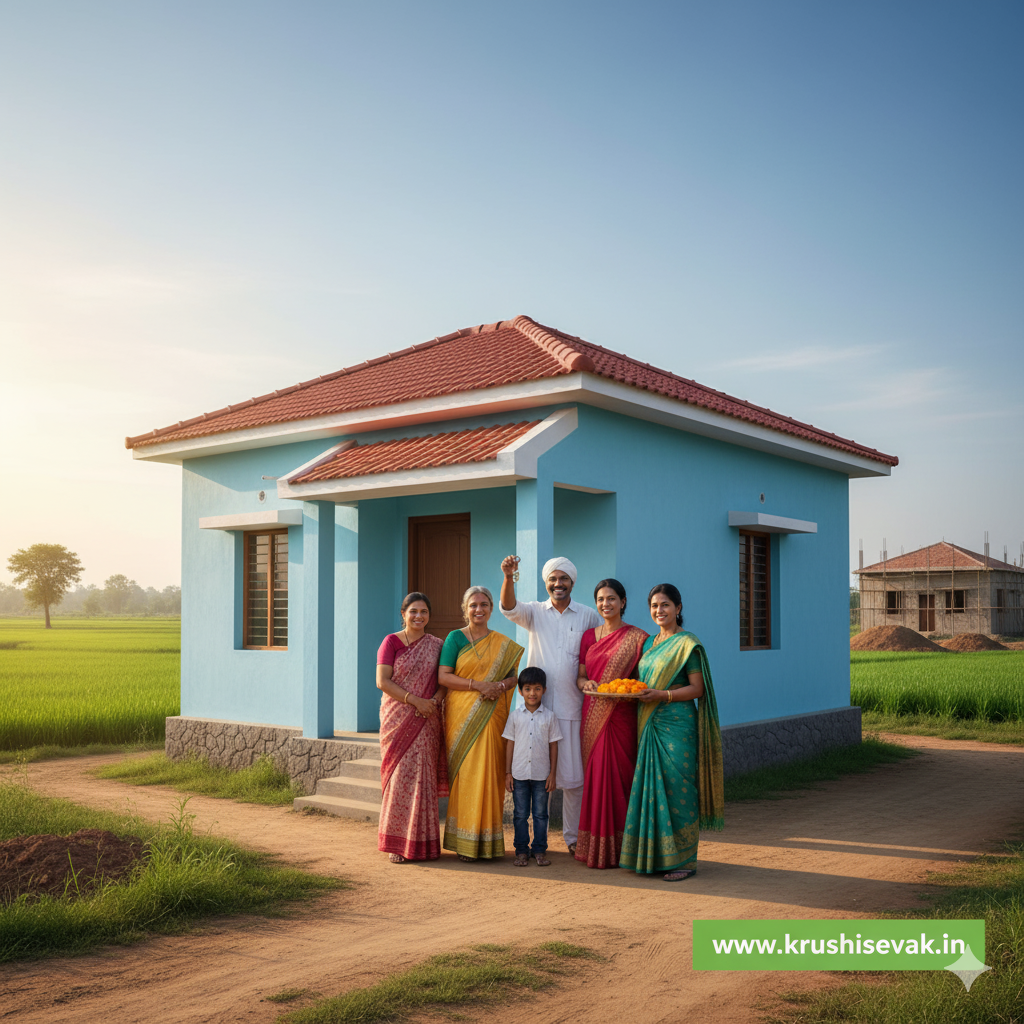

The Pradhan Mantri Awas Yojana (PMAY) is a major initiative by the Government of India aimed at providing financial assistance to Economically Weaker Sections (EWS) and Low-Income Group (LIG) citizens for constructing a pucca (permanent) house. The scheme is implemented in two components: Urban (PMAY-U) and Rural (PMAY-G).
1. Essential Documents for Pradhan Mantri Awas Yojana 2025
Applicants must keep the following key documents ready (the list may vary based on specific state requirements):
| No. | Document | Purpose |
|---|---|---|
| 1 | Aadhaar Card | Identity and address proof (for the applicant and family members) |
| 2 | PAN Card | Identity and for financial transactions |
| 3 | Income Certificate | To determine annual income (EWS: up to ₹3 Lakh, LIG: ₹3 Lakh to ₹6 Lakh) |
| 4 | Bank Account Details | Copy of Bank Passbook (The account must be Aadhaar-linked) |
| 5 | Residential Proof | Proof of being a resident of the respective State |
| 6 | Voter ID Card | Nationality and identity proof |
| 7 | Caste Certificate | For SC/ST/OBC applicants (for reservation and eligibility) |
| 8 | Affidavit (Self-Declaration) | Declaration that the applicant or any family member does not own a pucca house in India |
| 9 | Land Documents | 7/12 extract, 8A (If applicable for rural or BLC component) |
| 10 | Passport Size Photographs | Recent photos of the applicant |
| 11 | Mobile Number | For tracking the application status |
| 12 | For PMAY-G: MGNREGA Job Card (if applicable) |
2. How to Apply for Pradhan Mantri Awas Yojana 2025
The application procedure is different for Urban and Rural areas.
A) Application Process for Urban Areas (PMAY-Urban)
Citizens in urban areas can apply through the online method:
Step 1: Visit the Official Website
- Go to the official website: pmaymis.gov.in.
Step 2: Select ‘Citizen Assessment’
- In the main menu, click on the “Citizen Assessment” option.
- Select the relevant component under which you wish to seek benefit (e.g., “Benefit under other 3 components”).
Step 3: Aadhaar Verification
- Enter your Aadhaar Number and name as per Aadhaar to complete verification via OTP or biometrics.
Step 4: Fill the Form
- Once verified, the application form will open. Carefully fill in all details, including personal information, family member details, annual income, and bank details.
- Ensure all information is accurate.
Step 5: Submit the Application
- Read and accept the Self-Declaration.
- Enter the Captcha Code and click Save. You will receive an Application Number; keep this safe.
Step 6: Submit Documents (Offline Part)
- Take a printout of the filled application form. Attach the required documents and submit them physically at your nearest Common Service Center (CSC) or the Urban Local Body (Municipal Corporation/Council) office.
B) Application Process for Rural Areas (PMAY-Gramin)
The rural application process primarily relies on the SECC 2011 Data and Gram Sabha approval:
Step 1: Check the Permanent Waiting List (PWL)
- PMAY-G benefits are primarily given to families listed and found eligible in the Socio-Economic and Caste Census (SECC-2011) data.
- You can check if your name is on the list by visiting the rural website pmayg.nic.in and using the Beneficiary Search option.
Step 2: Contact Gram Panchayat
- If your name is not on the PWL but you believe you are eligible, you must contact your Gram Panchayat Office.
- In some states, new beneficiaries are selected through the AwaasPlus survey, subject to Gram Sabha approval.
Step 3: Offline Registration/Submission
- Obtain the required application form from the Gram Panchayat or Block Development Officer (BDO) office. Fill it out accurately and submit it along with the necessary documents to the respective office.
Step 4: Approval and Sanction
- After verification at the Gram Sabha and District level, the scheme’s benefit will be sanctioned, and the grant amount will be transferred directly to your bank account.