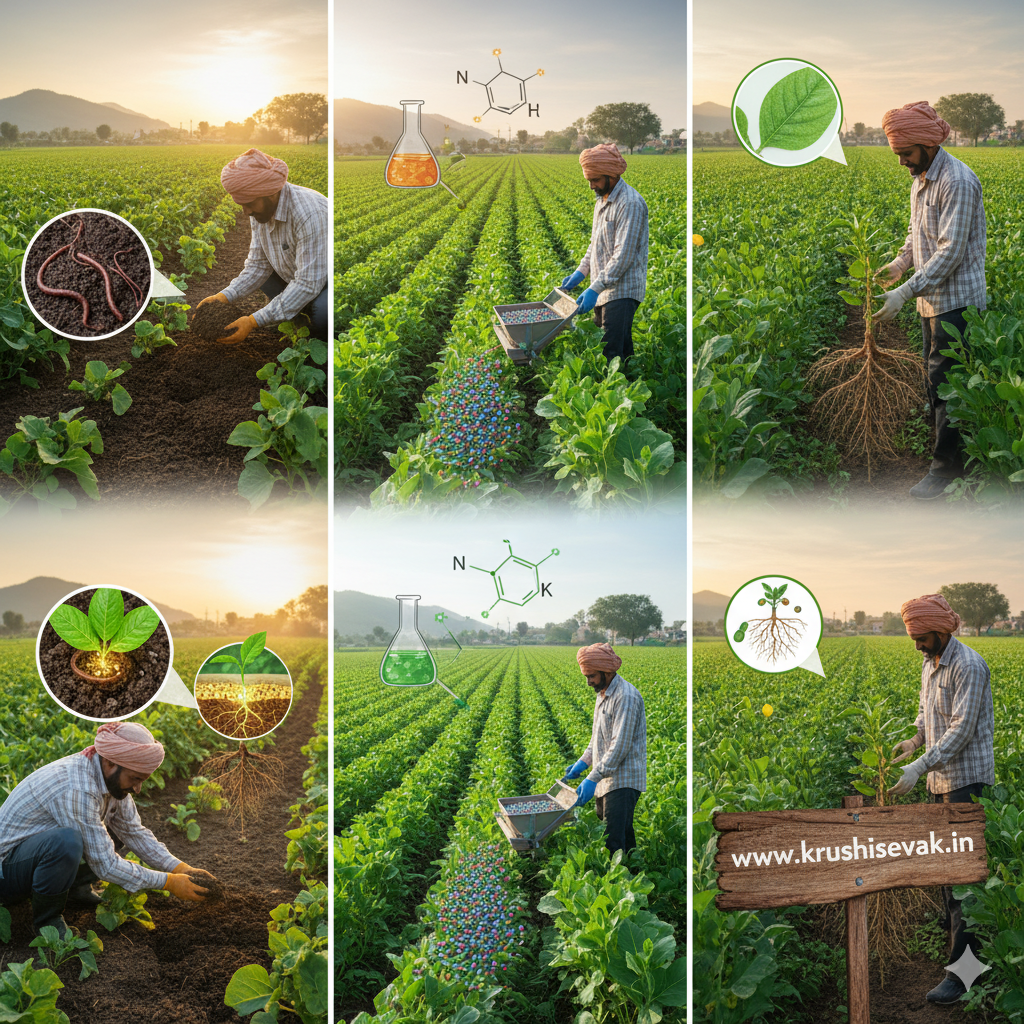

Dear farmers, fertilizers are absolutely essential for excellent crop growth and a bumper harvest. Fertilizers are substances that supply the necessary nutrients required by the soil and crops for their development. Proper planning of fertilizer use is crucial to maintain and enhance soil fertility.
Main Types of Fertilizers
Fertilizers are mainly classified into three types:
1. Organic Fertilizers 🌱
These fertilizers are made from the natural residues of plants and animals. They help improve soil health.
- Examples: Farmyard Manure (FYM), Compost, Vermicompost (Earthworm Compost), Green Manure, Oil Cakes.
- Key Benefits:
- Increase Organic Carbon in the soil.
- Improve the soil’s Water Holding Capacity.
- Help improve the physical structure of the soil.
2. Chemical Fertilizers (Inorganic) 🧪
These fertilizers contain specific nutrients essential for crops, produced through chemical processes. They provide nutrients to the crops quickly.
- Examples: Urea (Nitrogen), DAP (Nitrogen and Phosphorus), Potash (Potassium), Complex Fertilizers (e.g., 10:26:26, 19:19:19).
- Key Benefits:
- Provide nutrients to the crop in a definite amount and quickly.
- Immediately compensate for the deficiency of important nutrients like Nitrogen (N), Phosphorus (P), and Potassium (K).
- Useful for achieving high yields.
3. Bio-fertilizers (Microbial) 🦠
These are also called Biological Fertilizers. They contain micro-organisms that help make nutrients available to the crops.
- Examples: Rhizobium, Azotobacter, PSB (Phosphate Solubilizing Bacteria).
- Key Benefits:
- Absorb atmospheric Nitrogen and make it available to the crop (especially for pulse/legume crops).
- Dissolve locked-up Phosphorus in the soil, making it accessible to plants.
- Help reduce the use of chemical fertilizers and are environmentally friendly.
General Benefits of Fertilizers
- Increased Yield: Crop growth is vigorous, leading to a significant increase in production.
- Improved Quality: The quality, color, and taste of grains, fruits, and vegetables are enhanced.
- Nutrient Supply: The nutrient deficiency in the soil is addressed.
- Disease Resistance: The crop’s ability to fight diseases and pests is improved.