
For generations, sugarcane farming has been a cornerstone of agriculture across many regions. Farmers toil under the burning sun for months, preparing the soil, planting crops, and managing irrigation, all to harvest tons of lush green sugarcane. Yet, despite their hard work, many farmers find themselves stuck in a cycle of unpredictable market prices, delayed payments from sugar mills, and razor-thin profit margins.
Selling raw sugarcane directly to mills or middlemen often leaves farmers with barely enough to cover their input costs. But what if there was a way to break free from this cycle? What if the key to financial independence lay not in growing more crops, but in changing how those crops are processed?
This is the inspirational success story of how one visionary farmer shifted from being a simple raw material producer to a thriving agri-entrepreneur. By taking control of the supply chain—moving from farm to factory—and manufacturing organic gud (jaggery), he transformed his farm into a profitable enterprise and redefined his family’s future.
The Turning Point: Recognizing the Problem with Raw Sugarcane
For years, Ramesh (a representative story of thousands of progressive farmers) followed the traditional routine. He grew sugarcane on his 5-acre ancestral land and sold the entire harvest to the local sugar factory. However, three persistent challenges kept holding him back:
- Delayed Payments: Sugar mills frequently delayed payments by several months, creating severe cash-flow issues.
- Low Profit Margins: High costs for fertilizers, labor, and transport left behind very little net profit.
- Price Volatility: Market rates fluctuated wildly, leaving his annual income completely at the mercy of factors beyond his control.
Realizing that selling raw sugarcane would never build real wealth, Ramesh began researching value addition. He asked himself a fundamental question: How can I convert my raw harvest into a long-lasting, high-value product that consumers actually want?
The answer was simple, natural, and highly in demand: Organic Jaggery (Gud).
Why Organic Gud? Understanding the Market Shift
In recent years, health consciousness among urban consumers has skyrocketed. People are actively seeking natural alternatives to refined white sugar, which is heavily processed and stripped of its natural nutrients.
Unlike refined sugar, traditional jaggery is rich in iron, potassium, magnesium, and antioxidants. However, much of the commercial jaggery available in local markets contains chemical additives, artificial colors, and sulfur dioxide used for clarification and cosmetic bleaching.
Ramesh spotted a massive gap in the market: Pure, chemical-free, organic gud.
Urban households, fitness enthusiasts, and health-focused bakeries were willing to pay a premium price for 100% natural, unadulterated jaggery. By tapping into this rising demand, Ramesh wasn’t just selling a product; he was offering a healthy lifestyle choice.
Step-by-Step: The Journey From Farm to Factory
Transitioning from traditional farming to small-scale processing required planning, learning, and dedication. Here is how Ramesh executed his plan step-by-step:
1. Shifting to Organic Sugarcane Cultivation
First, Ramesh converted two acres of his land to 100% organic farming. He stopped using synthetic pesticides and chemical fertilizers, replacing them with organic compost, cow dung manure, and bio-fertilizers. While the transition required patience, it yielded high-quality, chemical-free sugarcane with a naturally rich sucrose content.
2. Setting Up a Mini Jaggery Processing Unit (Gud Bhatti)
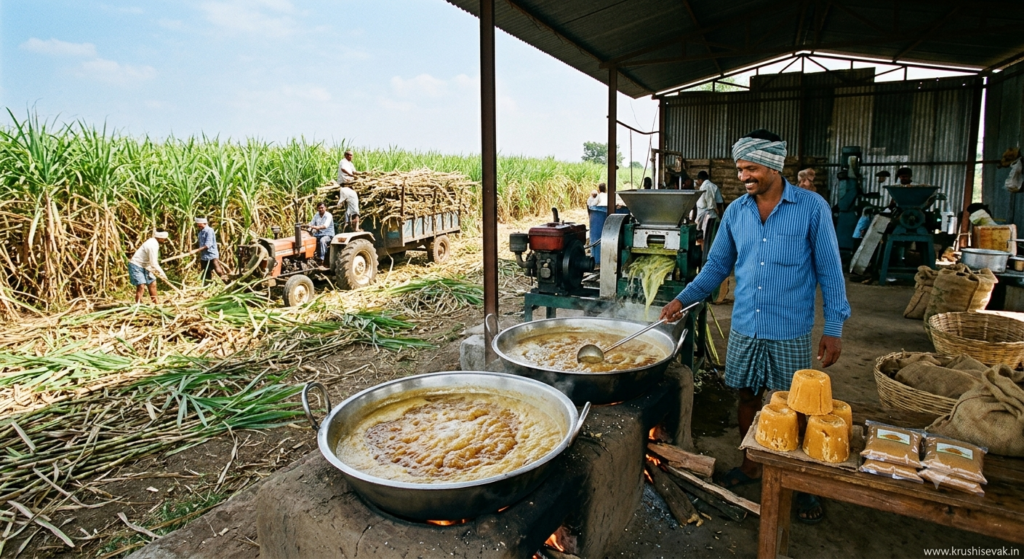
Instead of investing millions in large industrial machinery, Ramesh started small. He set up a hygienic, semi-automated crushing and boiling unit right near his farm. The setup included:
- A heavy-duty sugarcane crusher.
- Stainless steel boiling pans for hygienic processing.
- Filtration units to clear impurities naturally without adding chemicals.
- Mold trays for shaping the final jaggery blocks.
3. Natural Processing Without Chemicals
To keep the jaggery completely organic, Ramesh avoided chemical clarifiers. Instead, he used natural plant extracts (like wild okra/bhindi plant extract) to remove impurities during the boiling process. The juice was slowly cooked over controlled fires, retaining all its essential minerals, natural aroma, and rich golden-brown color.
4. Product Diversification
Understanding that modern consumers prefer convenience, Ramesh did not limit himself to traditional heavy jaggery blocks. He diversified his product line into:
- Organic Jaggery Cubes: Convenient for daily tea and coffee preparation.
- Organic Jaggery Powder (Shakkar): An easy 1:1 replacement for white sugar in baking and cooking.
- Flavored Gud: Jaggery infused with ginger, cardamom, sesame seeds, or dry fruits for added health benefits and taste appeal.
Overcoming Challenges: From Production to Branding
Setting up the processing unit was only half the battle; selling the finished product was where the real transformation happened.
Initially, local market vendors hesitated to pay a higher price for organic jaggery. To overcome this, Ramesh adopted a direct-to-consumer (D2C) model:
- Attractive & Hygienic Packaging: He moved away from open-air selling and packed his products in food-grade, moisture-proof pouch packaging with clear labelling.
- Certifications: He obtained FSSAI registration and organic certification, which built instant trust among consumers.
- Local Exhibitions and Social Media: He showcased his farm’s journey on WhatsApp, Instagram, and at organic farmers’ markets in nearby cities.
Once customers tasted the pure, rich flavor of his chemical-free jaggery, word-of-mouth marketing took over. Orders started pouring in from housing societies, organic stores, and local sweet shops.
The Result: Financial Success and Social Impact
The decision to transition from raw sugarcane to organic gud completely changed Ramesh’s financial trajectory:
- 3x Income Growth: By processing sugarcane into organic jaggery powder and cubes, his earnings per acre tripled compared to selling raw cane to mills.
- Direct Cash Flow: Instead of waiting months for sugar mill payouts, he now maintained a steady daily and weekly cash flow through direct sales.
- Job Creation: His small processing unit provided stable employment to local farm workers and women in his village throughout the harvesting season.
Key Takeaways for Aspiring Agri-Entrepreneurs
This organic gud business success story offers valuable lessons for anyone looking to enter the agricultural or food processing business:
- Focus on Value Addition: Selling processed, ready-to-use products yields significantly higher profit margins than selling raw commodities.
- Solve a Real Problem: Capitalize on health trends by offering clean, chemical-free alternatives to mainstream processed foods.
- Start Small and Scale: You don’t need a massive factory to start. A hygienic, small-scale unit with proper quality control is enough to build a brand.
- Embrace Direct Marketing: Use modern packaging, organic certifications, and digital channels to reach health-conscious urban buyers directly.
Conclusion
The journey from Farm to Factory is not just about installing machinery; it is about adopting a business mindset in agriculture. By turning raw sugarcane into organic gud, one farmer broke free from financial uncertainty and built a scalable, sustainable business.
If you own farmland or have access to raw agricultural materials, the message is clear: Don’t just sell what you grow—value-add, brand it, and build your own success story!