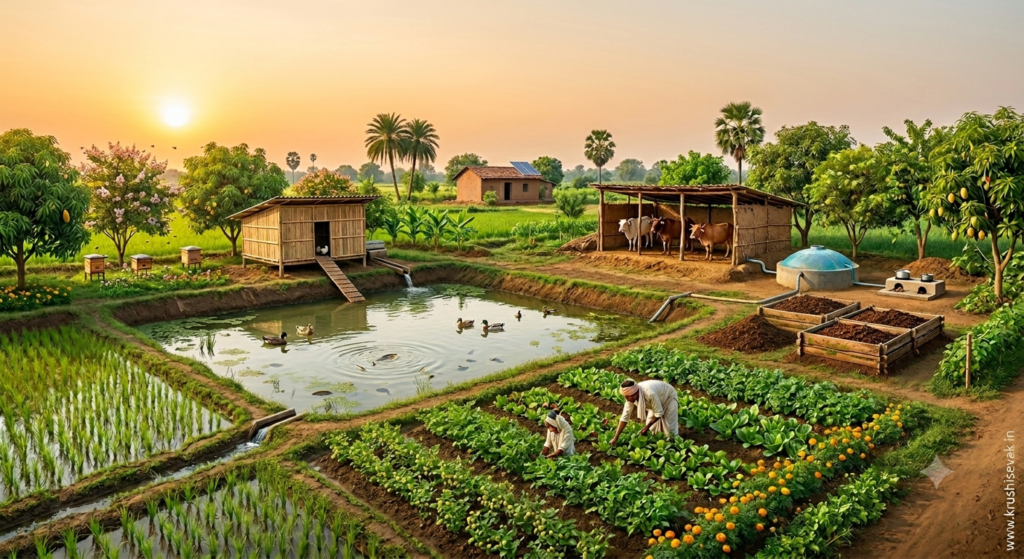

The Integrated Farming System (IFS) represents an eco-friendly and highly sustainable approach to modern agriculture. In conventional farming, individual agricultural activities are often conducted in isolation. Single-crop farming, or monoculture, focuses on maximizing the output of one specific commodity. However, an integrated farming system seamlessly coordinates multiple agricultural and allied activities on a single piece of land to create a self-sustaining ecosystem.
Rather than treating crop cultivation, livestock rearing, fish farming, and forestry as separate commercial activities, an integrated farming system links them together so that the output of one enterprise becomes the primary input for another. For example, crop residues feed livestock, animal manure fertilizes crop fields and feeds aquaculture ponds, and aquatic silt restores soil fertility. This circular flow of energy and nutrients reduces environmental waste, minimizes external purchasing costs, and boosts overall farm productivity.
As global populations grow, arable land decreases, and climate unpredictability creates severe economic risks for single-crop farmers, the integrated farming system stands out as an essential agricultural framework. It helps restore ecological balances, improves soil vitality, provides consistent year-round income, and establishes long-term food security for rural communities worldwide.
Core Principles of Integrated Farming System
The success of an integrated farming system rests on several foundational principles derived from ecological balance and resource efficiency.
1. Enterprise Complementarity
The primary principle of an integrated farming system is selecting enterprises that support and enhance each other rather than competing for resources. Land, water, labor, and sunlight are managed so that each component—whether crops, trees, animals, or fish—complements the biological requirements of the others.
2. Waste Recycling and Circularity
In a traditional farm setup, agricultural waste is often burned, discarded, or left to pollute the surrounding environment. In an integrated farming system, zero waste is the operational standard. Crop stubble, livestock dung, poultry droppings, unused food scraps, and wastewater are continuously collected, treated, recycled, and fed back into the biological production loop.
3. Maximum Spatial and Temporal Efficiency
An integrated farming system optimizes both vertical space and seasonal time. By using techniques like multi-tier cropping, agroforestry, and multi-enterprise scheduling, farmers utilize land continuously across all twelve months of the year without degrading soil health.
4. Soil and Ecosystem Restoration
Repeated chemical applications in high-input agriculture degrade soil structure, destroy beneficial microbes, and lower organic carbon levels. An integrated farming system prioritizes long-term soil health by incorporating farmyard manure, vermicompost, liquid bio-fertilizers, and leguminous cover crops into the crop management cycle.
Major Components of an Integrated Farming System
An effective integrated farming system incorporates various agricultural and allied enterprises customized to regional climate conditions, soil composition, water availability, and local market demand.
Crop Production Module
Crops serve as the foundation of most integrated farming system setups. A well-structured crop management plan includes:
- Field Crops: Cereals like rice, wheat, maize, and millets provide staple foods for human consumption and yield high volumes of straw for animal bedding and fodder.
- Legumes and Pulses: Crops like chickpeas, lentils, and soybeans fix atmospheric nitrogen in the soil, reducing the need for synthetic nitrogen fertilizers.
- Fodder Crops: Dedicated grasses and leguminous forage crops provide fresh, high-protein feed for dairy cattle, goats, and sheep.
Horticulture and Agroforestry Module
Integrating fruits, vegetables, flowers, and trees adds structural complexity and economic stability to the integrated farming system:
- Horticulture: Seasonal vegetables and spice crops yield fast, high-margin cash returns between major grain harvests. Orchards containing mango, guava, citrus, or papaya generate continuous long-term income.
- Agroforestry: Planting timber, fuelwood, or fruit-bearing trees along farm borders acts as a natural windbreak, minimizes soil erosion, enhances water retention, and sequesters atmospheric carbon.
Livestock and Animal Husbandry Module
Livestock play a crucial role in an integrated farming system by converting plant biomass into valuable bio-fertilizers and protein-rich food products:
- Dairy Cattle and Buffaloes: Supply milk for daily household consumption or sale, while yielding dung for biogas units and organic manure for crops.
- Goats and Sheep: Highly adaptable grazers that consume farm weeds and coarse crop residues, converting them into meat, milk, and nutrient-dense manure.
- Poultry and Duckery: Birds generate steady protein sources through eggs and meat. Their droppings act as potent, high-nitrogen fertilizers for fields and fish ponds.
Aquaculture Module
Fish farming integrates seamlessly into an integrated farming system. Farm ponds collect rainwater runoff, while livestock manure and poultry droppings serve as natural fertilizers that stimulate plankton growth for fish feed. Additionally, nutrient-rich silt that accumulates at the bottom of the pond can periodically be dredged and applied as topsoil fertilizer to crop fields.
Supplementary Allied Enterprises
- Vermicomposting: Uses earthworms to transform crop residues, animal manure, and organic farm waste into vermicompost, a nutrient-dense organic fertilizer.
- Apiculture (Beekeeping): Placing beehives around flowering crops increases plant yield through natural insect pollination while generating extra income from honey and beeswax sales.
- Mushroom Cultivation: Mushrooms thrive on agricultural byproducts like rice straw and sugarcane bagasse, turning waste into high-value food.
- Biogas Production: Anaerobic digesters break down animal dung and organic slurry to generate clean methane gas for domestic cooking and lighting, leaving behind a rich liquid slurry for soil fertilization.
Synergistic Mechanisms in an Integrated Farming System
The true strength of an integrated farming system lies in the biological interactions between its individual components.
Crop and Livestock Interconnection
Crops supply livestock with green fodder, dry straw, husks, and grain byproducts. In return, animals supply draft power and manure. When livestock dung and urine are processed into compost, farmyard manure, or fermented bio-liquids, they nourish soil microflora, eliminating the need for expensive chemical inputs.
Poultry, Fish, and Crop Interconnection
In an integrated farming system, poultry or duck housing is often constructed over or beside a fish pond. Droppings fall into the pond, fertilizing phytoplankton and zooplankton growth, which serves as natural food for fish species. When the pond water is periodically drained, this nutrient-dense liquid is channeled into vegetable fields to fertilize growing crops.
Agroforestry, Beekeeping, and Crop Interconnection
Boundary trees shelter fields from wind damage and reduce soil evaporation losses. Flowering trees and field crops supply continuous nectar to honeybees. In return, bees pollinate fruit orchards and field crops, raising total farm yields naturally.
Key Benefits of an Integrated Farming System
Adopting an integrated farming system offers significant ecological, financial, and practical advantages for agricultural producers.
1. Higher Overall Farm Productivity
By combining multi-tiered crop canopies, animal husbandry, and aquatic farming on a single piece of land, an integrated farming system produces far more total food and biomass per acre than a traditional monoculture farm.
2. Lower Input Costs and Higher Net Profit
Chemical fertilizers, commercial animal feed, synthetic pesticides, and fuel account for most expenses on conventional farms. By recycling internal farm waste into feed, manure, and energy within an integrated farming system, farmers significantly lower their production costs, increasing their net income.
3. Continuous Year-Round Income Stream
Monoculture farmers often wait months for harvest before earning income, leaving them vulnerable to seasonal cash shortages. An integrated farming system generates varied, continuous cash flows:
- Daily Income: Fresh milk sales, eggs, and leafy green vegetables.
- Weekly Income: Seasonal vegetables, mushrooms, and fish.
- Seasonal Income: Field crops, pulses, fruits, and honey.
- Long-Term Income: Timber, fruit orchards, and livestock sales.
4. Climate Resilience and Risk Reduction
Weather anomalies, sudden pest invasions, and volatile market prices pose severe threats to single-crop farmers. If bad weather damages a field crop in an integrated farming system, the farmer maintains financial stability through dairy, poultry, fish, and vegetable sales.
5. Soil Health and Environmental Sustainability
An integrated farming system minimizes reliance on synthetic agrochemicals, preventing groundwater pollution and chemical runoff into local waterways. Organic soil management improves microbial activity, enhances moisture retention, restores organic carbon, and turns the farm into an active carbon sink.
6. Enhanced Household Nutrition and Food Security
Families relying on monoculture farming often consume carbohydrate-heavy diets based on single staple crops. An integrated farming system naturally supplies a diverse range of home-grown foods—including fresh vegetables, milk, eggs, fruits, fish, and pulses—improving family nutrition and helping prevent rural malnutrition.
Step-by-Step Implementation Strategy for Integrated Farming System
Transitioning to an integrated farming system requires careful site analysis, strategic enterprise selection, and progressive execution.
Step 1: Comprehensive Site Assessment
Before introducing new enterprises, evaluate the farm’s natural environment and available resources:
- Land and Soil: Evaluate total acreage, soil type, topography, and drainage capacity.
- Water Supply: Determine groundwater availability, rainfall distribution, and suitable locations for rainwater harvesting ponds.
- Climate Conditions: Select plant varieties and livestock breeds adapted to local seasonal temperatures and humidity.
- Market Demand: Identify local demand for products such as fresh milk, eggs, organic vegetables, fish, and honey.
Step 2: Selecting Complementary Enterprises
Choose enterprises based on available resources, labor availability, and local demand. A versatile integrated farming system model for small-to-medium land holdings typically includes:
- Core crop production (Cereals and legumes)
- Horticultural plots (Vegetables and fruit trees)
- Small dairy unit (2 to 4 cows or buffaloes)
- Poultry unit or integrated fish pond
- Vermicomposting unit and small biogas digester
Step 3: Designing the Physical Layout
Arrange the layout of your integrated farming system to simplify daily operations and maximize resource transfers:
- Locate poultry housing adjacent to or directly over fish ponds for easy manure transfer.
- Place livestock sheds near biogas plants and vermicompost pits to reduce the labor needed to transport dung.
- Position composting facilities near high-demand vegetable plots and fields.
- Plant boundary trees along outer edges to serve as windbreaks without shading main crop fields.
Step 4: Building Waste Recycling Loops
Establish clear operational routines for managing and processing organic materials within the integrated farming system:
- Collect crop stubble after harvest; save clean fodder for livestock and direct the remaining residue to composting beds.
- Divert animal manure directly into biogas digesters or vermicomposting units.
- Route nutrient-rich bio-slurry from biogas production into irrigation channels to fertilize growing crops.
Step 5: Ongoing Monitoring and Optimization
Keep precise records of all input costs, labor requirements, yields, and revenues across every enterprise. If an individual enterprise in your integrated farming system underperforms or demands excessive labor relative to its financial returns, adjust its scale and allocate resources toward more profitable components.
Overcoming Challenges in Integrated Farming System Adoption
While an integrated farming system offers clear benefits, farmers may encounter operational challenges during implementation.
High Initial Setup Capital
Establishing fish ponds, animal housing, biogas digesters, and irrigation systems requires upfront capital. Farmers can address this by taking a phased approach—starting with low-cost components like crop production, vermicomposting, and small livestock units, then using the profits from those activities to fund future expansions like aquaculture or agroforestry.
Complex Daily Management
Managing multiple farming enterprises simultaneously within an integrated farming system requires knowledge across various fields, including animal husbandry, agronomy, aquaculture, and pest control. Participating in training sessions, agricultural extension programs, and field demonstrations helps farmers gain the skills needed to manage diverse enterprises effectively.
Increased Labor Requirements
Daily feeding, manure management, livestock care, and crop harvesting require continuous labor. Using labor-saving solutions—such as gravity-fed irrigation systems, elevated poultry units over fish ponds, and strategically placed composting beds—helps reduce daily labor demands.
Common Integrated Farming System Models
Integrated farming system models vary by region based on geography, climate, and local water availability.
Rice-Fish-Poultry Model
Commonly practiced in high-rainfall wetland areas. Rice is grown in flooded fields connected to deeper fish trenches or farm ponds, with poultry housing built along the pond edges. Poultry droppings fertilize the water, encouraging plankton growth for the fish. The fish and ducks eat weed seeds and insect pests, aerating the water and raising rice yields without synthetic chemicals.
Crop-Livestock-Biogas-Horticulture Model
Well-suited for irrigated plain lands. Field crops produce food grains for the family and fodder for dairy cattle. Cattle dung powers a biogas plant, producing clean cooking fuel for the household and nutrient-rich liquid slurry for vegetable gardens and fruit trees.
Agroforestry-Pasture-Livestock Model
Ideal for dryland and semi-arid regions. Drought-resistant pasture grasses, fodder bushes, and deep-rooted trees are grown together. Goats and sheep graze under the tree canopy, which protects them from heat stress, while their droppings naturally fertilize the soil and support grass growth.
Practical Considerations for Long-Term Success
To ensure long-term sustainability and profitability, farmers adopting an integrated farming system should follow key operational guidelines:
- Prioritize Soil Organic Carbon: Regularly apply compost, green manure, and crop residues to preserve soil microbial activity.
- Diversify Crop Rotations: Avoid planting the same crop family continuously on the same plot; rotate with leguminous crops to break pest cycles and replenish nitrogen naturally.
- Promote Natural Pest Management: Plant flowering border trees and cover crops to attract beneficial predator insects, reducing the need for chemical pesticides.
- Focus on Water Conservation: Use drip irrigation, mulching, and farm ponds to conserve rainwater and protect crops during dry periods.
- Align Production with Local Markets: Choose enterprises whose products have strong, reliable demand in nearby markets to ensure steady sales and cash flow.