
Technical and Economic Scope of the Scheme
Agricultural irrigation in Maharashtra has traditionally faced structural constraints due to erratic power availability, grid maintenance issues, and the high financial and environmental costs of diesel generation. Rural electricity distribution networks often run agricultural power lines exclusively during nighttime blocks to manage industrial grid loads. This operational system forces farmers to irrigate their crops under difficult and dangerous midnight conditions. Furthermore, thousands of farms in remote, tribal, or ecologically sensitive forest fringes remain completely unconnected to conventional power lines due to high terrain infrastructure costs.
To solve these compounding agricultural issues, the Government of Maharashtra, through the Department of Energy and the Maharashtra State Electricity Distribution Company Limited (MSEDCL), operates the Mukhyamantri Saur Krushi Pump Yojana (frequently expanded and integrated through the Magel Tyala Saur Krishi Pump Yojana framework). This macro-level sustainable energy campaign targets the deployment of eco-friendly, off-grid solar-powered agricultural pumping systems to replace expensive diesel units and eliminate reliance on traditional, heavily subsidized grid lines.
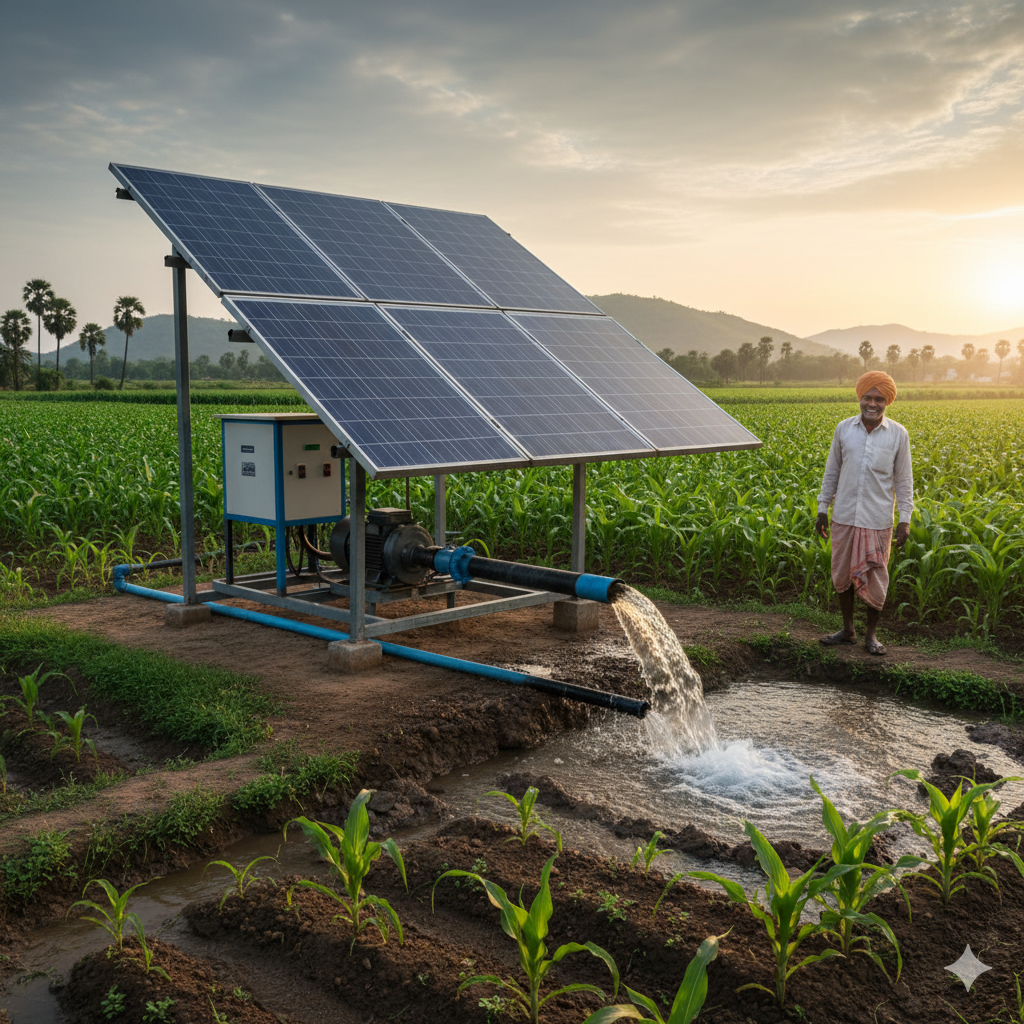
By utilizing direct photovoltaic conversion, the scheme provides farmers with uninterrupted, high-voltage irrigation power precisely during peak daytime hours. The program functions as an eco-friendly infrastructure initiative that reduces the carbon footprint of rural operations while lowering the massive financial subsidy burden borne by state power utilities. Managed through a transparent, fully digitized application architecture, the program aims to systematically upgrade smallholder farms with high-efficiency Brushless DC (BLDC) surface or submersible solar pumps backed by multi-year operational insurance warranties.
Core Eligibility Parameters and Pump Classifications
The distribution of solar pumping systems is governed by clear land ownership metrics, geographic constraints, and technical feasibility parameters. The state structures these criteria to prioritize regions lacking proper grid connections and smallholder producers vulnerable to crop failure.
1. General Beneficiary Targeting Criteria
- The Baseline Land Rule: The applicant must be a permanent resident of Maharashtra and hold clear, undisputed ownership of agricultural land with a valid land registry record.
- Electrification Status: The primary target group consists of farmers whose plots are completely un-electrified through conventional overhead grid systems. Additionally, farmers who have registered on the MSEDCL waitlist for an agricultural connection, or those located in remote, tribal, and forest-fringe hamlets where grid expansion is technically unfeasible, receive priority.
- Existing Connection Exclusions: Any farmer who already possesses a functional, conventional grid-tied agricultural electricity connection is legally excluded from claiming benefits under this program.
2. Mandatory Water Source Prerequisite
Solar pumps cannot operate effectively without an assured, sustainable ground or surface water resource. The applicant must have a functional, registered water source situated within or immediately adjacent to their land parcel. Eligible infrastructure types include:
- Individual or community farm ponds (Shetatale).
- Traditional open wells (Vihir).
- Deep agricultural borewells.
- Plots running directly alongside perennial domestic rivers, streams, or lifting canals.
3. Sizing Metrics: Matching Land Size to Pump Horsepower
To optimize natural resource allocation and ensure equitable system distribution, the capacity of the sanctioned solar pumping kit scales directly with the verified acreage of the applicant’s farm:
- Up to 2.5 Acres of Land: Eligible for a 3 HP (Horsepower) solar agricultural pump kit.
- From 2.51 to 5.0 Acres of Land: Eligible for a 5 HP solar agricultural pump kit.
- Above 5.0 Acres of Land: Eligible for a 7.5 HP high-capacity solar agricultural pump kit.
Farmers have the flexibility to request a lower-capacity pump than their maximum eligible limit if their crop water requirements or well recharge rates are lower, but they cannot request a size that exceeds these statutory land boundaries.
4. Co-Beneficiary and Environmental Zoning Rules
- Shared Land Ownership: If the agricultural plot is listed under joint family ownership (where multiple names appear on the land title), the primary applicant must provide a formal, notarized No Objection Certificate (NOC) signed by all registered co-sharers to establish single-user pump operation rights.
- Groundwater Dark Zones: If the farm is located within an ecologically stressed watershed area designated as a “Dark Zone” by state hydrological surveys, the applicant must obtain an explicit clearance certificate from the Ground Water Surveys and Development Agency (GSDA) confirming that the proposed draw rate will not collapse localized aquifers.
System Subsidies and Financial Frameworks
The scheme features an attractive financial subsidy layout designed to reduce the capital cost of solar technology, making it affordable for smallholder households. The remaining capital outlay is fully balanced via coordinated funding injections from central renewable energy programs (such as PM-KUSUM) and state budgetary provisions.
Beneficiary Share Breakdown
The cash contribution required from the farmer represents a small fraction of the total market cost of the equipment, scaled by social category metrics:
- General Category Farmers: Mandated to contribute exactly 10% of the total government-negotiated price of the solar pump kit as their upfront financial stake.
- Scheduled Caste (SC) & Scheduled Tribe (ST) Farmers: Entitled to a deeper concession, requiring a contribution of only 5% of the total system cost.
System Kit Specifications and Warranty Extensions
The capital package covers the procurement and installation of a complete off-grid solar infrastructure kit. Beyond the physical motor and multi-crystalline or mono-crystalline solar panels, the package includes an automated dual-axis or manual tracking mounting structure, a weather-proof controller unit, dynamic circuit protections, and a basic field lighting system (often including LED domestic bulbs and built-in USB mobile charging ports).
Crucially, to safeguard smallholders against operational risks, every system installed by empanelled vendors comes with a comprehensive 5-year comprehensive repair guarantee and full insurance coverage protecting against environmental damage, theft, and natural decay.
Required Documentation Checklist
To pass the integrated online screening process without experiencing system delays or immediate application rejections, farmers must assemble a complete dossier of digital documents:
- 7/12 Land Extract (Satbara Utara): A recent copy of the land title document, showing updated crop logs and confirming the explicit presence of an active water source (well, borewell, or pond) on the plot.
- 8-A Land Holding Certificate: An official document mapping the consolidated total land area held by the farmer within that village circle, which determines the allowable pump horsepower (3 HP, 5 HP, or 7.5 HP).
- Aadhaar Card: The primary identity document used for mandatory biometric verification and unique registration tracking.
- Caste Certificate: A valid community certificate issued by authorized state revenue executives, mandatory for verifying eligibility for the reduced 5% financial contribution tier for SC/ST beneficiaries.
- Aadhaar-Linked Bank Passbook: A clear copy of the bank account statement displaying active routing parameters (IFSC and Account Number) to process any direct benefit transactions.
- No Objection Certificates (NOCs): Written consent papers from joint landholders (if applicable) or structural clearance approvals from the GSDA or Forest Department if operating near protected natural zones.
- Current Contact Credentials: An active, permanent mobile phone number registered in the farmer’s name to receive mandatory processing status update SMS logs.
Step-by-Step Online Application Process
The submission and execution workflow for the Mukhyamantri Saur Krushi Pump Yojana is managed through a centralized, high-speed electronic portal operated directly by MSEDCL.
Step 1: Portal Access and Preliminary Registration
The farmer or an authorized digital kiosk operator accesses the official dedicated MSEDCL Solar Energy Portal (mahadiscom.in/solar/ or the direct regional portal gateway). On the landing terminal, the applicant clicks on the “Apply Online” option under the New Applications dashboard. The portal presents a basic registration box where the user selects their district, taluka, and village coordinates, and inputs their unique Aadhaar identifier alongside an active mobile number.
Step 2: Form A-1 Data Entry
Upon validating the mobile connection through a secure system-generated One-Time Password (OTP), the interface unlocks the digital Form A-1. The user must fill out all integrated fields accurately:
- Applicant Information: Full name matching Aadhaar spelling, residential details, and communication coordinates.
- Agricultural Land Matrix: Exact survey numbers, Gat numbers, and accurate acreage calculations.
- Water Infrastructure Profiles: Selecting the specific type of irrigation source available (e.g., Well, Borewell, River) and specifying its current operational depth.
- Grid History Log: Declaring whether an agricultural electricity waitlist application number already exists for that field site, which helps accelerate priority sorting.
Step 3: Document Uploading and Digitization
The applicant shifts to the document management module. Using a standard flatbed scanner or a high-resolution mobile document scanning application, the user uploads clean, legible copies of their 7/12 land extract, 8-A certificate, Aadhaar card, and caste credentials into their designated portal slots. The platform enforces strict file size boundaries, requiring each uploaded file to be formatted as a PDF or JPEG under 500 KB to avoid transmission timeouts.
Step 4: Submission Confirmation and Reference Generation
The applicant reviews the entire digital form to ensure absolute data matching between the uploaded physical land papers and the typed online form. The user checks the final legal self-declaration box and hits the “Submit Application” button. The MSEDCL system processes the entry and generates a unique, permanent Beneficiary ID / Application Tracking Number. This code is immediately pushed to the applicant’s phone via an automated confirmation SMS and must be retained for all future verification checkpoints.
Verification, Field Assessment, and Installation Workflow
Once the online Form A-1 is submitted, the application transitions into a multi-layered verification and execution pipeline involving local utility engineering offices and empanelled technology vendors.
1. Technical Field Survey and Site Inspection
Within ten days of receiving the digital application on the backend server, the local Sub-Divisional Office (SDO) of MSEDCL schedules a physical field survey. A junior engineer or field technical officer visits the designated land plot to confirm multiple parameters:
- Verifying the physical existence and capacity of the cited water source.
- Checking the plot layout to identify an open area for mounting the solar array that is completely free from tree canopies, residential shadows, or dust-producing structures.
- Confirming that the farm completely lacks a conventional electricity line, thus validating its un-electrified status.
The officer logs these parameters directly into the MSEDCL field app, embedding geotagged photos of the site. If discrepancies are found, the portal updates the application status to flag the issues, giving the farmer a defined timeline to upload corrections.
2. Issuance and Payment of the Demand Note
If the physical site survey report confirms total technical viability, the MSEDCL system approves the application and issues an official Demand Note (Firm Quotation) detailing the exact monetary share required from the beneficiary (10% for general, 5% for SC/ST).
The beneficiary receives an alert via SMS and can download the document. The payment must be completed within the stipulated timeline via the secure online payment gateway integrated into the portal or through authorized local consumer collection centers using digital banking or demand drafts.
3. Vendor Selection and System Commissioning
As soon as the payment of the Demand Note reflects on the central ledger, the portal grants the beneficiary access to a dynamic directory of Empanelled Solar Vendors approved by the state for that specific revenue division. The farmer selects their preferred technology manufacturer or installation agency through their online dashboard.
Upon receiving the digital Letter of Award (LOA) via the internal enterprise resource planning system, the selected installation firm is contractually mandated to transport the materials and complete the full physical setup of the solar panels, structural tracking systems, controller, and pump within 90 days.
Once the equipment is functional and pumping water, the agency uploads a formal joint commissioning report containing live, geotagged photographs showing the operational system alongside the beneficiary farmer. This document releases the final state subsidy payments to the vendor, finalizing the application and installation cycle.