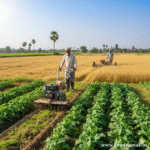

The agricultural sector serves as the economic backbone of Maharashtra. To sustain agricultural productivity, implement state-sponsored welfare schemes, and provide technical guidance directly to rural farmers, the Department of Agriculture, Government of Maharashtra, regularly conducts recruitment for the position of Krushi Sevak (Agriculture Assistant).
The Krushi Sevak Bharti is one of the most highly anticipated competitive examinations in the state for individuals possessing a background in agricultural studies. Securing a position as a Krushi Sevak offers a stable government career path along with the opportunity to bring meaningful development to rural farming communities. This comprehensive guide details the responsibilities, strict eligibility standards, comprehensive examination syllabus, selection process, and remuneration package related to the recruitment drive.
The Role and Responsibilities of a Krushi Sevak
A Krushi Sevak operates at the grassroots level of the state administration, functioning as the vital link between agricultural scientists, government bodies, and individual farmers. The position demands both administrative diligence and active field participation.
Extension of Agricultural Technology
One of the primary duties of a Krushi Sevak is to educate farmers about modern, scientific agricultural techniques. This includes disseminating information on high-yielding crop varieties, efficient water management practices (such as drip and sprinkler irrigation), organic farming practices, and optimal soil health management.
Implementation of Government Schemes
The Maharashtra state government alongside central authorities constantly roll out welfare and subsidy initiatives, such as the Pradhan Mantri Fasal Bima Yojana (Crop Insurance), PM Krishi Sinchayee Yojana, and soil health card distributions. The Krushi Sevak is responsible for identifying eligible beneficiaries within their assigned village or taluka, helping them process applications, and validating ground-level deployment.
Damage Assessment and Reporting
During environmental crises—such as severe droughts, unseasonal rainfall, hailstorms, or massive pest infestations—the Krushi Sevak conducts extensive field surveys. They draft the initial spot assessment reports (Panchnamas) that specify the exact percentage of crop damage. These reports form the baseline for determining the financial compensation packages allocated to affected farmers.
Eligibility Criteria for Krushi Sevak Bharti
Candidates wishing to apply for the Krushi Sevak recruitment must fulfill strict eligibility parameters regarding educational qualification, age limitations, and regional residency status.
Educational Qualification
The educational guidelines are highly specialized. General degree holders are typically not eligible for this technical position. A candidate must possess one of the following qualifications from a government-recognized university or institute:
- A Diploma in Agriculture or a higher Degree in Agriculture (B.Sc. Agriculture).
- A Diploma or Degree in related allied fields such as Horticulture, Agricultural Engineering, Charcoal and Forestry, or Food Technology.
- Equivalent vocational certifications focused on agricultural technology approved by the Maharashtra Council of Agricultural Education and Research (MCAER).
Applicants must have completed their qualifying exams and possess their final certificates or provisional degrees at the time of submitting the application form.
Age Limit Regulations
The age limit for candidates is determined as per the prevailing guidelines of the Government of Maharashtra:
- General Category (Unreserved): The minimum age required is 18 years, while the maximum permissible age limit is typically capped at 38 or 40 years depending on the specific notification cycle.
- Reserved Categories (SC, ST, OBC, VJ/NT): Candidates belonging to reserved categories receive an upper age relaxation of up to 5 years, allowing them to apply up to the age of 43 or 45.
- Special Class Relaxations: Enhanced age relaxations are granted to specialized categories, including Persons with Disabilities (PwD), meritorious sports personalities, ex-servicemen, and project-affected individuals, as per specific state government resolutions.
Language and Domicile Requirements
Because the job requires daily, deep communication with the local farming populace, candidates must be fluent in reading, writing, and speaking the Marathi language. Furthermore, applicants must hold a valid Domicile Certificate of Maharashtra to prove their status as residents of the state.
Detailed Examination Pattern
The selection process for Krushi Sevak Bharti relies heavily on a single-stage, objective-type computer-based test (CBT) or offline written examination. To qualify, candidates must understand the layout of the paper, which balances language proficiency, analytical skills, general awareness, and specialized technical core concepts.
The complete examination consists of 200 multiple-choice questions, with each question carrying one mark, culminating in a total of 200 marks. The total duration permitted to solve the entire paper is exactly 120 minutes (2 hours). The question paper is divided into two broad sections: General Subjects and the core Technical Subject.
Section A: General Aptitude and Languages (80 Marks)
This section assesses the candidate’s general intellectual abilities and linguistic capacity. It is split into four distinct sub-modules, each containing exactly 20 questions for 20 marks:
- Marathi Language Proficiency: 20 Questions / 20 Marks. The difficulty level matches the Secondary School Certificate (SSC) framework.
- English Language Proficiency: 20 Questions / 20 Marks. Tested at the standard SSC level.
- General Intelligence and Reasoning Test: 20 Questions / 20 Marks. Evaluates logical deductions and mathematical reasoning.
- General Knowledge Awareness: 20 Questions / 20 Marks. Assesses familiarity with regional and national events.
Section B: Core Agriculture Subject (120 Marks)
This section holds the maximum weight in determining the final merit list. It consists of 120 specialized questions testing technical concepts from agricultural diplomas and degrees. The section evaluates a candidate’s practical and theoretical understanding of crops, soil chemistry, farm tools, and regulatory laws.
In-Depth Syllabus Breakdown
To score well and clear the competitive cut-off marks, aspirants must study each subject topic by topic. The detailed breakdown of the Krushi Sevak syllabus includes:
1. Marathi Language Syllabus
The Marathi portion evaluates basic grammar, comprehension, and vocabulary usage:
- Standard sentence structures and identification of common grammatical errors.
- Detailed vocabulary including synonyms (Samanarthi Shabd) and antonyms (Viruddharthi Shabd).
- Correct usage of idioms (Vakprachar) and popular folk proverbs (Mhani) in sentences.
- Passage comprehension and basic editing patterns.
- Familiarity with prominent Marathi literature, famous poets, and award-winning authors of Maharashtra.
2. English Language Syllabus
Designed to test functional English grammar and communication comprehension:
- Core English grammar including parts of speech, tenses, subject-verb agreement, and active/passive voice modifications.
- Vocabulary exercises checking antonyms, synonyms, and proper word substitutions.
- Spotting common spelling errors and sentence correction parameters.
- One-word substitutions and understanding the contextual meaning of phrases.
3. General Intelligence and Reasoning Syllabus
This section tests a candidate’s mental agility and problem-solving speed:
- Number series, alphabetical patterns, and coding-decoding puzzles.
- Analogy recognition, spatial visualization, and classification matrices.
- Blood relations, direction sense tests, and linear or circular seating arrangements.
- Venn diagrams, calendar anomalies, and clock-related mathematical calculations.
4. General Knowledge Syllabus
A mix of static knowledge and dynamic current events, with an emphasis on Maharashtra:
- Geography of India and Maharashtra, covering river patterns, climate zones, mountain systems, and mineral resources.
- History of India and the social reform movements led by iconic thinkers in Maharashtra.
- Indian Constitution basics, local self-governance models (Panchayati Raj), and administrative layouts.
- Current socio-economic events, sports honors, awards, and technological developments.
- Central and state-sponsored agrarian welfare initiatives, insurance schemes, and irrigation models.
5. Specialized Technical Agriculture Syllabus
The largest section of the exam covers the fundamentals of agricultural sciences:
- Crop Cultivation and Agronomy: Principles of crop breeding, classification of crops based on climate zones, factors influencing crop growth, and crop rotation schedules.
- Soil Science and Chemistry: Physical properties of soil (texture, density, porosity, structure), soil organic matter indices, soil testing mechanisms, pH parameters, electrical conductivity, and addressing soil salinity or alkalinity challenges.
- Fertilizers and Nutrient Management: Organic manures, vermicomposting methods, green manure usage, chemical fertilizers, micro-nutrients, and Integrated Nutrient Management (INM) models.
- Crop Protection and Pathology: Major plant diseases and insect pests common to Maharashtra, biological pest control methodologies, and the safe application of insecticides and fungicides.
- Horticulture, Floriculture, and Vegetable Production: Greenhouse nursery management, plantation techniques for commercial fruit crops (mango, grapes, pomegranate, citrus), vegetable farming patterns, and post-harvest technology.
- Agricultural Extension and Social Forestry: Models for training farmers, community organizing, rural sociology principles, watershed management guidelines, and agricultural marketing infrastructure.
- Irrigation and Water Management: Drip irrigation, sprinkler assemblies, calculating crop-water requirements, drainage systems, and rainwater harvesting structures.
Recruitment Selection Process
The selection process for the Krushi Sevak position follows a clear, single-stage framework designed to ensure transparency:
1. Online Examination
All registered applicants appear for the computer-based written test. The test uses an objective multiple-choice format. Candidates must secure the minimum qualifying marks specified in the official notification to remain in contention.
2. Merit List Generation
Once the exams conclude, the department aggregates the marks and releases a normalized merit list. This list is categorized by district and administrative division, reflecting the vacancies available in regions like Pune, Nashik, Nagpur, Amravati, Aurangabad, Latur, Konkan, and Kolhapur.
3. Document Verification
Candidates whose names appear on the provisional merit list are invited to an in-person document verification phase. They must present all original documents, including educational transcripts, their birth certificate, category caste validation papers, non-creamy layer certificates (where applicable), and their Maharashtra domicile card. Any discrepancy during this stage results in immediate disqualification.
4. Final Appointment and Regional Allocation
Following successful document verification, the department issues formal selection letters. Candidates are allocated to specific village circles or taluka divisions within their selected district to begin their service.
Salary and Career Progression
The financial structure and job designation for a Krushi Sevak follow a distinct probation model:
The Probation Phase
Newly recruited candidates join the department as Krushi Sevak on a fixed term of probation, typically lasting for three consecutive years. During this three-year period, employees receive a fixed monthly stipend or consolidated honorarium rather than a full salary scale. This monthly stipend is generally around ₹16,000 to ₹21,000, depending on the latest state pay revisions.
Regularization and Pay Scale
Upon the successful completion of the three-year probation period without any disciplinary issues, the candidate is regularized in service. Their official job title transitions from Krushi Sevak to Krushi Sahayyak (Agriculture Assistant).
Once regularized, the employee moves into a full permanent government pay scale (typically under the Maharashtra 7th Pay Commission structure) with a pay band starting around ₹25,500 to ₹81,100 plus standard government allowances. These allowances include Dearness Allowance (DA), House Rent Allowance (HRA), and Medical Benefits.
Career Advancement Chart
A regularized Krushi Sahayyak has a clear path for professional growth based on seniority, departmental exams, and performance evaluations:
- Krushi Sahayyak (Agriculture Assistant)
- Krushi Paryavekshak (Agriculture Supervisor)
- Mandal Krushi Adhikari (Circle Agriculture Officer)
- Taluka Krushi Adhikari / Sub-Divisional Agriculture Officer (Class II positions)
Step-by-Step Guide on How to Apply Online
When the Department of Agriculture releases the recruitment advertisement notification, eligible candidates can apply using these steps:
- Visit the Official Recruitment Web Portal: Navigate to the central portal of the Maharashtra Agriculture Department at krishi.maharashtra.gov.in.
- Access the Registration Link: Click on the notification titled “Krushi Sevak Bharti Application Form” to open the external recruitment registration page.
- Create Candidate Profile: Provide your primary mobile number, email ID, and full name to complete the basic registration. The system will send a unique login ID and password via text message.
- Fill Out the Profile Details: Log into the dashboard and fill out the detailed form, including your educational credentials, division choices, and reserved category parameters.
- Upload Scanned Documents: Upload clear digital copies of your passport-size photo, signature, left thumb impression, and self-declaration text.
- Pay the Application Fee: Pay the required examination fee securely through online channels like net banking, debit/credit cards, or UPI. The fee varies for general and reserved categories.
- Print Confirmation Page: Save a digital copy and print out the completed application form and fee receipt for your future reference.
Conclusion
Securing a position through the Krushi Sevak Bharti Maharashtra recruitment offers a fulfilling career for agriculture diploma and degree holders. Success in this competitive process requires a balanced study plan that addresses language skills, reasoning ability, and the core concepts of agricultural sciences. By understanding the job responsibilities, exam format, and syllabus, aspirants can prepare effectively to build a stable career in service of the state’s farming community.
The following video provides an extensive visual overview of the exact exam criteria, age relaxations, and notification cycles for the Maharashtra Agriculture Assistant examination: Maharashtra Krushi Sevak Bharti Eligibility and Details.