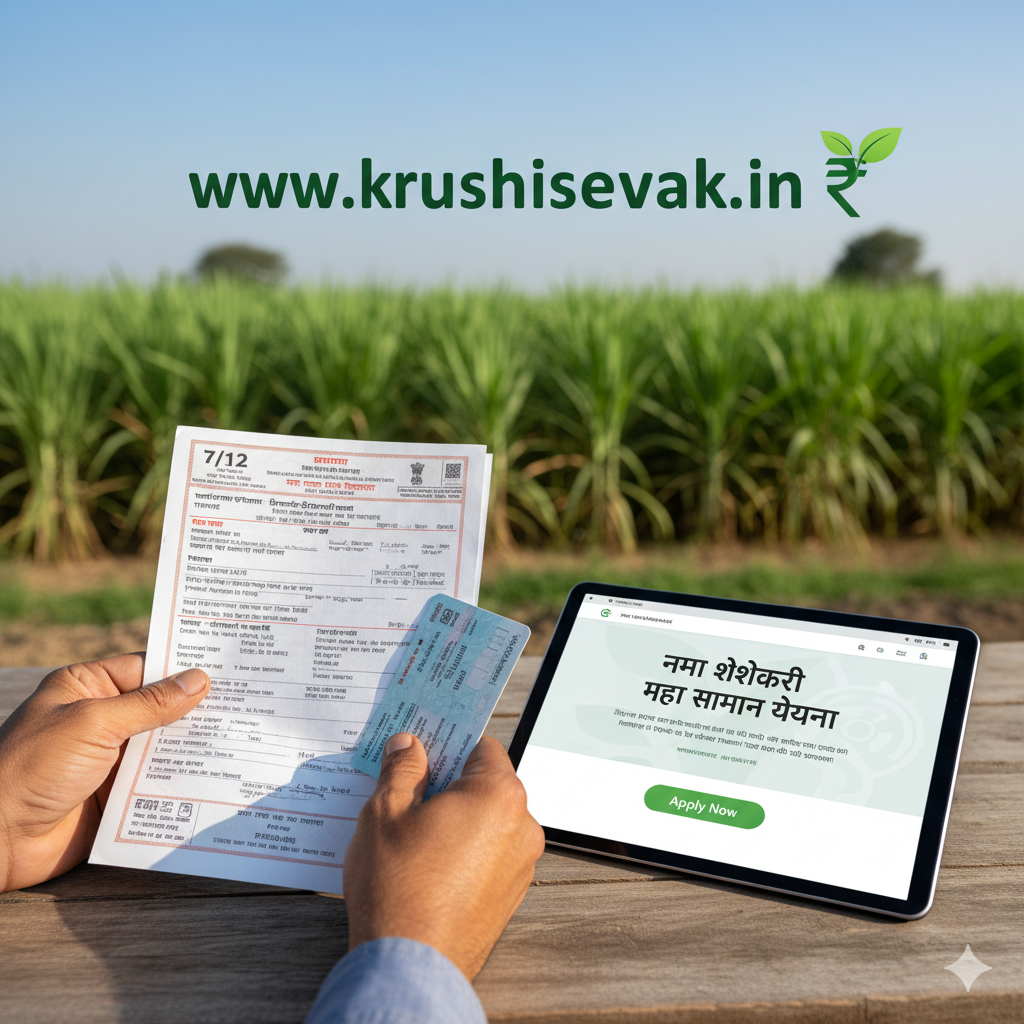

The agricultural sector serves as the backbone of Maharashtra’s rural economy. To alleviate the financial burden on cultivators and minimize reliance on informal credit networks, the Government of Maharashtra introduced the Namo Shetkari Mahasanman Nidhi Yojana (NSMNY).
Launched on June 15, 2023, this state-level scheme supplements the central government’s Pradhan Mantri Kisan Samman Nidhi (PM-KISAN) initiative. Combined, these programs deliver robust direct income support to small and marginal landowners across the state. This comprehensive guide outlines the policy layout, required documentation, registration processes, and recent developments surrounding this social security asset.
Part 1: Strategic Architecture and Objectives
The primary goal of the Namo Shetkari Mahasanman Nidhi Yojana is to stabilize farm incomes before the sowing seasons. Farmers often face upfront cash flow constraints when procuring seeds, chemical fertilizers, organic compost, pesticides, and hired labor.
The Financial Blueprint
Under the provisions of the scheme, the state government distributes a fixed annual financial assistance package of ₹6,000 per eligible farmer family.
- Installment Frequency: The funds are structured into three equal installments of ₹2,000 each, spaced across four-month intervals within the fiscal cycle.
- The Convergence Effect: This state funding runs parallel to the central PM-KISAN allocation of ₹6,000 per year. Consequently, a qualified agricultural family in Maharashtra receives an aggregate direct cash transfer of ₹12,000 per annum.
- Fund Delivery Mode: The financial aid uses the Direct Benefit Transfer (DBT) mechanism, sending money straight to Aadhaar-mapped bank accounts to eliminate institutional leaks or middleman friction.
Part 2: Eligibility Rules and Exclusion Criteria
The Namo Shetkari Yojana shares its core operational framework with the PM-KISAN database. This structural alignment guarantees that land records checked at the central level automatically sync with the state’s welfare system.
Mandatory Qualifications
- State Residency: The applicant must be a permanent resident of Maharashtra and own cultivable land registered within the state boundaries.
- PM-KISAN Status: The farmer must be actively registered and approved on the central PM-KISAN portal. If an individual is disqualified or blocked from the central pool, their state benefit stops automatically.
- Land Validation: The family unit must hold legal, active agricultural land listings verified by up-to-date land registry extracts.
- Banking Infrastructure: The beneficiary must maintain an active bank account linked to an Aadhaar number, with active Central Identity Data Repository (CIDR) verification and functional DBT pathways.
Explicit Operational Exclusions
To target the aid toward economically vulnerable smallholders, the state enforces clear exclusion rules. The following groups are ineligible:
- Institutional Landholders: Any corporate entities, cooperative societies, or trust bodies holding agricultural titles.
- High-Income Professionals: Registered practitioners in specialized fields, including doctors, engineers, legal consultants, architects, and chartered accountants.
- Income Tax Payers: Any individual or family member who submitted an income tax return in the preceding assessment year.
- Government Employees and Pensioners: Active workers or retired personnel from state ministries, central departments, local bodies, or public sector undertakings (PSUs) whose monthly pension exceeds ₹10,000. This exclusion does not apply to multi-tasking staff or Class IV workers.
- Constitutional Office Holders: Former or current Members of Parliament (MPs), Members of the Legislative Assembly (MLAs), mayors of municipal corporations, or chairpersons of district councils.
Part 3: Essential Documentation Requirements
Enrolling in the scheme relies heavily on clean paperwork. Discrepancies in spellings between land titles and identity cards are a primary cause for held or delayed payments.
Primary Personal Documents
- Aadhaar Card: Serving as the definitive identity marker, the applicant’s name on the Aadhaar card must correspond exactly with the name on the regional land records.
- Registered Mobile Number: An active mobile connection linked to the Aadhaar card is vital to receive One-Time Passwords (OTPs), verification alerts, and installment transaction confirmations.
- Maharashtra Domicile Certificate: Legal proof confirming long-term residency within the state.
Land and Agricultural Records
- 7/12 Land Extract (Satbara Utara): The legal document detailing land survey numbers, ownership proportions, and cultivation types. This certificate confirms the land is designated for active farming.
- 8-A Land Extract (8-अ उतारा): An aggregated statement of land holdings showing the combined acreage registered under a specific family or individual within a village circle.
- Ferfar (Mutation Transcript): Required if a recent transfer of land occurred due to inheritance, partition, or legal sale.
- Ration Card: A valid family ration card helps local land authorities confirm the boundaries of a single farmer family unit.
Financial and Technical Prerequisites
- Aadhaar-Seeded Bank Passbook: A complete printout or digital image of the bank passbook detailing the account number, IFSC code, and branch address. The account must have functional Direct Benefit Transfer permissions.
- PM-KISAN Identification Number: The specific registration code issued by the Pradhan Mantri Kisan portal, which acts as the core key for verifying the state profile.
- Completed Electronic Know Your Customer (eKYC) Status: A digital receipt or dashboard confirmation showing that biometric or OTP-based eKYC has been successfully updated on the master portal.
Part 4: Step-by-Step Application Process
Because the Namo Shetkari Yojana pulls from the central infrastructure, the enrollment process splits into two distinct paths based on your current PM-KISAN status.
Scenario A: For Active PM-KISAN Beneficiaries
If you currently receive the ₹2,000 installments from the central government, no separate registration is required for the Namo Shetkari Yojana.
- The Government of Maharashtra periodically extracts data updates directly from the central database.
- The state generates a corresponding local beneficiary list based on those active entries.
- The funds drop into your existing, verified account automatically during the designated state release cycles.
Scenario B: For New or Unregistered Farmers
If you own cultivable land but have never registered under either scheme, you must first apply through the unified portal.
- Step 1: Accessing the Portal: Open a secure web browser and go to the official PM-KISAN portal (pmkisan.gov.in) or visit the dedicated state portal (nsmny.mahait.org).
- Step 2: Accessing the Registration Desk: Locate and select the “New Farmer Registration” utility on the home dashboard.
- Step 3: Preliminary Identity Checks: Select your geographic profile (Rural or Urban Farmer Registration). Enter your Aadhaar number, input your active mobile number, and select Maharashtra as your state. Complete the visual captcha test and click “Get OTP”.
- Step 4: Form Fields Completion: Once the mobile OTP is verified, the system opens a detailed digital profile form. Fill in your district, sub-district, block, and village coordinates. Provide your precise personal details, making sure your name matches your Aadhaar information.
- Step 5: Logging Land Data: Enter your exact land ownership metrics. This includes the Survey/Khasra number, the Dag/Khata number, and the precise land area listed in hectares. You must specify whether the land was acquired before or after February 1, 2019, and detail the ownership origin (e.g., gift, purchase, or ancestral death).
- Step 6: Document Uploading: Upload clear, legible PDF copies of your 7/12 land extract, 8-A statement, and identity cards. Keep the file sizes within the specified limits on the screen.
- Step 7: Submission and Reference Capture: Click the save button to submit your application. The system will create a unique Registration ID. Print or save this reference code for future tracking.
Part 5: The Administrative Verification Pipeline
After submitting your application, your file moves through a four-stage digital validation process to confirm your eligibility before any money is paid out.
- Stage 1: Taluka Nodal Officer (TNO) Review: The field officers at the taluka level review your physical or digital land records against local village revenue registers to confirm land possession.
- Stage 2: District Nodal Officer Approval: Once cleared by the taluka team, your file moves to the district office. Here, the team runs verification checks against exclusion lists, checking for government employment or professional tax liabilities.
- Stage 3: State Nodal Officer Validation: The Department of Agriculture at the state level runs a final audit on the compiled batch files, packaging the approved records for the banking sector.
- Stage 4: Public Financial Management System (PFMS) Sync: The final, approved list is synced with the PFMS network. The bank verifies that the account remains active and that the Aadhaar card is properly mapped for direct deposits.
Part 6: Reviewing Your Status and Troubleshooting Disruptions
If an expected payment is delayed, you can check the status of your application online without needing to visit a local government office.
How to Check Account Status Online
- Visit the official portal at pmkisan.gov.in or navigate to the state tracking page at nsmny.mahait.org.
- Select the “Beneficiary Status” or “Know Your Status” link on the home dashboard.
- Enter either your system-generated Registration Number or your Aadhaar Card number.
- Input the security captcha displayed on the page and click “Get Data”.
- The dashboard will show your complete installment history, processing dates, and any failure logs sent back by the bank.
Addressing Payment Failures
If the system shows a status error, the issue is typically caused by one of three common technical misconfigurations:
- Aadhaar Not Seeded: The account is active, but the bank has not turned on the flag that maps the account to the Aadhaar card for direct deposits. To fix this, fill out a single-page Aadhaar seeding mandate at your local bank branch.
- Failed eKYC: Installments are paused if you haven’t completed your periodic identity check. You can resolve this quickly by using the face-authentication feature on the PM-KISAN mobile app or by visiting a Common Service Center (CSC) for a biometric fingerprint scan.
- Land Seeding Flag Set to “No”: This happens if your land records weren’t properly matched to your profile during the system updates. To fix it, bring physical copies of your 7/12 extract and your application slip to your local Agriculture Officer (Kishi Sevak) or Talathi office to manually flip the verification flag to “Yes”.
Part 7: Recent Developments and Headlines
Since its launch, the Namo Shetkari Mahasanman Nidhi Yojana has scaled rapidly, evolving into one of Maharashtra’s largest direct financial support programs.
Key Program Milestones
- Widespread Program Reach: The initiative now supports more than 90 lakh farming families across Maharashtra’s 36 districts, prioritizing rain-fed agricultural zones in Marathwada and Vidarbha.
- Steady Fund Releases: The state has maintained regular funding cycles, matching the delivery schedule of the central government’s payments.
- Substantial Capital Investment: In the 2023–2024 state budget, Deputy Chief Minister and Finance Minister Devendra Fadnavis initially allocated ₹6,900 crore for the program. The state government has continued to provide strong budgetary support across subsequent fiscal years to keep the system well-funded.
- The March 2026 Funding Cycle: In March 2026, the state government approved a funding release of ₹1,774 crore to cover the program’s 8th installment. This cash injection delivered direct support to eligible farmers just as they began planning for the upcoming pre-monsoon planting season.
The Namo Shetkari Yojana highlights how state and central resources can work together to support rural communities. By building on an existing database and using automated direct deposits, the program provides reliable, transparent financial relief, helping millions of farmers build a more stable and resilient livelihood