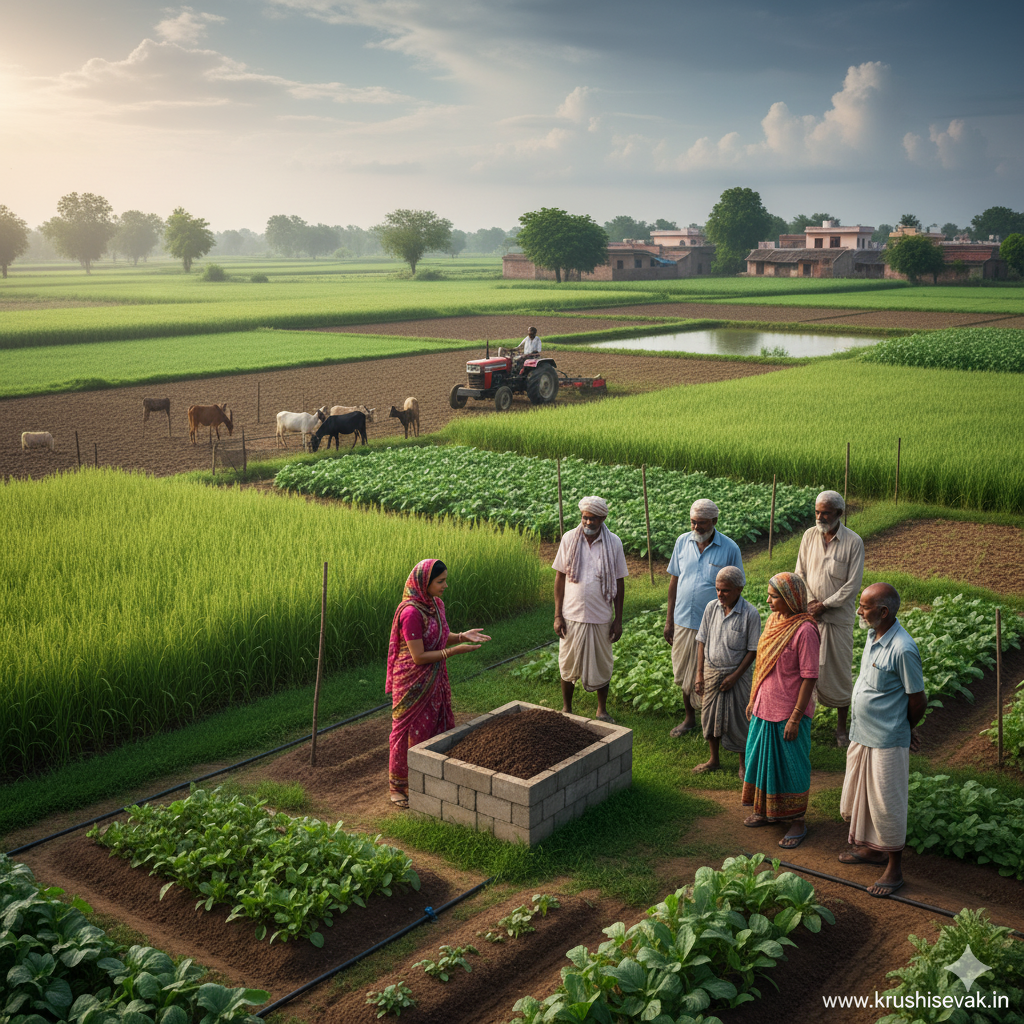

Rainfed agriculture constitutes a major portion of Maharashtra’s cultivable land, particularly in the drought-prone regions of Marathwada and Vidarbha. Relying solely on unpredictable monsoon rains exposes small and marginal farmers to extreme climate risks and financial vulnerability.
To mitigate these risks and build resilient agrarian livelihoods, the government has actively rolled out the Rainfed Area Development Scheme 2025 Maharashtra (implemented under the Pradhan Mantri Rashtriya Krishi Vikas Yojana – RAD framework). The scheme promotes an optimized Integrated Farming System (IFS) model that shifts the focus from mono-cropping to a holistic, multi-revenue farming architecture.
Here is an extensive directory covering the components, subsidy structures, eligibility, and digital application guidelines for the scheme in 2025–26.
What is the Rainfed Area Development (RAD) Scheme?
The Rainfed Area Development (RAD) component functions under the broader vision of the National Mission for Sustainable Agriculture (NMSA). It explores zone-specific farming models designed by agricultural scientists to optimize land use.
Instead of cultivating a single seasonal crop, the scheme assists farmers in integrating conventional agricultural crops with horticulture, livestock, agroforestry, and supplementary low-water-use businesses. This multi-tiered setup guarantees that even if a dry spell triggers crop failure, secondary streams like dairy, poultry, or apiary keep the farm household financially afloat.
Core Objectives of the 2025–26 Layout in Maharashtra
- Enhancing Climate Resilience: Protecting farmers against severe heat waves, delayed monsoons, and sudden prolonged droughts.
- Resource Conservation: Utilizing precision irrigation, on-farm water management, and organic soil health rejuvenation.
- Income Diversification: Ensuring a multi-cropping system coupled with allied ventures to maximize cash inflows per unit of land.
- Minimizing Production Losses: Shifting toward resource-efficient practices such as silage production to secure fodder during summer crises.
Key Components and Subsidy Matrix
Under the Rainfed Area Development Scheme 2025 Maharashtra, a financial assistance subsidy cap of up to ₹30,000 per farm family is sanctioned directly via the Direct Benefit Transfer (DBT) portal.
To qualify for the package, beneficiaries are required to implement a blended system consisting of at least two components from the primary IFS cluster and at least two components from allied activities.
### A) Integrated Farming System (IFS) Categories
Farmers must pick a combination comprising at least two of the following structural interventions:
- Agricultural Crops: High-yielding, climate-resilient varieties of pulses, oilseeds, and coarse cereals adapted to dryland conditions.
- Horticulture / Agroforestry: Cultivating drought-tolerant fruit crops (such as dragon fruit, amla, or ber) alongside wood or timber-yielding trees along boundary fields.
- Livestock Integration: Setting up dairy units, goat rearing, or poultry setups to generate routine weekly returns.
B) Allied Agricultural Activities
To maximize synergies, at least two supporting sub-components are mandatory:
- Silage Units: Green fodder storage systems to keep livestock fed when grass is scarce.
- Vermicompost / Organic Inputs: Infrastructure to manufacture earthworm-based compost and bio-fertilizers using farm waste.
- Beekeeping (Apiculture): Installing bee boxes to enhance local crop pollination while harvesting raw honey for commercial sales.
- Fishery Units: Establishing minor farm ponds paired with inland aquaculture where water allows.
Implementation Strategy: The Cluster-Based Approach
The Maharashtra Agriculture Department enforces the scheme using an area-focused, group-oriented approach rather than isolated allocations.
- Geographic Focus: The scheme remains operationally active across all 34 rural districts of Maharashtra.
- Sub-division Strategy: The local departments map out and select exactly two target projects (clusters) per agricultural sub-division.
- Cluster Sizing: Each selected cluster operates with a minimum contiguous or closely situated block mapping of 20 hectares.
- Priority Allotments: Villages categorized under tribal upliftment frameworks like the Dharti Aaba Tribal Upliftment Mission, aspirational talukas designated by NITI Aayog, and communities dominated by SC/ST populations receive absolute preference during project profiling.
Eligibility Criteria for Applicants
To clear the rigid pre-screening protocols built into the state’s processing platform, prospective applicants must fulfill the following benchmarks:
- Landholding Bounds: Farm size is not a restricting parameter for this scheme. The financial assistance remains uniform across all scales of farmers, ensuring small, marginal, and large landowners receive equitable access.
- Mandatory Digital Identity: Possession of a verified Farmer ID (AgriStack) is non-negotiable for approval.
- Banking Linkage: The applicant’s primary bank account must be fully linked with their Aadhaar card to prevent middleman interventions.
- Social & Gender Priorities: Special reservation quotas are carved out for women farmers and individuals with physical disabilities (Divyangjan). SC/ST applicants must provide self-attested caste verification records online.
- Farming Intent: Farmers must provide a voluntary pledge confirming their willingness to shift from traditional setups into the state-outlined Integrated Farming System framework.
Step-by-Step Online Application Process on MahaDBT
From the 2025–26 fiscal year onward, Maharashtra transitioned its selection protocol to a transparent “First Come, First Served” methodology based on application submission timestamps. This eliminates reliance on random lottery systems for specific components, rewarding swift digital registration.
Step 1: Portal Registration
- Head over to the official portal: mahadbt.maharashtra.gov.in.
- Click on “New Applicant Registration”.
- Select “Yes” for Aadhaar authentication, input your Aadhaar number, and verify identity via the registered mobile OTP.
- Set up your custom Username and unique Password.
Step 2: Profile Completion (100% Target)
- Log into your dashboard and navigate to user profile options.
- Complete all segments: Personal Details, Income Data, and Domicile Information.
- Fill in land ownership details exactly matching your official 7/12 extract and 8-A documents.
- Confirm your active bank details linked with the Aadhaar-Enabled Payment System (AEPS).
Step 3: Choosing the RAD Scheme
- Click on the “Apply Scheme” section on your main interface.
- Select the Agriculture Department Schemes tab.
- Locate Pradhan Mantri Krishi Vikas Yojana – Rainfed Area Development (RAD).
- Choose your intended primary IFS components and accompanying allied systems.
Step 4: Document Upload & Submission
- Upload scanned files of your 7/12 land records, Aadhaar card, and category credentials (if applicable). Ensure PDF formats stay below 500KB.
- Submit your finalized sheet.
- Keep track of your exact submission placement using the “Application Timestamp Report” option directly inside your panel.
Vital Documentation Checklist
Ensure you have digital, clear copies of these records ready before starting your registration:
- Valid Aadhaar Card linked to an active mobile number.
- Recent 7/12 and 8-A land revenue extracts.
- Official AgriStack Farmer ID number.
- Bank passbook front page displaying IFSC and clear account routing numbers.
- Self-attested Caste Certificate (required only for SC/ST financial quotas).
Conclusion: The Path Forward for Rainfed Agriculture
The Rainfed Area Development Scheme 2025 Maharashtra represents a structural leap forward from conventional subsidization to strategic rural enterprise creation. By promoting the Integrated Farming System (IFS), the state empowers vulnerable dryland farmers to build multiple pillars of financial support, ensuring that a weak monsoon no longer means economic distress.
With the state matching technology via the revamped MahaDBT timestamp tracking mechanism, accessing these benefits is faster and more transparent than ever. If you meet the criteria within the regional sub-divisions, registering early can help secure the financial support needed to build a resilient, multi-income farm.