
For decades, traditional agriculture in many developing regions has been a gamble against nature, market fluctuations, and rising debt. Millions of farmers find themselves trapped in a vicious cycle of high input costs and low crop yields. However, some dare to break away from conventional paths.
This is the incredible dragon fruit farming success story of Ramesh Kumar (name changed for representation), a traditional farmer buried under a mountain of debt, who took a leap of faith into exotic horticulture and transformed himself into a self-made millionaire (Crorepati).
The Breaking Point: The Pitfalls of Traditional Farming
Ramesh, a resident of a semi-arid district, owned five acres of ancestral land. For generations, his family cultivated traditional crops like wheat, paddy, and sugarcane. While these crops are staples, they come with heavy baggage:
- Skyrocketing Input Costs: Chemical fertilizers, pesticides, and constant tractor usage drained his savings.
- Water Scarcity: Groundwater levels were depleting rapidly, making water-intensive crops like paddy unsustainable.
- Price Volatility: Middlemen dictated market rates. A bumper harvest often led to a crash in prices, leaving Ramesh unable to pay back his agricultural loans.
By 2021, Ramesh owed over ₹8 Lakhs ($10,000 USD) to local banks and private moneylenders. Facing the grim reality of losing his land, he realized that continuing with traditional farming would mean financial ruin. He needed an alternative that required less water, offered high market value, and wasn’t easily ruined by shifting weather patterns.
The Turning Point: Discovering the ‘Kamalam’ (Dragon Fruit)
During a visit to a regional agricultural expo, Ramesh came across a stall displaying a vibrant, pink, scale-skinned fruit—Dragon Fruit (scientifically known as Hylocereus undatus, and locally rebranded in India as Kamalam).
What caught his attention wasn’t just the fruit’s exotic appearance, but its agronomic characteristics:
”I learned that dragon fruit is essentially a cactus. It thrives in poor soil, requires minimal water compared to sugarcane, and commands a premium price in urban markets. That was the day I decided to stop fighting my land’s dry climate and start working with it.”
— Ramesh Kumar
Step-by-Step Transition: Implementing the Trellis Method
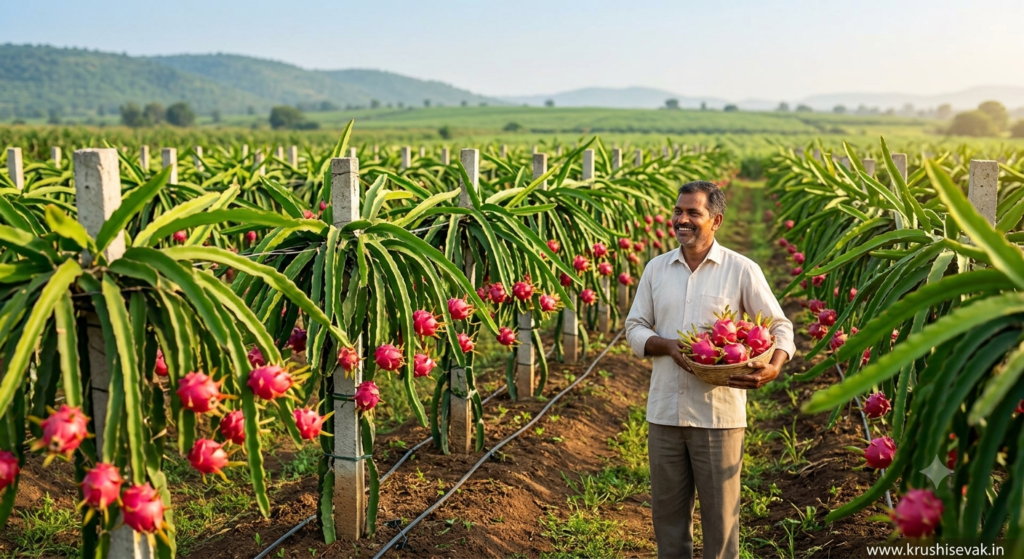
Transitioning to dragon fruit farming isn’t as simple as sowing seeds; it requires a structured, long-term infrastructure layout. Ramesh utilized the last of his credit to set up a high-yielding Trellis (Pole) System on a pilot plot of 2 acres.
1. Land Preparation and Soil Quality
Dragon fruit requires excellent drainage, as waterlogging can rot the roots. Ramesh created raised beds mixed with organic manure and sand to ensure optimal aeration.
2. Erecting Concrete Pillars
Because dragon fruit is a climbing cactus, it needs structural support. Ramesh installed 400 concrete poles per acre. Each pole was 6 feet high, buried 1.5 feet into the ground, and capped with a circular concrete ring or iron frame to allow the cactus vines to hang outward gracefully.
3. Sowing the Saplings
Four saplings (cuttings) were planted around the base of each pole. Ramesh chose the Red-Fleshed variety, which is sweeter and commands a higher price in the domestic market than the white-fleshed variety.
4. Smart Irrigation
He installed a drip irrigation system. Unlike paddy, which needs standing water, dragon fruit only requires moisture around its root zone. Ramesh cut his water consumption by nearly 80%.
The Timeline to Becoming a ‘Crorepati’
Dragon fruit is a perennial crop; once planted, it can yield fruit for up to 20 to 25 years. Here is how Ramesh’s financial trajectory completely shifted over four years:
Year 1: The Waiting and Care Phase
The first year required patience. Dragon fruit plants take about 12 to 14 months to give their first commercial harvest. Ramesh intercropped the open spaces with short-duration vegetables like chickpeas and chillies to maintain a basic cash flow.
Year 2: Breaking Even
By the second year, the vines had draped over the concrete rings. The first harvest yielded around 4 to 5 tonnes of fruit per acre. Selling at a wholesale price of ₹120 per kg, Ramesh generated around ₹10 to ₹12 Lakhs. He completely cleared his outstanding debts.
Year 3 & 4: Exploding Profits
By Year 3, the plants reached peak maturity. Each pole was yielding between 20 to 25 kg of fruit annually.
| Metric | Year 2 | Year 3 | Year 4 (Peak) |
|---|---|---|---|
| Yield per Acre | 5 Tonnes | 8 Tonnes | 10 to 12 Tonnes |
| Total Production (5 Acres) | 25 Tonnes | 40 Tonnes | 55 to 60 Tonnes |
| Average Market Price/kg | ₹120 | ₹130 | ₹140 |
| Gross Annual Revenue | ₹30 Lakhs | ₹52 Lakhs |
By factoring in additional revenue streams—such as selling high-quality rooted cuttings/saplings to neighboring farmers looking to replicate his success—Ramesh’s annual turnover comfortably crossed the ₹1 Crore ($120,000+ USD) mark by the fourth year.
Why Dragon Fruit Farming is a Goldmine
Ramesh’s remarkable dragon fruit farming success story boils down to a few undeniable advantages this crop has over traditional farming:
- Low Maintenance Costs: Once the initial infrastructure (poles and drip lines) is set up, operational costs drop drastically. There is no need for annual tilling, heavy pesticide use, or intensive labor.
- High Demand and Health Trends: Post-pandemic consumer behavior has shifted drastically toward immunity-boosting superfoods. Dragon fruit is rich in antioxidants, Vitamin C, and fiber, ensuring consistent demand in tier-1 and tier-2 cities.
- Long Fruiting Season: Instead of a single harvest, dragon fruit yields in multiple “flushes” or waves between June and November, giving farmers a steady stream of income for six months straight.
- Resilience: The cactus is highly resistant to major pests and can survive extreme heatwaves up to 45°C without dying.
Lessons for Aspiring Agropreneurs
Ramesh’s journey from a debt-ridden farmer to a millionaire offers critical takeaways for anyone looking to enter modern commercial agriculture:
- Do Not Skimp on Initial Infrastructure: High-quality concrete poles and a reliable drip irrigation setup are non-negotiable. Poor quality supports will collapse under the weight of mature cacti.
- Focus on Organic Nutrition: Ramesh shifted primarily to cow dung manure, vermicompost, and bio-fertilizers, which enhanced the sweetness and shelf-life of his fruit, allowing him to command a premium price.
- Direct Marketing: Instead of relying entirely on traditional mandis (wholesale markets), Ramesh used social media and direct-to-retail tie-ups with urban supermarkets, cutting out greedy middlemen.
Conclusion
Ramesh Kumar’s journey is a powerful testament to how innovation, calculated risk, and a shift from traditional crops to high-value horticulture can reverse a farmer’s fortune. He didn’t just escape the clutches of a debt trap; he built an agricultural empire that employs local youth and serves as a model farm for the entire region.
For the modern farmer, the lesson is clear: the future of agriculture lies not in doing what has always been done, but in adapting to the changing climate, market demands, and smarter technology.