
Introduction: The Crisis in Traditional Monoculture
For generations, traditional agriculture has relied heavily on monoculture—the practice of growing a single crop year after year on the same land. While this method once fueled the Green Revolution, it has increasingly left small and marginal farmers vulnerable to market volatility, climate unpredictability, pest outbreaks, and skyrocketing input costs. When a single crop fails due to erratic rainfall or a sudden market crash, the farmer’s entire livelihood collapses.
This was the exact reality faced by Rajesh Kumar, a 42-year-old farmer from a semi-arid region in Central India. Owning just three acres of ancestral land, Rajesh found himself trapped in a vicious cycle of debt. He spent heavily on chemical fertilizers, synthetic pesticides, and expensive seeds for Bt cotton, only to watch his profits dwindle due to depleting groundwater levels and degraded soil health.
The turning point came when Rajesh realized that continuing down the same path would mean financial ruin. He needed an agricultural system that didn’t put all his eggs in one basket. His search for a sustainable, resilient, and highly profitable alternative led him to the principles of the Integrated Farming System (IFS). This is the success story of how Rajesh transformed his struggling three-acre plot into a thriving, self-sustaining circular ecosystem, multiplying his net income by over 400% while restoring the environment.
Understanding Integrated Farming Systems (IFS)
Before diving into Rajesh’s operational execution, it is vital to understand what integrated farming actually entails. Integrated farming is a holistic, waste-minimizing agricultural strategy where multiple enterprises—such as crop cultivation, livestock rearing, poultry, aquaculture, agroforestry, and beekeeping—are executed simultaneously on the same piece of land.
The core philosophy of IFS is simple yet profoundly effective: the waste product of one enterprise becomes the valuable input for another.
Instead of relying on external, expensive commercial inputs like chemical fertilizers and synthetic animal feed, an integrated farm creates a closed-loop system. This internal recycling drastically reduces production costs, enhances biodiversity, improves soil organic matter, and provides the farmer with regular daily, weekly, and seasonal income streams.
The Master Plan: Designing a 3-Acre Closed-Loop Ecosystem
When Rajesh approached his local Krishi Vigyan Kendra (Agricultural Science Center), experts advised him against completely abandoning his traditional crops overnight. Instead, they helped him map out a customized 3-Acre IFS model designed to optimize space, water, and labor throughout the year.
Rajesh divided his land into strategic, highly integrated zones:
Zone 1: Diversified Crop Cultivation and Agroforestry (2 Acres)
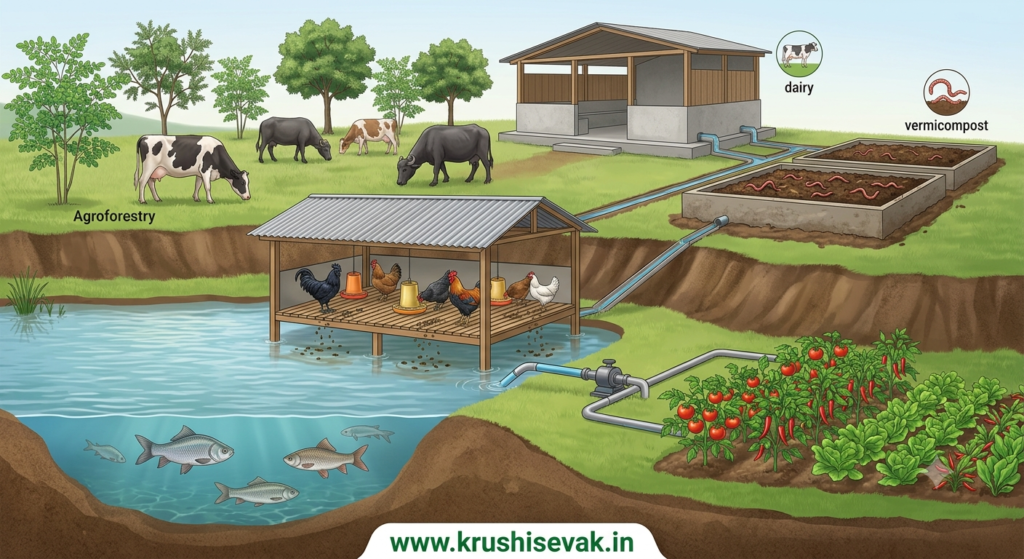
Instead of cultivating only cotton, Rajesh dedicated his main plot to a mixture of high-value cash crops, grains, and vegetables. He adopted a multi-tier cropping system. On the borders of his land, he planted nitrogen-fixing agroforestry trees like Melia dubia and Moringa (drumstick). The main fields were utilized for a rotating cycle of paddy, wheat, pulses (like pigeon pea), and seasonal vegetables (tomatoes, chilies, and leafy greens).
Zone 2: Dairy and Vermicomposting (0.5 Acres)
Rajesh invested in three high-yielding indigenous Murrah buffaloes and two Gir cows. The livestock unit was situated close to the cropping zone to minimize transport logistics. Directly adjacent to the dairy shed, he constructed four vermicomposting beds.
Zone 3: Poultry and Aquaculture Integration (0.5 Acres)
The most innovative part of the farm layout was a 40 \times 40 foot farm pond dug to harvest rainwater. Rajesh built a raised poultry shed directly over the pond. This shed housed 150 country chickens (Kadaknath and Vanaraja breeds).
Step-by-Step Integration: How the Synergies Work
The magic of Rajesh’s integrated farming success story lies in the seamless, automated synergies between these diverse components. Here is exactly how the waste streams flow across his three acres to eliminate expenditure and maximize output:
The Livestock-to-Crop Synergy
In traditional farming, buying chemical fertilizer is one of the highest seasonal expenses. On Rajesh’s farm, the five dairy animals produce roughly 50 to 60 kilograms of dung and dozens of liters of urine every single day.
Instead of letting this go to waste, Rajesh channels the dung into his vermicomposting units, where red earthworms convert the raw manure into nutrient-rich vermicompost within 45 to 60 days. This compost is applied directly to the vegetable and field crops, completely replacing synthetic nitrogen and phosphorus.
Furthermore, Rajesh uses the cow urine to formulate Jeevamrutha—a traditional, bio-enzyme liquid fertilizer that inoculates the soil with beneficial microbes. Within two years of application, the soil organic carbon on his farm jumped from a dismal 0.3% to a healthy 0.85%, drastically increasing the water-retention capacity of his land.
The Crop-to-Livestock Synergy
Animal feed is typically the largest running cost in dairy farming. Rajesh eliminated this problem by utilizing his crop residues. The straw from his paddy and wheat crops is stored as dry fodder.
Additionally, he dedicated a small, highly efficient patch of land to grow Azolla, an aquatic fern that grows rapidly on water surfaces and contains over 25% crude protein. By mixing Azolla and green maize fodder grown on his farm borders into the livestock feed, Rajesh reduced his dependence on commercial cattle feed concentrates by 60%, saving thousands of dollars annually while increasing milk fat content.
The Poultry-to-Fish Synergy
The integration of poultry and aquaculture represents a classic circular economy. The country chickens housed in the raised shed over the pond drop their droppings directly through the slatted wire floor into the water below.
Chicken manure is incredibly rich in nitrogen and phosphorus. In the water, this waste acts as an organic fertilizer that stimulates the rapid growth of phytoplankton and zooplankton—the natural, primary food source for fish.
Rajesh stocked his pond with a smart mix of surface, column, and bottom-feeding fish species, including Catla, Rohu, and Mrigal. Because the fish feed entirely on the naturally occurring plankton generated by the poultry droppings, Rajesh spends absolutely zero money on commercial fish feed pellets.
The Pond-to-Crop Synergy
The farm pond serves multiple purposes. During monsoon seasons, it acts as a rainwater harvesting structure, recharging the local water table. During dry spells, the nutrient-rich water from the fish pond, which is laden with fish excreta and organic compounds, is pumped out to irrigate the vegetable crops. This “aquaponics-style” irrigation acts as a liquid fertilizer boost, causing vegetables to grow faster and look healthier, commanding a premium price at local markets.
Financial Transformation: Breaking Down the Numbers
To appreciate why this integrated farming success story is turning heads in the agricultural community, one must look at the profound shift in financial stability.
The Old Monoculture Model
When Rajesh practiced traditional cotton monoculture, his financial cycle looked like this:
- Income Frequency: Once or twice a year (after harvest).
- High Risk: Total reliance on cotton market prices and monsoon timing.
- High Input Costs: Heavy expenses on seeds, chemical pesticides, weedicides, and tractor rentals.
- Net Annual Profit: Roughly $600 to $800 per acre, totaling around $1,800 to $2,400 annually for his entire holdings, much of which went toward paying off high-interest loans from local moneylenders.
The New Integrated Farming Model
Under the IFS model, Rajesh’s economic structure transformed from a high-risk seasonal gamble into a highly resilient, multi-stream daily revenue machine.
- Daily Income: The dairy unit produces 35 to 40 liters of milk daily. Selling this to the local cooperative ensures a steady, reliable daily cash flow that covers all household expenses and daily farm running costs.
- Weekly Income: The vegetable patch yields fresh tomatoes, chilies, and leafy greens twice a week. Rajesh sells these directly at the local organic farmers’ market, bypassing exploitative middlemen.
- Monthly Income: The poultry component yields country eggs and mature broiler/country chickens, which are sold to local restaurants and individuals looking for organic meat.
- Seasonal Income: The major field crops (paddy and pulses) provide a substantial lump-sum payout twice a year.
- Annual Income: Harvesting the fish pond once a year yields nearly 800 to 1,000 kilograms of fresh fish, providing a massive financial boost ahead of major festival seasons or school tuition payments for his children.
Today, Rajesh’s net annual profit across his three integrated acres sits at an astonishing $9,500 to $11,000. He has completely cleared his ancestral debts, built a concrete house, and invested in solar-powered irrigation pumps to further reduce running costs.
Key Benefits of the Integrated Farming System
Rajesh’s integrated farming success story highlights several undeniable advantages that this farming style offers to modern agriculture:
- Risk Mitigation: Climate change causes unpredictable weather. If a sudden heatwave ruins Rajesh’s vegetable crop, his dairy, poultry, and fish units act as an economic safety net, keeping his farm profitable.
- Drastic Cost Reduction: By substituting chemical fertilizers with vermicompost and replacing commercial animal/fish feed with crop residues and poultry droppings, the cost of production drops by 40% to 50%.
- Soil and Environmental Rejuvenation: The heavy application of organic matter restores microfauna, earthworms, and essential nutrients to the soil. Carbon sequestration increases, and chemical runoff into local water bodies is completely eliminated.
- Optimal Resource Management: Space and time are used to their maximum potential. Vertical integration (like poultry over fish ponds) ensures that not a single square foot of land is wasted.
- Year-Round Employment: Traditional farming leaves laborers and farmers unemployed during off-seasons. IFS requires steady, manageable, year-round maintenance, ensuring continuous employment for the family.
Overcoming Challenges: Lessons for Aspiring IFS Farmers
While Rajesh’s journey is an incredibly inspiring integrated farming success story, it did not happen without significant effort, learning, and overcoming distinct hurdles. Aspiring farmers looking to replicate this model must keep the following challenges in mind:
1. High Initial Capital Investment
Setting up an integrated farm requires more upfront capital than traditional crop sewing. Digging a pond, constructing a dairy shed, buying high-yielding livestock breeds, and setting up poultry cages requires initial funding. Rajesh managed this by starting small—he began with just the dairy and crop integration, and used the profits from the first two years to self-fund the poultry and fish pond construction.
2. High Technical Knowledge Requirements
IFS is a sophisticated science. You must understand the balance of water quality in the fish pond, how to manage poultry diseases organically, and how to maintain the moisture levels of vermicompost beds. Farmers must be willing to seek training from agricultural universities and extension officers.
3. Intensive Management and Labor
Monoculture farmers often have downtime between sowing and harvesting. An integrated farm, however, requires attention 365 days a year. The animals must be milked, the poultry fed, and the pond monitored daily. It demands disciplined time management and active involvement from the farming family.
Conclusion: The Future of Farming is Integrated
The story of Rajesh Kumar proves that small agricultural landholdings do not have to be a recipe for poverty. By shifting the perspective from “maximizing the yield of one crop” to “maximizing the efficiency of an entire ecosystem,” integrated farming offers a permanent solution to the rural agrarian crisis.
Rajesh has now become a beacon of hope in his district. His farm serves as a live demonstration center, inspiring over 200 local farmers to abandon pure chemical monoculture in favor of integrated systems.
As the world grapples with climate change, topsoil degradation, and rising food insecurity, this integrated farming success story stands as a brilliant testament to the power of ecological harmony. It shows that when we work with nature rather than against it, sustainable agriculture can be deeply profitable, environmentally restorative, and life-changing for generations to come.