
Agriculture stands as the historic backbone of the Indian socio-economic structure. However, the sector has fundamentally suffered due to its overwhelming reliance on the vagaries of monsoon rains. Out of the vast cultivable land in India, a massive portion has historically remained rainfed, leaving millions of farmers vulnerable to droughts, changing weather cycles, and structural crop failures. To address this profound systemic vulnerability, the Government of India launched the Pradhan Mantri Krishi Sinchayee Yojana (PMKSY) on July 1, 2015.
The primary vision of PMKSY is rooted in two powerful national directives: “Har Khet Ko Pani” (Water for Every Farm) and “Per Drop More Crop”. The overarching goal of this flagship umbrella initiative is to streamline water use, expand institutional irrigation capabilities, and drive comprehensive on-farm water management across the nation. By converging structural schemes from multiple ministries under a single unified implementation framework, PMKSY seeks to maximize physical access to water on the farm, stimulate the adoption of precision irrigation technologies, and enrich the foundational groundwater aquifers of rural landscapes.
Over more than a decade of intensive execution, the scheme has witnessed multiple strategic extensions. The Union Cabinet approved the continuation of the program with an aggressive total financial outlay to scale up its components through the mid-2020s. In the 2026–27 budgetary allocations, the program continues to receive substantial financial support, highlighting its role in fostering climate-resilient farming, expanding localized water storage capacities, and transitioning traditional flood-irrigation practitioners into modern micro-irrigation managers.
The Strategic Objectives Driving PMKSY
PMKSY is not merely a funding channel for digging canals; it represents a conceptual shift in how water is sourced, managed, and utilized at the grassroots level. The foundational architecture of the scheme is organized around several clear objectives:
- Convergence of Investments: The program was designed to create a singular platform that integrates public and private investments in the irrigation sector, breaking the silos between different government ministries.
- Expansion of Cultivable Area: It actively works to extend the geographical footprint of assured, protective irrigation across previously ignored drylands, giving farmers the confidence to invest in high-yield crops.
- On-Farm Water Efficiency: By systematically discouraging wasteful flood-irrigation practices, PMKSY aims to optimize the economic output of every drop of water used in the fields.
- Adoption of Precision Systems: The scheme focuses heavily on introducing farmers to micro-irrigation systems like drip and sprinkler networks, which deliver water precisely where it is required.
- Aquifer Recharge and Conservation: Through targeted ecological restorations, the scheme aims to reverse the dangerous drop in groundwater levels by promoting rainwater harvesting and sustainable watershed development.
- Water Budgeting and Extension: It seeks to empower community institutions and local farmers with scientific knowledge regarding crop alignment, water budgeting, and efficient moisture retention techniques.
Core Pillars and Components of the Umbrella Scheme
To ensure a holistic approach to the water crisis, PMKSY merges distinct administrative responsibilities across multiple central ministries. Each component focuses on a specific aspect of the irrigation pipeline, from major engineering works to localized field interventions.
1. Accelerated Irrigation Benefit Programme (AIBP)
Administered predominantly under the Ministry of Jal Shakti, the Accelerated Irrigation Benefit Programme focuses on the fast-tracked completion of ongoing major and medium irrigation projects, including national-level dam and canal networks that had faced decades of bureaucratic or financial delays.
The target of AIBP is to maximize the creation of structural irrigation potential across expansive agricultural zones. In recent updates, the government incorporated advanced structural elements into this component, including the Modernization of Command Area Development and Water Management (M-CADWM) sub-scheme. This initiative ensures that the vast water resources generated by major reservoirs are effectively distributed to individual agricultural fields through pressurized piped distribution networks rather than open, inefficient earthen channels.
2. Har Khet Ko Pani (HKKP)
The HKKP component acts as the distribution arm of the large-scale irrigation network, ensuring equitable water access for small and marginal holdings. It focuses heavily on:
- Creating new localized water sources through minor irrigation systems, including both surface water developments and sustainable groundwater extractions.
- The comprehensive repair, renovation, and restoration of traditional village water bodies, tanks, and community ponds to boost their storage capacity.
- Constructing specialized distribution networks and field channels to safely convey water from main canal networks directly to remote agricultural clusters.
- Developing command areas to prevent the uneven distribution of water, making sure that farmers at the tail-end of a canal receive their fair share.
3. Watershed Development Component (WDC-PMKSY)
Managed under the Department of Land Resources within the Ministry of Rural Development, the Watershed Development Component targets rainfed and degraded landscapes. Rather than relying on external water bodies, WDC-PMKSY builds local self-reliance by managing rainwater run-off.
The activities under this component include the construction of continuous contour trenches, check dams, gully plugs, farm ponds, and specialized earth embankments. By slowing down the flow of rainwater across fields, this component minimizes topsoil erosion, restores soil health, and facilitates deep groundwater recharge. Furthermore, it incorporates an integrated approach to livelihood generation, assisting landless rural households in developing alternative revenue streams through agro-forestry and pasture management.
4. Per Drop More Crop (PDMC)
Originally a core pillar managed under the Department of Agriculture and Farmers Welfare, the Per Drop More Crop component focuses on maximizing field-level efficiency. To improve operational management and combine related agricultural programs, this initiative was strategically transitioned to operate under the broader umbrella of the Pradhan Mantri Rashtriya Krishi Vikas Yojana (PM-RKVY), while maintaining its core PMKSY mandate.
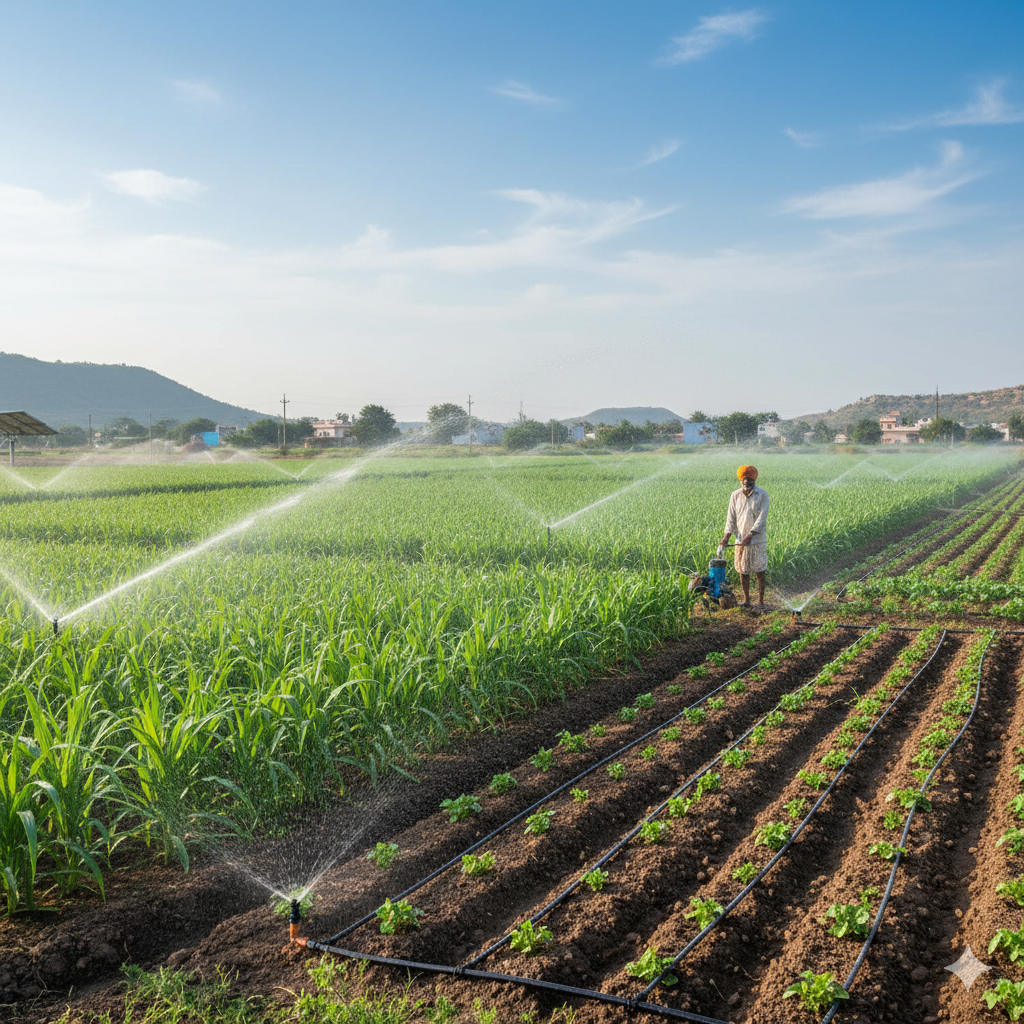
PDMC promotes micro-irrigation technologies like drip systems and overhead sprinklers. Unlike conventional flood methods where up to sixty percent of water is lost to evaporation and deep percolation, precision systems deliver moisture and liquid fertilizers (fertigation) directly into the plant root zone. This targeted delivery optimizes resource absorption, cuts energy requirements for pumping water, reduces weed growth, and significantly lowers cultivation expenses.
The Funding Pattern and Center-State Coordination
PMKSY is a Centrally Sponsored Scheme, meaning its financial execution is dependent on a shared funding dynamic between the Central Government and the respective State Governments. The allocation ratio is strategically calibrated to support economically vulnerable or geographically challenged regions:
For general states, the financial burden is divided in a 60:40 ratio between the Central Government and the State Administration.
For the North-Eastern States and the Himalayan Territories (including Jammu & Kashmir, Himachal Pradesh, and Uttarakhand), the Central Government covers 90% of the cost, while the State contributes 10%.
In the case of Union Territories, the scheme is completely backed by 100% central funding.
This funding architecture ensures that state departments remain actively invested in the ground-level execution, monitoring, and long-term maintenance of the created assets, while receiving heavy fiscal support from the central exchequer.
Operational Guidelines: Eligibility and Support Framework
To ensure that the financial subsidies and physical assets created under PMKSY reach genuine beneficiaries, the government has instituted rigorous operational guidelines. The program is explicitly designed to prioritize small, marginal, and female farmers who otherwise lack the financial capital to build independent irrigation setups.
Farmer Eligibility Criteria
The scheme maintains an inclusive eligibility structure. Any individual farmer, group of farmers, cooperative society, self-help group, or producer collective holding valid agricultural land in any State or Union Territory can apply for benefits.
The financial subsidy payable for installing micro-irrigation systems is capped at a maximum land limit of five hectares per beneficiary. Furthermore, to prevent the misuse of public funds, a beneficiary can only claim the government subsidy for a specific plot of land once every seven years, and they must formally agree to maintain the installed equipment for at least five consecutive years.
The Subsidy Allotment Structure
The financial assistance provided for micro-irrigation under the PDMC guidelines is categorized by farmer demographics:
- Small and Marginal Farmers: Individuals holding less than two hectares of land receive up to a 55% subsidy on the total cost of installing drip or sprinkler networks.
- Other Farmers: Medium and large landholders receive up to a 45% subsidy on the installation costs.
The remaining balance can be covered by the farmer through institutional crop loans, bank credits, or personal savings, making high-end technology accessible to the wider farming community.
Step-by-Step Process to Avail PMKSY Benefits
The implementation process has been heavily digitized to eliminate bureaucratic delays and prevent corruption. Farmers looking to access subsidies for micro-irrigation or farm pond development can utilize both online and offline application streams.
Step 1: Preliminary Registration and Profile Creation
Farmers can log on to the dedicated state-specific agriculture portal linked to the national PMKSY system. They must complete their basic registration by providing their mobile number, Aadhaar card details, and verified bank account information. Alternatively, they can approach their local Gram Panchayat or the Block Agriculture Officer to complete this registration manually.
Step 2: Document Submission and Verification
The applicant must submit self-attested copies of vital documents, which include:
- Land ownership records (such as the Khasra, Khatauni, or 7/12 extract).
- Aadhaar card for identity verification.
- A recent passport-sized photograph.
- A bank passbook containing the IFSC code to facilitate direct benefit transfers.
- A valid certificate proving an assured localized water source, such as a borewell, open well, or a valid canal connection.
- Caste certificates, if applicable, to access special category allocations.
Step 3: Technical Survey and Field Inspection
Once the documents are verified by block-level officials, a certified technical team or an empanelled micro-irrigation vendor visits the farmer’s field. They assess the soil health, map the topography, verify the availability of the water source, and draft a customized layout design for the drip or sprinkler installation.
Step 4: System Installation and Subsidy Release
Following administrative approval of the layout design, the chosen vendor installs the precision irrigation system on the farmer’s field. A post-installation physical verification is conducted by government supervisors, which often includes geotagging the asset to ensure full transparency. Upon successful verification, the designated subsidy amount is credited directly to the vendor or the farmer’s bank account via the Public Financial Management System (PFMS).
Technology and ICT Integration within PMKSY
Modern challenges require technological solutions. To track progress and ensure accountability, PMKSY utilizes state-of-the-art information and communication technology tools:
- Bhuvan Geo-Portal: The scheme coordinates with the Indian Space Research Organisation (ISRO) to utilize the Bhuvan satellite platform. Check dams, farm ponds, and community assets constructed under the watershed component are systematically geotagged, allowing real-time spatial monitoring and preventing duplicate fund reporting.
- Management Information Systems (MIS): A robust, end-to-end national online portal tracks every stage of the application process. From the initial farmer registration to physical field inspections and financial disbursements, every transaction is logged transparently.
- Integrated Mobile Apps: Field officers use dedicated mobile applications to upload real-time, time-stamped, and GPS-tagged photographs of irrigation assets directly from remote villages, ensuring high institutional accountability.
Socio-Economic and Environmental Impact of PMKSY
The broad execution of PMKSY over the years has driven visible structural shifts across India’s rural landscapes. The program has evolved from a simple infrastructure initiative into a major engine for sustainable development.
Enhanced Crop Yields and Economic Security
By replacing the unreliable nature of monsoon rains with assured micro-irrigation, farmers have successfully transitioned from single-crop regimes to highly lucrative multi-cropping and multi-tier systems. Fields that once lay barren during the dry summer months now yield high-value horticultural crops, fresh vegetables, and pulses. This reliable water supply has significantly lowered the cost of cultivation by reducing labor expenses, saving electricity, and minimizing fertilizer wastage through controlled fertigation.
Sustainable Resource Conservation
On the environmental front, PMKSY has mitigated the unchecked exploitation of deep aquifers. The adoption of micro-irrigation has demonstrated up to a fifty percent saving in water usage compared to old flood-irrigation models, while simultaneously boosting overall crop productivity. Concurrently, the extensive check dams and continuous contour trenches built under the watershed component have successfully raised local water tables, brought life back to dried-up open wells, and improved soil moisture profiles in rainfed areas. This dual focus on water conservation and agricultural productivity has established PMKSY as a pillar of India’s long-term agricultural resilience.