
In the heartland of rural India, where the landscape is a patchwork of emerald green and dusty brown, the story of Ramesh Kumar begins. Born in a small, drought-prone village in the Marathwada region of Maharashtra, Ramesh was no stranger to the vulnerabilities of traditional Indian agriculture. Like millions of others, his family depended entirely on a five-acre plot of semi-arid land. For generations, they followed the conventional path: waiting for the monsoons, sowing cotton and pigeon peas, and praying that the market prices would not crash at harvest time.
The reality of farming in India often oscillates between hope and despair. For Ramesh, the tipping point arrived during a consecutive three-year drought cycle. The monsoons failed, the open well on their farm completely dried up, and the soil hardened into an impenetrable crust. Deprived of options, Ramesh’s father had to take high-interest loans from local moneylenders to purchase seeds and synthetic fertilizers for the next season. When those crops withered under the scorching sun, the family found themselves trapped in a vicious cycle of rural debt.
Ramesh, who had recently completed his high school education, witnessed his parents contemplating selling their ancestral land to repay the debt. The local community was rapidly emptying out, as disillusioned youth abandoned their fields to migrate to nearby cities for menial, low-wage labor. Agriculture was widely viewed as a dead-end profession—a legacy of financial ruin. Yet, Ramesh refused to accept this fate. He looked at the cracked earth not as a failed asset, but as an unsolved problem, firmly believing that the solution lay not in escaping the land, but in transforming how it was managed.
Shifting the Paradigm: The Transition to Scientific and Sustainable Farming
Ramesh realized early on that continuing with age-old methods in a changing climate was a recipe for failure. He understood that the primary culprit behind their declining yields was the severe degradation of soil health, caused by decades of excessive chemical fertilizer use and inefficient flood irrigation. If he wanted to save his family’s livelihood, he needed a scientific approach.
Seeking Knowledge and Mentorship
Ramesh began his transformation by breaking away from the isolation typical of traditional rural farmers. He traveled to the nearest district headquarters to visit the Krishi Vigyan Kendra (KVK), an agricultural science center established by the government. There, he met with agronomists and soil scientists who became his mentors.
The first step was a comprehensive soil test—a simple concept that had never been practiced on his family’s farm. The results were revealing: the soil was almost completely depleted of organic carbon and vital micronutrients. The heavy application of urea had altered the soil’s natural structure, making it unable to retain water. Armed with this data, Ramesh enrolled in short-term training modules covering:
- Organic composting and vermicomposting
- Micro-irrigation systems and water management
- Integrated Pest Management (IPM)
- High-density plantation methods
Rebuilding the Soil from Scratch
Returning to his village, Ramesh faced immediate skepticism from elders who mocked his “modern ideas.” Undeterred, he dedicated one acre of his land as an experimental plot. He stopped using synthetic fertilizers entirely on this patch, replacing them with farmyard manure, vermicompost, and liquid bio-fertilizers like Jeevamrutha—a traditional fermented mixture of cow dung, urine, jaggery, and pulse flour.
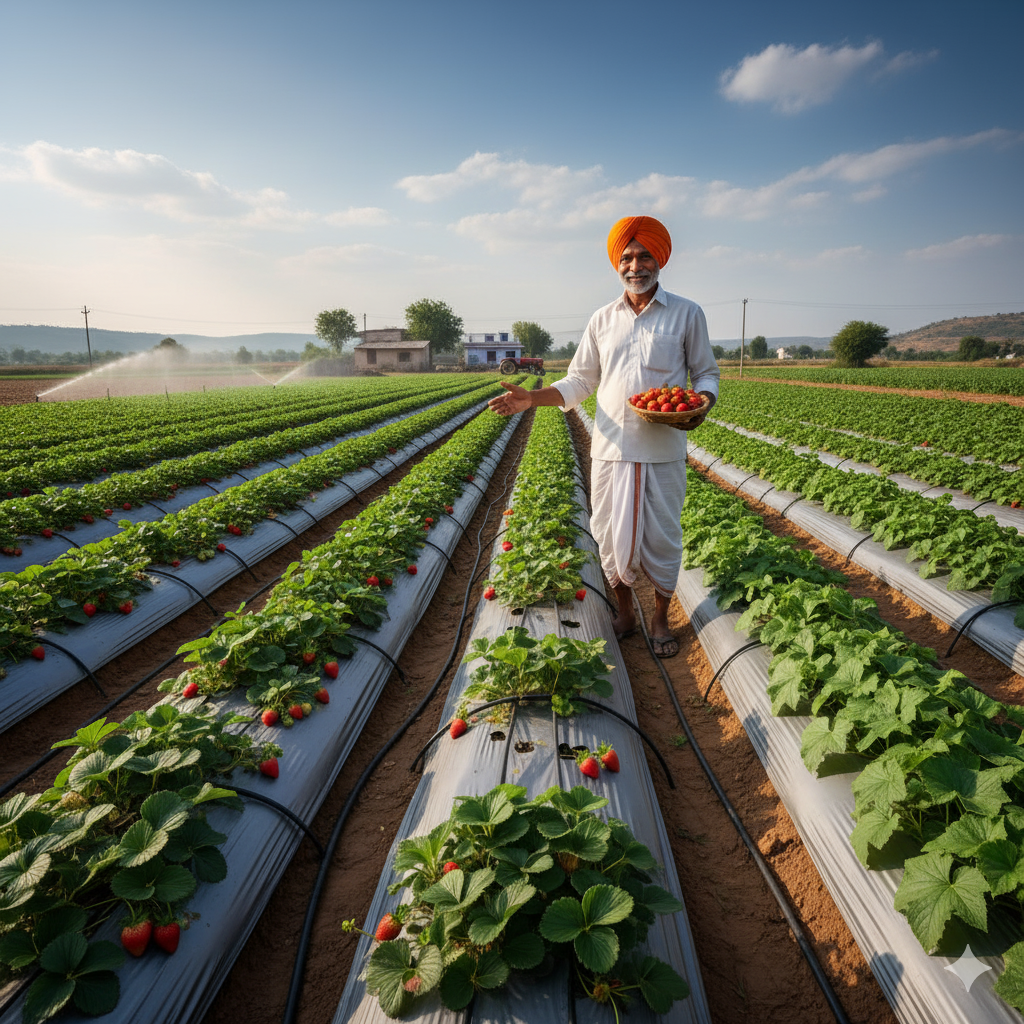
To tackle the persistent water scarcity, Ramesh pooled his meager savings to install a basic drip irrigation system across his experimental acre. Rather than flooding the fields and losing over half the water to evaporation, drip irrigation delivered moisture directly to the root zones of the plants. Within a single crop cycle, the results were undeniable. The experimental plot remained green and healthy using only a fraction of the water, and the soil regained its dark, crumbly texture, teeming with earthworms.
Innovation in Action: Diversification and the Integrated Farming System
A fundamental flaw in the traditional farming model is monoculture—relying completely on a single cash crop. If that specific crop fails or its market price plummets, the farmer loses everything. Ramesh tackled this structural vulnerability by designing a highly diversified Integrated Farming System (IFS) tailored to his five acres.
The Power of Multi-Tier Cropping
Instead of dedicating his entire land to cotton, Ramesh divided his farm into distinct zones. He introduced a multi-tier cropping model that maximized vertical and horizontal space. In one section, he planted a fruit orchard featuring high-yield pomegranate and guava trees, which are resilient to dry climates.
In the open spaces between the fruit trees, he intercropped short-duration vegetables like onions, chilies, and leafy greens. This strategy served a dual purpose:
- Continuous Cash Flow: While the fruit trees took a few years to reach full maturity and bear marketable yields, the intercropped vegetables provided a steady, weekly income that covered the farm’s operational expenses.
- Microclimate Creation: The dense ground cover provided by the vegetable crops acted as a natural mulch, preventing soil erosion, retaining moisture, and suppressing weed growth.
Integrating Livestock and Circular Economy Principles
To further insulate his farm from external market shocks, Ramesh introduced dairy and poultry units into his agricultural ecosystem. He started with three native-breed dairy cows. The choice of indigenous breeds was deliberate; they possessed high natural immunity to tropical diseases and required less intensive maintenance than imported crossbreeds.
The integration of livestock transformed his farm into a self-sustaining, circular ecosystem. The crop residues, such as corn stalks and pulse husks that were previously burned or discarded, were processed into high-nutrition fodder for the cattle. In return, the cows provided milk, which offered a reliable daily revenue stream. More importantly, the cow dung and urine served as the primary raw ingredients for his organic fertilizers and bio-pesticides. By eliminating the need to buy external fertilizers and chemical sprays, Ramesh reduced his total cost of cultivation by nearly forty percent.
Scaling Up: Embracing Agribusiness, Technology, and Direct Marketing
Achieving a high crop yield is only half the battle won; the true test of a farmer’s success lies in navigating the highly fragmented supply chains of rural markets. For decades, Indian farmers have been at the mercy of multiple layers of middlemen and commission agents operating in wholesale markets, who pocket the lion’s share of profits while leaving the producer with pennies.
Adopting Digital Tools
Ramesh realized that to maximize his returns, he had to transition from a simple primary producer to a sophisticated agri-entrepreneur. He started leveraging digital platforms and mobile applications to check real-time market prices across different regional trading hubs. Instead of rushing to harvest and sell his produce during peak supply periods when prices drop, he used basic solar-powered cold storage facilities to extend the shelf life of his high-value fruits, selling them when market demand peaked.
The Genesis of a Farmer Producer Organization
Recognizing that an individual smallholder farmer lacks bargaining power, Ramesh rallied the youth and progressive farmers of his village to form a local Farmer Producer Organization (FPO). Starting with just fifteen members, the collective steadily expanded.
Operating as a unified entity allowed the FPO to achieve economies of scale:
- Bulk Purchasing: The group purchased high-quality seeds, bio-inputs, and micro-irrigation equipment directly from manufacturers at wholesale prices, cutting input costs significantly for every member.
- Direct-to-Consumer Marketing: By aggregating their harvests, the FPO could bypass traditional middlemen entirely. They established direct supply contracts with urban residential complexes, organic retail stores, and supermarkets in major cities.
Ramesh also introduced basic farm-level value addition. Instead of selling raw turmeric and chilies, the FPO set up a small processing unit to clean, dry, grind, and package these spices under their own community brand name. This move into processing boosted their profit margins by more than fifty percent, keeping the wealth generated within the village economy.
Overcoming Obstacles and Breaking Social Barriers
The road from a debt-ridden smallholder to a celebrated agri-entrepreneur was far from smooth. Every stage of Ramesh’s journey was marked by significant systemic and environmental hurdles.
Institutional and Cultural Hurdles
In the early days, securing institutional credit from commercial banks was an uphill battle. Banks were hesitant to extend loans for non-traditional, organic farming ventures without substantial collateral. Ramesh had to rely on micro-finance groups and transparent peer-to-peer lending to fund his initial drip irrigation and dairy setup.
There was also a profound cultural barrier to overcome. Rural society often equates successful modern farming with heavy tractor usage, industrial chemical spraying, and vast monoculture fields. Ramesh’s reliance on organic mixtures, manual mulching, and mixed cropping was initially viewed as backward. When he began cultivating less common crops like medicinal herbs and exotic vegetables, neighbors openly predicted his bankruptcy. It was only when his yields consistently outpaced conventional farms—even during deficient monsoon seasons—that the skepticism faded into admiration.
Climate Adaptation in Real Time
Climate change brought unpredictable unseasonal rains and intense hail storms that threatened to wipe out entire vegetable harvests overnight. To protect his high-value crops, Ramesh adapted by constructing low-cost shade net houses and polytunnels using locally available bamboo and UV-stabilized plastic sheets. These structures provided a controlled environment, shielding delicate saplings from extreme weather and pest infestations while allowing him to grow off-season vegetables that commanded premium prices in the market.
A Beacon of Hope for Rural India
Today, Ramesh Kumar’s five-acre plot has evolved into a vibrant, model integrated farm that attracts agricultural students, scientists, and thousands of fellow farmers from across the state. His annual income has grown exponentially, securing his family’s financial future and enabling him to invest in advanced education for his children.
The true impact of Ramesh’s journey, however, extends far beyond his personal financial success. He has effectively reversed the trend of distress migration in his immediate community. By proving that farming can be a highly lucrative, modern enterprise, he has inspired dozens of local youth to return to their family lands. The FPO he helped establish now supports hundreds of families, fostering a resilient rural economy rooted in ecological sustainability and collective bargaining power.
Ramesh’s story serves as a powerful reminder that the challenges facing Indian agriculture—water scarcity, soil degradation, and market volatility—are not insurmountable. With a willingness to innovate, an embrace of scientific methods, and an entrepreneurial mindset, a small piece of land can be transformed from a source of historical debt into a driver of generational prosperity.