
Introduction
For thousands of years, agriculture relied entirely on the natural, slow decomposition of organic matter to replenish fields. Farmers relied on intuition, crop rotation, and standard animal manure to sustain their yields. However, as the global population expanded, these traditional methods could no longer keep pace with the demand for food. The true transformation of modern agriculture began when scientists unlocked the secrets of plant nutrition, learning to concentrate and manufacture the essential elements that drive plant growth.
Today, fertilizers stand as the foundational pillar of global food security. Just as the human body requires a balanced diet of proteins, carbohydrates, and vitamins to grow, plants require a specific mix of chemical elements to complete their lifecycles. When a crop is harvested, it takes the nutrients it absorbed from the earth with it, leaving the soil slightly depleted. If those nutrients are not actively replaced, the land eventually becomes exhausted, leading to stunted crops, dropping yields, and eventual soil failure.
Fertilizers solve this fundamental issue by returning vital nutrients to the earth. In the modern agricultural landscape, farmers have access to a sophisticated toolkit of plant nutrition, ranging from fast-acting synthetic minerals to living biological inoculants. However, managing this toolkit requires deep scientific precision. Applying too little fertilizer leads to crop failure and food shortages, while applying too much causes chemical root burn, wasted financial capital, and severe environmental pollution. To build a highly productive, sustainable, and profitable farming system, it is essential to understand the distinct types of fertilizers, their primary benefits, and the scientific management frameworks that govern their proper use.
The Chemistry of Growth: Essential Plant Nutrients
To understand why fertilizers are so critical, one must first examine what happens at the molecular level within a growing crop. Plants require a total of seventeen essential elements to survive and thrive. Carbon, hydrogen, and oxygen are absorbed freely from the air and water. The remaining fourteen elements must be drawn directly from the soil through the root system.
Based on the volumes that plants consume, these soil-derived nutrients are divided into three clear categories:
1. Primary Macronutrients (NPK)
These are the elements consumed in the largest quantities. They serve as the foundational building blocks for plant architecture, cellular energy, and reproductive yield.
- Nitrogen (N): The primary engine of vegetative growth. Nitrogen is a core component of amino acids, proteins, and chlorophyll—the green pigment responsible for capturing sunlight during photosynthesis. A robust supply of nitrogen creates lush, deep-green foliage and drives rapid stem stretch.
- Phosphorus (P): The energy currency of the plant. Phosphorus plays an indispensable role in cell division, early root development, and complex energy transfers (ATP). It is critical for helping the plant establish a strong foundation early in its life and is essential for triggering robust flowering and seed production.
- Potassium (K): The structural and metabolic regulator. Potassium regulates the opening and closing of stomata (the microscopic pores on leaves that handle water transpiration and gas exchange). It activates critical enzymes, improves overall water-use efficiency, strengthens plant stalks to prevent lodging (falling over), and builds natural resistance against droughts, cold snaps, and diseases.
2. Secondary Macronutrients
Required in smaller but still substantial quantities, these elements provide structural stability and chemical balance:
- Calcium (Ca): Holds cell walls together, acting like the structural mortar in a brick building, which prevents tissue collapse.
- Magnesium (Mg): The metallic core of the chlorophyll molecule, making it absolutely vital for driving photosynthesis.
- Sulfur (S): Essential for the synthesis of key amino acids and oils, directly affecting the flavor, aroma, and protein content of crops like onions, garlic, mustard, and oilseeds.
3. Micronutrients (Trace Elements)
Required only in microscopic amounts, elements such as Zinc, Iron, Boron, Manganese, Copper, and Molybdenum function as vital catalysts for complex biochemical reactions, enzyme activation, and hormone production within the plant tissue.
The Fertilizer Spectrum: Major Classifications
Modern fertilizers are organized into three broad groups based on their origin, manufacturing profiles, and how they interact with the soil matrix.
Chemical (Synthetic) Fertilizers
Chemical fertilizers are highly concentrated, manufactured mineral salts designed for rapid nutrient delivery. They are created through industrial chemical reactions, such as the Haber-Bosch process, which captures inert nitrogen gas from the atmosphere and converts it into pure ammonia.
Common chemical varieties include Urea (highly concentrated nitrogen), Diammonium Phosphate (DAP) (supplying a simultaneous dose of nitrogen and highly soluble phosphorus), and Muriate of Potash (MOP) (potassium chloride).
The primary advantage of chemical fertilizers is their immediate availability. Because they are highly water-soluble, they dissolve into free ions within the soil solution the moment they contact moisture, allowing crops to absorb them almost instantly. This rapid delivery makes them highly effective for correcting acute nutrient deficiencies mid-season.
Organic Fertilizers
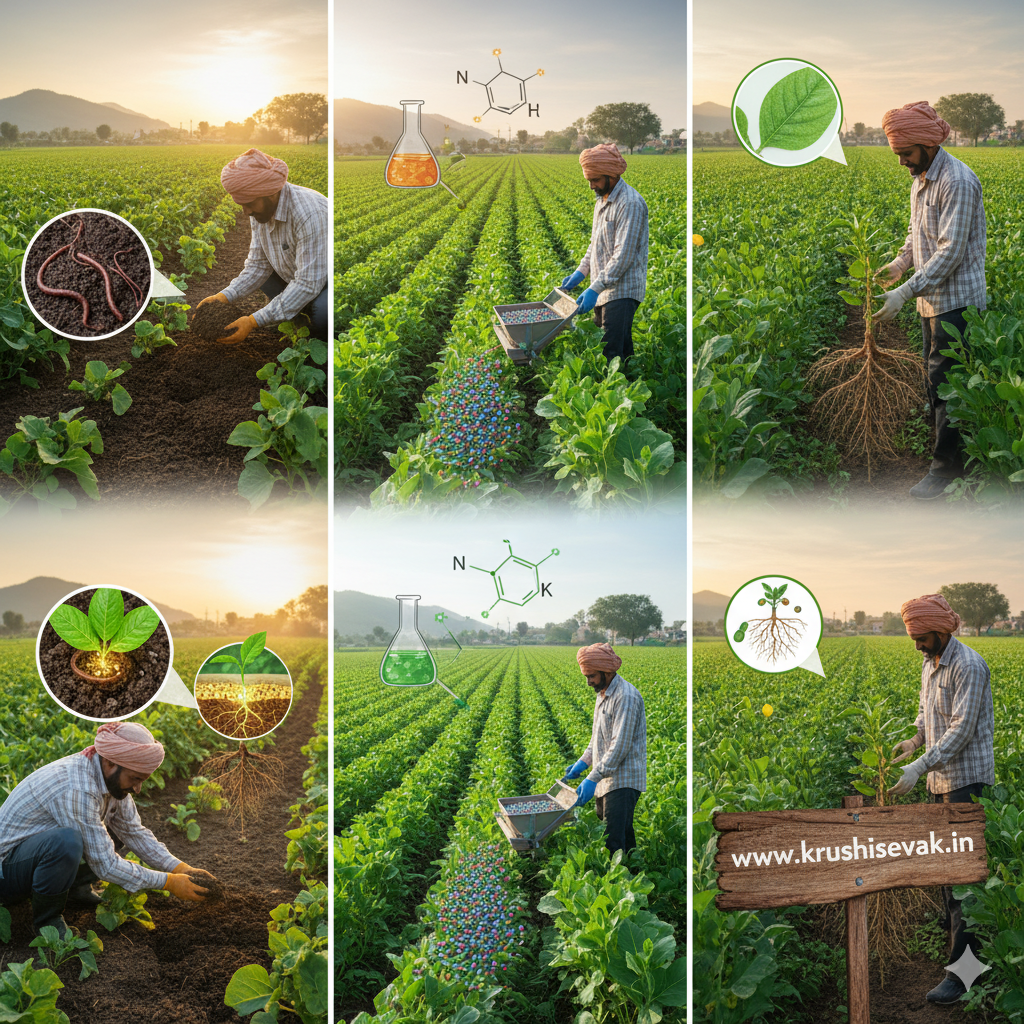
Organic fertilizers are soil amendments derived entirely from natural, carbon-based animal, plant, or mineral materials. Classic examples include Farmyard Manure (FYM), Compost, Vermicompost (earthworm castings), Bone Meal (slow-release phosphorus), and Green Manures (cover crops plowed directly back into the mud).
Unlike chemical options, organic fertilizers contain nutrients bound within complex organic molecules that are completely insoluble in water. They require the active help of soil microorganisms—such as bacteria and fungi—to break them down through mineralization into simple, plant-available forms.
This creates a highly stable, natural, slow-release mechanism. The nutrients are released gradually over several months, perfectly matching the crop’s growth curve while dramatically reducing the risk of nutrient leaching.
Bio-fertilizers
Representing the cutting edge of modern agricultural biotechnology, bio-fertilizers are living formulations containing specialized, beneficial microorganisms. They do not add direct raw nutrients to the field. Instead, they function as active biological workers that unlock existing, unreachable nutrient pools within the soil matrix.
Rhizobium bacteria inoculants colonize the roots of leguminous crops, forming nodules that capture inert nitrogen from the air and convert it into plant-ready ammonia. Phosphorus-Solubilizing Bacteria (PSB) secrete mild organic acids that dissolve mineral bonds, unlocking tightly bound phosphorus reserves already present in the ground.
By restoring these natural biological cycles, bio-fertilizers allow farmers to cultivate a living, self-sustaining root ecosystem.
Structural and Economic Benefits of Balanced Fertilization
When managed correctly, combining these different fertilizer types provides massive, multi-tiered benefits across the entire agricultural value chain.
Maximizing Crop Yields and Land Use Efficiency
The most direct benefit of systematic fertilization is a significant increase in crop yield per acre. By ensuring that plants never experience nutritional bottlenecks, fertilizers allow crops to reach their full genetic potential. This high-density productivity is crucial for global food security, as it allows farmers to grow more food on existing fields. This efficiency reduces the economic pressure to clear forests, wetlands, and wild ecosystems for new agricultural land.
Rebuilding Soil Structure and Water Retention
While chemical fertilizers supply raw elements, organic fertilizers provide the vital carbon matrix needed to build healthy soil architecture. As organic matter decomposes, it produces sticky polysaccharide gums and stable humic acids that bind loose soil particles together into crumb-like units called soil aggregates.
This aggregate structure alters the physical texture of the soil: heavy, compacted clay soils become loose and well-aerated, while loose, sandy soils gain structural cohesion. This open soil structure acts like a biological sponge, maximizing water-holding capacity and allowing crops to thrive during extended dry spells.
Protecting Crops from Stress and Disease
Nutritional balance directly influences a plant’s health and immune system. Plants that receive an optimized, balanced diet are inherently more robust and better equipped to handle environmental stress.
For instance, proper potassium levels help plants manage water loss during droughts, while a healthy soil microbiome—cultivated by bio-fertilizers—creates natural competition that suppresses harmful root-rotting fungi and destructive nematodes. This biological protection reduces a farm’s reliance on chemical pesticides and fungicides.
The Scientific Framework for Proper Use: The 4R Stewardship
Because modern fertilizers are highly potent, applying them through generalized guesswork can cause chemical root burn, soil degradation, and severe economic waste. To guide growers toward sustainable, high-efficiency practices, agronomic scientists developed the universal 4R Stewardship Framework. This system outlines the core principles needed to maximize plant nutrient absorption while keeping environmental impact to an absolute minimum.
1. Right Source: Matching Fertilizer to Soil and Crop Profile
The “Right Source” principle states that the selected fertilizer must deliver nutrients in a chemical form that matches the specific crop’s biological needs and the unique chemical properties of the local soil.
For example, applying an ammonium-based nitrogen fertilizer to highly alkaline soils helps slightly acidify the immediate root zone, making locked-up trace elements like iron and zinc more available to the plant. Conversely, for chloride-sensitive crops like potatoes, tobacco, or grapes, using Sulfate of Potash (SOP) is the correct choice over standard Muriate of Potash (MOP) to prevent chemical toxicity.
2. Right Rate: Guided by Rigorous Soil Testing
Applying too little fertilizer leaves crops undernourished and stunts yields, while applying too much leads to high input costs and soil toxicity. Determining the exact volume requires a professional Soil Health Test.
A comprehensive soil analysis measures the baseline levels of residual nutrients already present within the field. By subtracting these existing levels from the known target nutritional requirements of the specific crop, farmers can calculate the precise amount of fertilizer needed.
Modern precision agriculture builds on this by using tractor-mounted sensor arrays and drone imagery to dynamically adjust fertilizer rates across different zones of a single field, applying inputs only where the soil demands them.
3. Right Time: Aligning Application with Peak Growth Phases
Plants consume nutrients at vastly different rates throughout their lifecycles. A newly germinated seedling requires very little nitrogen but needs a solid supply of phosphorus to build its initial root system. The demand for nitrogen and potassium surges exponentially later, during the rapid vegetative stretch and early flowering stages.
Therefore, applying the entire season’s worth of fertilizer in a single blanket dose during sowing is highly inefficient. Excess nutrients will simply leach away into deep groundwater or evaporate into the air before the roots can capture them.
Proper use relies on Split-Application strategies: applying a small baseline dose during planting (basal application) followed by precisely timed top-dressings designed to match the crop’s peak consumption windows.
4. Right Place: Strategic Positioning for Easy Root Access
Where fertilizer is physically placed in the soil profile dictates how efficiently the plant can consume it. If chemical nitrogen granules are simply scattered across the surface of a dry field without being mixed into the soil (broadcasting), a significant percentage of the nitrogen will turn into ammonia gas and escape into the air through volatilization.
Proper placement methodologies include:
- Band Placement: Concentrating a narrow strip of fertilizer two inches to the side and two inches below the seed line during planting, keeping nutrients within easy reach of emerging roots without burning the sensitive seedling.
- Side-Dressing: Deep-placing fertilizer bands along the sides of established crop rows during active growth periods.
- Fertigation: Injecting fully water-soluble chemical and liquid bio-fertilizers directly into a modern drip or micro-sprinkler irrigation system. This technique delivers highly diluted, perfectly metered nutrients directly to the active root zone, virtually eliminating surface runoff and maximizing nutrient use efficiency.