
Introduction
For generations, dairy farming has been a cornerstone of rural economies and global food systems. Traditionally, it was practiced as a labor-intensive, subsistence-based activity relying heavily on manual labor, inherited wisdom, and generalized herd management. However, the modern dairy sector is facing unprecedented economic pressures. Rising feed costs, volatile milk pricing, climate-induced heat stress, and acute labor shortages are squeezing profit margins tighter than ever before.
To survive and thrive in this challenging landscape, dairy farming must transition from a traditional craft into a highly precise, tech-driven enterprise. The modern dairy revolution is defined by the strategic integration of advanced hardware, data analytics, and biological breakthroughs. By embracing automation, artificial intelligence, internet-of-things (IoT) connectivity, and advanced genetic tools, farmers can significantly increase milk yield per animal while minimizing operational overheads.
Technology does not replace the stockmanship of a skilled farmer; rather, it amplifies it. It provides the actionable, real-time data needed to optimize herd health, streamline feeding regimens, and maximize reproductive efficiency. This comprehensive exploration delves into the cutting-edge technological advancements that are reshaping global dairy operations, demonstrating how the smart application of modern tools directly translates into exponential production and financial growth.
Smart Herd Management: The IoT and Wearable Revolution
The foundation of any profitable dairy operation lies in the individual health and well-being of the cattle. In large-scale operations, monitoring every single cow visually for early signs of illness or heat (estrus) is a logistical impossibility. Modern technology solves this bottleneck by deploying the Internet of Things (IoT) via sophisticated cattle wearables.
Smart Collars and Ear Tags
Similar to fitness trackers worn by humans, modern dairy cows are increasingly equipped with smart collars, ear tags, or ankle rumination sensors. These non-invasive devices are packed with multi-axis accelerometers that continuously track the animal’s behavior 24 hours a day. They measure exact durations of rumination (chewing the cud), eating, resting, walking, and active heat behaviors.
AI-driven cloud platforms analyze these behavioral metrics in real time. For instance, if a cow’s rumination time drops by twenty percent, the system automatically flags a smartphone alert for the farmer. This behavioral shift often occurs 24 to 48 hours before any clinical symptoms of metabolic diseases (like ketosis or mastitis) display visually. Early detection allows for prompt veterinary intervention, saving thousands on emergency veterinary care and preventing long-term drops in milk production.
Rumen Boluses
For even deeper biological monitoring, some advanced farms utilize biotelemetry via smart rumen boluses. These are small, biocompatible capsules administered orally that settle permanently in the cow’s reticulum. Equipped with internal sensors, the bolus continuously measures core body temperature, activity levels, and internal pH.
Sudden fluctuations in core temperature can provide immediate warnings of systemic infections, while acute drop-offs in rumen pH signal the onset of Subacute Rumen Acidosis (SARA)—a costly nutritional disorder driven by improper feed ratios. By monitoring the herd from the inside out, farmers gain an unparalleled shield against silent production losses.
Precision Milking and the Power of Automation
Milking is historically the most repetitive, time-consuming, and labor-reliant aspect of dairy farming. The introduction of modern automation has completely redefined this process, creating cleaner, faster, and highly data-driven environments.
Robotic Milking Systems (Voluntary Milking Systems – VMS)
Robotic milking represents a massive leap forward in precision dairy technology. In a voluntary milking setup, cows are not driven into a parlor by workers at fixed intervals. Instead, they freely walk into a robotic milking stall whenever they choose, enticed by a small portion of customized feed pellets.
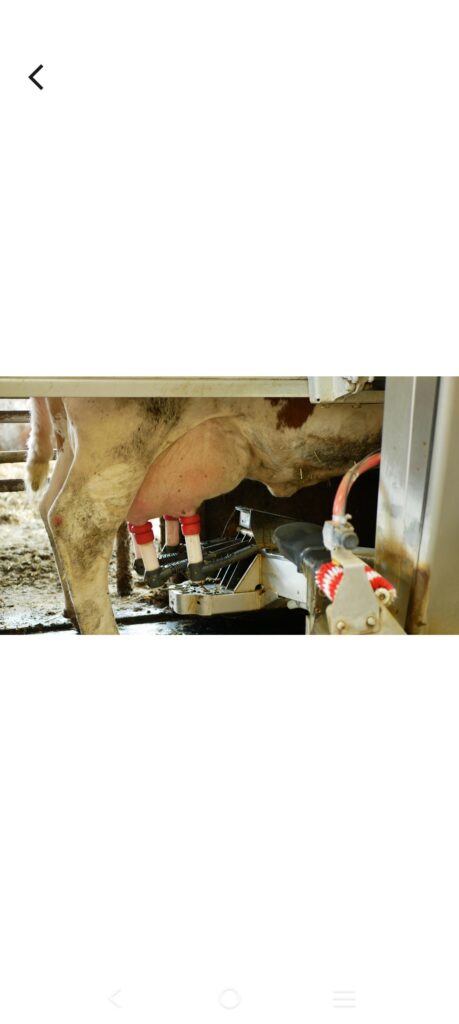
Once inside, a robotic arm utilizes laser guides, 3D cameras, and optical sensors to map the cow’s udder, clean the teats, and precisely attach the teat cups. Because the system operates entirely autonomously, cows are often milked three to four times a day rather than the traditional twice-daily schedule. This voluntary increase aligns closer with natural biological rhythms, resulting in a sustainable 10% to 15% increase in total milk production per cow.
Furthermore, these robots double as highly sophisticated chemical laboratories. As the milk flows, inline sensors analyze the electrical conductivity, color, temperature, and somatic cell count (SCC) of the milk from each individual quarter of the udder. If the system detects early-stage, subclinical mastitis, it automatically diverts that specific milk away from the main bulk tank and alerts the manager, ensuring maximum food safety and preserving the premium quality tier of the farm’s collective milk supply.
Automated Parlor Identifiers and Rapid-Exit Systems
For larger herds where individual robotic stalls may not fit the physical layout, modern parallel or rotary parlor designs are equipped with automated Radio Frequency Identification (RFID) readers. As a cow enters the parlor, the system instantly identifies her, pulls up her production history on an overhead screen, and automatically adjusts the vacuum pressure and pulsation settings of the milking machine to match her specific historical milk flow curve. This personalized mechanical approach prevents over-milking and tissue damage, protecting long-term udder health.
Data-Driven Nutrition and Automated Feeding
Feed accounts for roughly 50% to 70% of the total recurring operational expenses on a dairy farm. Wasteful feeding practices, imprecise nutrient ratios, and unpalatable feed mixes can quickly ruin a farm’s financial viability. Modern technology approaches dairy nutrition as an exact science.
Total Mixed Ration (TMR) Tracking Software
To achieve maximum milk yields, cows must consume a highly consistent blend of roughage, grains, minerals, and vitamins, known as Total Mixed Ration (TMR). Modern feed mixer wagons are equipped with electronic weighing scales integrated with Bluetooth-enabled TMR software.
The software calculates precise ingredient weights based on the current herd size and weather conditions. If the feeder operator accidentally dumps too much silage into the mixer, the software recalculates the required weights of the remaining grain ingredients in real time to maintain the exact nutritional balance. This eliminates human error, ensures the cows receive an optimized ration every day, and prevents digestional upsets that sharply lower milk production.
Automatic Feed Pushers and Robotic Feeders
Cows are natural grazers that prefer eating small amounts throughout the day and night. However, as they eat, they tend to push the feed out of their physical reach in the barns. Manual feed pushing is labor-intensive and frequently neglected during night shifts.
Autonomous robotic feed pushers operate like heavy-duty, industrial versions of household robotic vacuums. Moving silently along pre-programmed magnetic or laser-guided routes through the barn every one to two hours, they push the feed back toward the fence. This constant availability encourages frequent, smaller meals, boosting feed intake, improving rumen fermentation efficiency, and driving higher fat and protein yields in the milk.
”Modern dairy technology transforms the farm from a space of repetitive manual labor into a center of digital precision, where data analytics protect animal welfare and maximize every drop of profit.”
Genetic Innovations and Advanced Breeding Technologies
While structural automation and daily health trackers optimize current operational performance, long-term profit scaling depends on the biological quality of the herd. The application of biotechnology has drastically accelerated the genetic progress of dairy cattle.
Genomic Testing
Historically, selecting which heifers (young female cows) to keep for breeding was a slow game of trial and error based on looking at their mother’s performance. Today, dairy farmers can collect a tiny tissue or tail-hair sample from a newborn calf and send it for genomic sequencing.
Within weeks, the genomic test provides a highly accurate prediction of the calf’s future genetic potential, including its lifetime profitability index, disease resistance, heat tolerance, and expected milk production traits. Farmers can aggressively cull low-performing animals early on, saving thousands in rearing costs, while retaining only the elite genetics to build the future herd.
Sexed Semen and Embryo Transfer
The financial viability of a dairy farm is heavily impacted by the gender of newborn calves; male calves (bulls) are generally a financial drain for dairy-focused operations, whereas female calves (heifers) represent future milk production. The widespread adoption of sexed semen technology guarantees a 90% or higher probability of producing female calves.
By pairing genomic testing with sexed semen, a farmer can breed their top-performing cows exclusively with female-centric elite genetics to generate high-value replacements. Conversely, they can breed their lower-tier dairy cows with conventional beef semen, producing high-demand crossbred beef calves that can be sold to the meat industry for a premium, opening up an entirely new revenue stream.
Environmental and Climate Control Technologies
High-producing dairy cows are highly sensitive to temperature. When the ambient temperature combined with relative humidity exceeds a certain threshold, cows enter a state of biological heat stress. Under heat stress, cows eat less, their rumen efficiency degrades, and milk production can suddenly plunge by 20% to 35%. Furthermore, conception rates during breeding drop significantly. Modern structural engineering and sensor arrays provide effective tools to mitigate this climate challenge.
Smart Ventilation and Soaking Systems
Modern dairy barns are designed as dynamic microclimates. Temperature-Humidity Index (THI) sensors positioned throughout the housing facilities continuously monitor environmental comfort levels. When THI values rise, an automated control system activates high-capacity low-speed (HVLS) fans and automated water-soaking lines.
The system operates on optimized cycles: spraying a coarse mist of water directly onto the cows’ backs to wet the skin, followed by high-velocity air blasts to accelerate evaporative cooling. This automated intervention maintains the cows’ internal core temperatures, ensuring consistent milk production and stable reproduction cycles even during intense summer heatwaves.
Integrating Enterprise Resource Planning (ERP) Systems
The massive volumes of data generated by wearable sensors, robotic milking systems, automated feeding wagons, and genomic labs could easily overwhelm a manager if left fragmented. The ultimate step in modernizing a dairy farm is consolidating these individual data streams into a single, unified Dairy Enterprise Resource Planning (ERP) platform.
Software solutions like Uniform-Agri, DelPro, or CowManager integrate all operational inputs into a centralized dashboard. The system automatically cross-references financial outlays (such as feed bills, utility costs, and veterinary medicines) against exact production outputs (such as daily milk volumes, fat percentages, and calf sales).
This granular financial mapping calculates the exact “Margin Over Feed Cost” (MOFC) for individual cows and specific groups. It identifies precisely which animals are highly profitable assets and which ones are operating at a loss. Armed with this level of commercial intelligence, dairy farmers can move away from rough estimates and make highly rational, data-driven management decisions that maximize their bottom line.
Conclusion
The transformation of dairy farming through modern technology is no longer a futuristic concept reserved for academic experimental farms; it is an urgent economic necessity for commercial survival and profitability. The strategic deployment of smart wearables, robotic milking, precision feeding, genomic selection, and integrated climate controls directly addresses the core vulnerabilities of traditional farming.
While the initial capital investment required to adopt these advanced technologies can be significant, the returns are substantial and measurable. Through reduced labor requirements, optimized feed conversion, early disease prevention, and elevated per-animal milk yields, modern technology provides a clear and structured path to financial resilience. By treating data as a vital farm resource—just like clean water and quality forage—modern dairy managers can secure a highly productive, sustainable, and profitable future for their operations.