
Introduction
The construction sector stands as one of the largest employers of unorganized labor, engaging millions of individuals in physically demanding and often hazardous environments. Despite their foundational contribution to urban development, infrastructure expansion, and economic growth, construction workers have historically faced structural challenges. These include seasonal employment gaps, low wage security, lack of access to healthcare, and inadequate social safety nets.
To bridge this socio-economic divide, various state welfare boards across India have enacted targeted policy frameworks. In Maharashtra, this takes the form of the Bandhakam Kamgar Yojana, a comprehensive welfare program managed by the Maharashtra Building and Other Construction Workers Welfare Board (MBOCWWB).
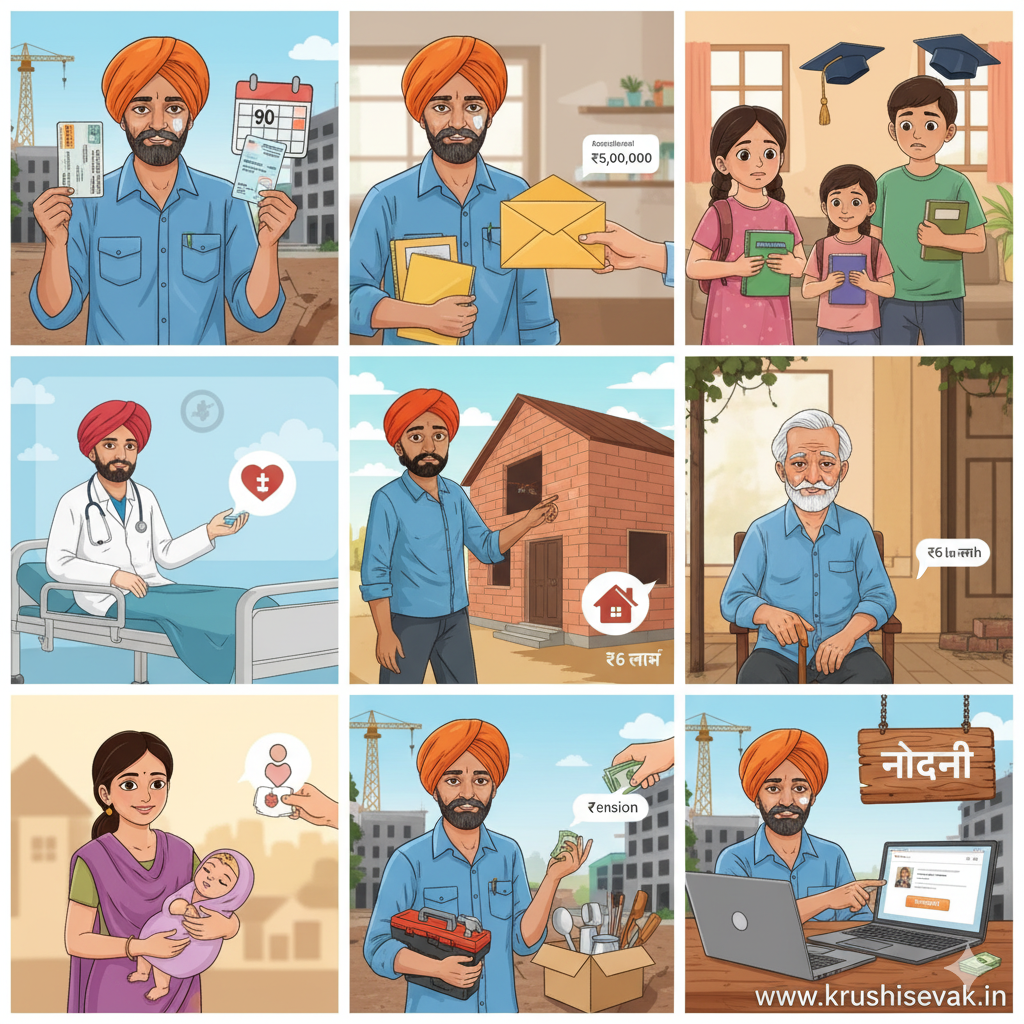
Funded systematically through a statutory 1% building cess collected on construction projects, this scheme converts real estate development revenue into direct, multi-tiered support for laborers. The program covers a wide range of needs, from providing immediate financial assistance and health coverage to funding educational scholarships for workers’ children, supporting affordable housing, and providing long-term social security. This guide provides a detailed analysis of the program, outlining the specific eligibility requirements, extensive financial benefits, and step-by-step registration processes needed to access these life-changing resources.
Who is Considered a Construction Worker?
A common misconception is that the Bandhakam Kamgar Yojana only covers masonry workers or individuals mixing concrete on site. In reality, the legal scope of the Building and Other Construction Workers (BOCW) Act of 1996 covers a broad spectrum of skilled, semi-skilled, and unskilled labor fields.
Any worker engaged in the building, alteration, repair, maintenance, or demolition of buildings, streets, roads, railways, tramways, airfields, irrigation networks, drainage systems, or waterworks is eligible. This inclusive definition covers:
- Masons, bricklayers, and concrete mixers.
- Carpenters, woodworkers, and interior decorators executing ceiling or plaster of Paris (POP) installations.
- Electricians engaged in structural wiring, cabling, and power distribution setup.
- Plumbers, gutter workers, and sanitation hardware installers.
- Painters, varnishers, and surface treatment specialists.
- Tile layers, marble cutters, and floor polishing technicians.
- Welder and iron fabricators manufacturing windows, metal grills, and safety doors.
- Glaziers engaged in glass cutting and structural glass panel installations.
- Laborers working on infrastructure projects such as dams, canals, bridges, cooling towers, and pipelines.
- Workers manufacturing bricks or tiles outside of traditional factory acts.
- Installers of energy-efficient systems like solar panels and modular kitchen frameworks.
Eligibility Criteria for Registration
To prevent the misallocation of state resources and ensure that benefits reach genuine unorganized laborers, the welfare board enforces strict baseline eligibility criteria.
1. Age Demographics
The applicant must be an adult citizen actively capable of manual labor. The legally mandated age bracket requires the worker to be between 18 and 60 years of age. Individuals who have crossed the upper threshold of 60 are considered retired from active construction labor under this framework and shift toward senior pension-oriented social systems.
2. Minimum Service Threshold (The 90-Day Rule)
The most critical prerequisite for registration is the employment duration clause. The worker must have been actively employed in building or other construction activities for not less than 90 days within the preceding 12 months. This requirement confirms their status as a regular sector participant rather than a casual or non-construction worker.
3. Geographical Residency
The applicant must be a permanent resident of the state implementing the specific welfare board scheme. For the Maharashtra framework, the individual must possess valid local residency proof to confirm they are actively contributing to construction activities within the state’s borders.
Comprehensive Benefits Under the Scheme
The Bandhakam Kamgar Yojana stands out for its wide-ranging, comprehensive support structure. Rather than offering a single cash payout, the welfare board distributes financial aid across four key areas: Educational Assistance, Health Care Coverage, Financial Support, and Social Security Schemes.
1. Educational Assistance for Children
The board prioritizes breaking the cycle of generational poverty by funding the education of workers’ children. These educational benefits are typically restricted to the first two children of a registered worker:
- Primary Education: An annual stipend of ₹2,500 for children studying from the 1st to the 7th standard.
- Secondary Education: An annual grant of ₹5,000 for students in the 8th to the 10th standard, provided they maintain a compulsory minimum school attendance of 75%.
- Higher Secondary Support: An annual payment of ₹10,000 for children pursuing their 11th and 12th standards.
- Merit Incentives: A one-time reward of ₹10,000 is granted to any child who secures 50% or higher marks in their 10th or 12th board examinations.
- Undergraduate Degrees: An annual assistance of ₹20,000 to the worker’s spouse or first two children to cover books, tuition, and material costs for standard graduation tracks.
- Technical and Professional Degrees: Generous academic support providing ₹60,000 annually for Engineering degrees and up to ₹1,00,000 per academic year for medical degree courses.
- Vocational and IT Training: Annual assistance of ₹20,000 for standard Diploma courses, ₹25,000 for Post-Graduate Diploma programs, and full fee reimbursement for government-approved digital literacy programs like the MS-CIT course.
2. Health Care and Medical Welfare
Given the high physical risk associated with construction labor, the scheme provides extensive healthcare protections:
- Critical Illness Coverage: Financial medical aid up to ₹1,00,000 to cover treatment costs for critical illnesses impacting the registered worker or their legally recognized family members.
- Maternity Benefits: Financial assistance ranging from ₹15,000 to ₹20,000 to support female construction workers or the wives of registered male workers during childbirth, helping ensure safe deliveries and proper neonatal care.
- Permanent Disability Support: In the unfortunate event of a workplace accident resulting in 75% or higher permanent disability, the worker receives a lumpsum financial package of ₹2,00,000 to secure their future livelihood.
- Family Planning Incentives: If a registered worker or their spouse undergoes an official family planning procedure after the birth of their first female child, the board deposits ₹1,00,000 in a fixed deposit account within a nationalized bank. This sum remains locked, gaining interest in the name of the female child, until she reaches 18 years of age.
- Routine Health Check-ups: Fully funded annual medical check-up camps and targeted diagnostic screenings managed by competent state medical authorities.
3. Financial and Housing Assistance
Capital accumulation is a major challenge for unorganized laborers. The scheme offers targeted capital grants to help workers secure permanent housing and handle life milestones:
- Atal Bandhkam Kamgar Awas Yojana: This flagship housing integration aligns with national programs like the Pradhan Mantri Awas Yojana. Eligible registered construction workers receive a direct housing subsidy grant of up to ₹2,00,000 for building a new home or purchasing an affordable housing unit. Alternatively, the board provides up to ₹6,00,000 in financial backing to subsidize interest components on formal bank home loans.
- Marriage Expense Reimbursement: A financial grant of ₹30,000 is disbursed to assist with the marriage expenses of the registered construction worker for their first legal marriage.
- Essential Toolkits: Provision of professional, industry-specific safety gear and essential toolkits to enhance worker productivity and occupational safety on site.
4. Social Security and Family Bereavement Support
The scheme ensures that a worker’s family is protected from sudden economic shocks if an unfortunate event occurs:
- On-Site Accidental Death Benefit: If a registered construction worker suffers a fatal accident while performing their duties on site, a direct lump sum of ₹5,00,000 is paid to their legal heirs.
- Natural Death Financial Aid: In the case of a natural demise during the active registration period, the legal heirs receive a security payout of ₹2,00,000.
- Funeral Assistance: An immediate emergency cash payout of ₹10,000 is given to the family to cover funeral and cremation costs.
- Widow/Widower Pension Cover: The surviving spouse of a deceased registered worker receives an annual pension of ₹24,000 for a continuous period of 5 years to help them adjust financially.
Required Documents for Application
To ensure smooth processing and avoid delays, applicants must compile a verified set of supporting documents before starting the registration process.
- Aadhaar Card: The primary biometric document used to verify identity and link the worker to the Direct Benefit Transfer (DBT) network.
- Proof of Age: A school leaving certificate, birth certificate, passport, or an official voter identification card confirming the worker falls within the 18-to-60 age bracket.
- Proof of Residence: A local ration card, electricity bill, voter ID, or domicile certificate verifying permanent residence in the state.
- The 90-Day Work Certificate: This is the most crucial document. It is a formal employment certificate verifying that the applicant completed at least 90 days of construction work over the past year. This certificate can be officially issued and signed by a licensed building developer, a registered civil contractor, a municipal engineer, or designated local rural authorities like the village Gram Sevak or ward officer.
- Bank Account Passbook: A legible copy of the bank passbook showing the account number, branch details, and IFSC code. This account must be directly linked to the worker’s Aadhaar card to enable secure, electronic subsidy transfers.
- Self-Declaration Form: An officially signed self-attestation confirming that the applicant is an unorganized construction laborer and is not simultaneously drawing duplicate benefits from alternative state labor welfare boards.
- Passport-Size Photographs: Three recent passport-sized color photographs for physical records and identity matching.
Step-by-Step Online Registration Process
The registration ecosystem has transitioned from a cumbersome, paper-based administrative workflow into a transparent, digital portal system (mahabocw.in). Eligible workers can complete their registration using a smartphone, a home computer, or by visiting a local Common Service Center (CSC) or MahaeSeva Kendra.
Step 1: Portal Entry and Eligibility Validation
The applicant logs onto the official online portal of the Maharashtra Building and Other Construction Workers Welfare Board. On the homepage, they select the “Workers Registration” option. The system prompts them to enter their date of birth, current mobile number, and local district. The portal runs an automated check to verify they meet the baseline eligibility criteria before opening the main portal interface.
Step 2: Authentication via Aadhaar
The user inputs their twelve-digit Aadhaar card number and clicks on the verification tab. A secure One-Time Password (OTP) is sent to the mobile number officially linked to their Aadhaar card. Once entered, this securely authenticates the user’s basic demographic profile, pulling their legal name and date of birth directly from the central database to eliminate data entry mistakes.
Step 3: Complete Personal and Family Profile Entry
The applicant then fills out the comprehensive digital registration form, which is broken down into clear, manageable sections:
- Personal and Contact Info: Permanent home address, current structural location, active contact details, and gender.
- Family Structure: Names, ages, and relationship statuses of dependent family members and children to enable future educational and family planning claim verifications.
- Nominee Designation: The name, identity proof, and account specifics of the chosen family nominee who would receive benefits in the event of an emergency or death.
Step 4: Employment History and Contractor Particulars
The applicant logs their construction work details from the previous year. This includes entering the developer or contractor’s official name, registration license number, exact site address, type of construction work performed, and the specific dates that complete the mandatory 90-day work certificate.
Step 5: Bank Account and IFSC Integration
The applicant enters their bank account numbers, re-verifies the alphanumeric IFSC code, and records the branch name. This step ensures that future financial scholarships, medical aids, and housing grants are sent directly to the correct account without third-party interference.
Step 6: Uploading Scanned Supporting Documents
The user uploads scanned copies or clear photos of the required documents compiled earlier (Aadhaar, proof of age, signed 90-day work certificate, self-declaration form, and bank passbook). The portal requires files to be uploaded in clear, high-resolution formats (PDF, JPEG, or PNG) with a maximum file size usually limited to 2MB per document.
Step 7: Fee Payment and Application Tracking
A token registration fee of ₹1 along with an initial annual subscription charge of ₹1 (totaling ₹2) is paid through integrated digital payment gateways (UPI, net banking, or debit card). Once payment is processed, the system generates a unique Application Reference Number (ARN) and tracking ID.
The file is then digitally routed to the local Block Development Officer or District Labor Officer for scrutiny. After successful physical or digital field verification of the 90-day work credentials, the application is approved. The worker can then download their official digital Construction Worker Identity Card directly from the portal, unlocking access to all available benefits.
”The digital transformation of the BOCW portal empowers construction workers, turning a previously complex administrative process into a transparent, secure, and accessible path to comprehensive social security.”
Mandatory Annual Renewal Process
Registration under the Bandhakam Kamgar Yojana is not a one-time, permanent asset. To remain active, the registration must be renewed annually or in structured multi-year segments. This requirement ensures that the beneficiary remains an active participant in the construction sector.
During the renewal window, the worker must log back into the integrated computer system, upload a fresh 90-day work certificate covering the most recent twelve-month cycle, and pay the nominal annual subscription fee. If a worker fails to renew their profile within the designated timeframe, their registration status shifts to inactive, freezing their access to educational scholarships, health benefits, and housing grants until the profile is officially updated and validated by the labor board.
Conclusion
The Bandhakam Kamgar Yojana represents a major step forward in establishing dignity, safety, and economic security for unorganized construction workers. By shifting from ad-hoc financial handouts to a structured welfare model, the scheme protects vulnerable workers from the daily risks of hazardous labor.
From funding primary and advanced university education for the next generation to providing robust health insurance, housing assistance, and life-risk coverages, the program offers a reliable safety net for construction families.
By understanding the clear eligibility criteria, gathering the required 90-day employment verifications, and using the accessible online portals, eligible workers can quickly secure their registration. Participating in this state welfare framework ensures that the individuals who build our modern cities have a secure foundation to build a prosperous future for their own families.