
Introduction: The Necessity of Agricultural Mechanization
For generations, farming has been a labor-intensive endeavor. The traditional image of a farmer involves long hours of manual toil, using hand tools or draft animals to plow fields, sow seeds, manage weeds, and harvest crops. While these conventional methods sustained communities for centuries, they are no longer sufficient to meet the challenges of modern agriculture.
Today’s agricultural landscape is shaped by unique pressures. Farmers must produce higher food volumes to feed a rapidly growing global population, deal with erratic weather patterns caused by climate change, and manage narrow operational windows. To make matters more difficult, rural areas face a growing labor crisis. Rapid urbanization, migration to industrialized cities, and shifting youth demographics have made seasonal farm labor scarce and expensive.
During peak seasons—such as field preparation, sowing, and harvesting—a delay of even a few days due to missing labor can devastate a farmer’s seasonal profits. If a field is not sown before the first monsoon rains, or if a mature crop is left exposed to unexpected storms, the financial loss can be catastrophic.
To overcome these structural bottlenecks, tractor-operated modern implements have emerged as essential tools for survival and growth. By shifting from manual or animal-powered tasks to mechanized attachments, modern implements turn tractors from simple towing vehicles into versatile, high-speed power hubs. This transition allows a single operator to accomplish in hours what used to take days or weeks, significantly lowering production costs and maximizing crop yields.
Evolution of the Tractor: From Towing Vehicle to Power Hub
When tractors were first introduced to farms, they were viewed primarily as mechanical replacements for draft animals like oxen or horses. Their primary purpose was to pull heavy plows through tough fields. However, the true transformation of the tractor occurred with the invention and standardization of three critical engineering components:
- The Three-Point Hitch: A hydraulic linkage system that allows implements to be securely lifted, lowered, and angled directly by the tractor’s internal controls. This turns the tractor and its attachment into a unified, highly maneuverable machine.
- The Power Take-Off (PTO) Shaft: A splined drive shaft that transfers rotary mechanical power directly from the tractor’s engine to an attached implement. This allows attachments to spin, shake, or pump using the tractor’s engine power.
- Auxiliary Hydraulic Valves: Pressurized fluid systems that allow tractors to power external hydraulic cylinders, enabling complex motions on heavy implements like tipping trailers, loaders, and folding harrows.
Thanks to these advancements, a modern tractor functions as a mobile power plant capable of supporting an expansive range of specialized implements across every phase of the agricultural cycle.
Phase 1: Primary and Secondary Tillage Implements
Soil preparation is the foundation of a successful crop cycle. Tillage aims to break up hard ground, clear weeds, aerate the soil, and create a loose, fine seedbed that encourages rapid root growth.
The MB Plow and Disc Plow (Primary Tillage)
The Mouldboard (MB) Plow and Disc Plow are engineered to cut through uncultivated land, lifting, shattering, and completely inverting the soil. This process buries surface crop residues deep underground, where they decompose into organic matter, while exposing deep soil nutrients to air and sunlight.
- Labor and Cost Reduction: Manually digging one acre of land with spades requires dozens of workers and days of physical labor. An animal-drawn plow can take over a week for the same area. A tractor-mounted 3-bottom MB plow can complete an acre in a few hours, drastically reducing labor costs and ensuring fields are prepared well within optimal planting windows.
The Rotary Tiller (Rotavator)
The rotavator is a PTO-driven implement that uses rotating L-shaped or C-shaped steel blades to pulverize soil. Unlike traditional methods that require multiple passes with a plow followed by a harrow, a rotavator accomplishes primary tilling, clod crushing, and seedbed leveling in a single pass.
- Labor and Cost Reduction: By combining multiple field prep steps into a single tractor run, the rotavator slashes diesel consumption by 30% to 40% and minimizes tractor wear. It also reduces soil compaction because heavy machinery passes over the field fewer times, protecting the long-term health of the soil.
Phase 2: Sowing and Planting Implements
Sowing seeds manually by broadcasting (scattering seeds by hand) or using traditional single-row seed drills often leads to poor seed placement, uneven germination, and significant seed waste. Modern tractor-operated sowing machinery resolves these issues through mechanical precision.
The Automatic Seed-cum-Fertilizer Drill
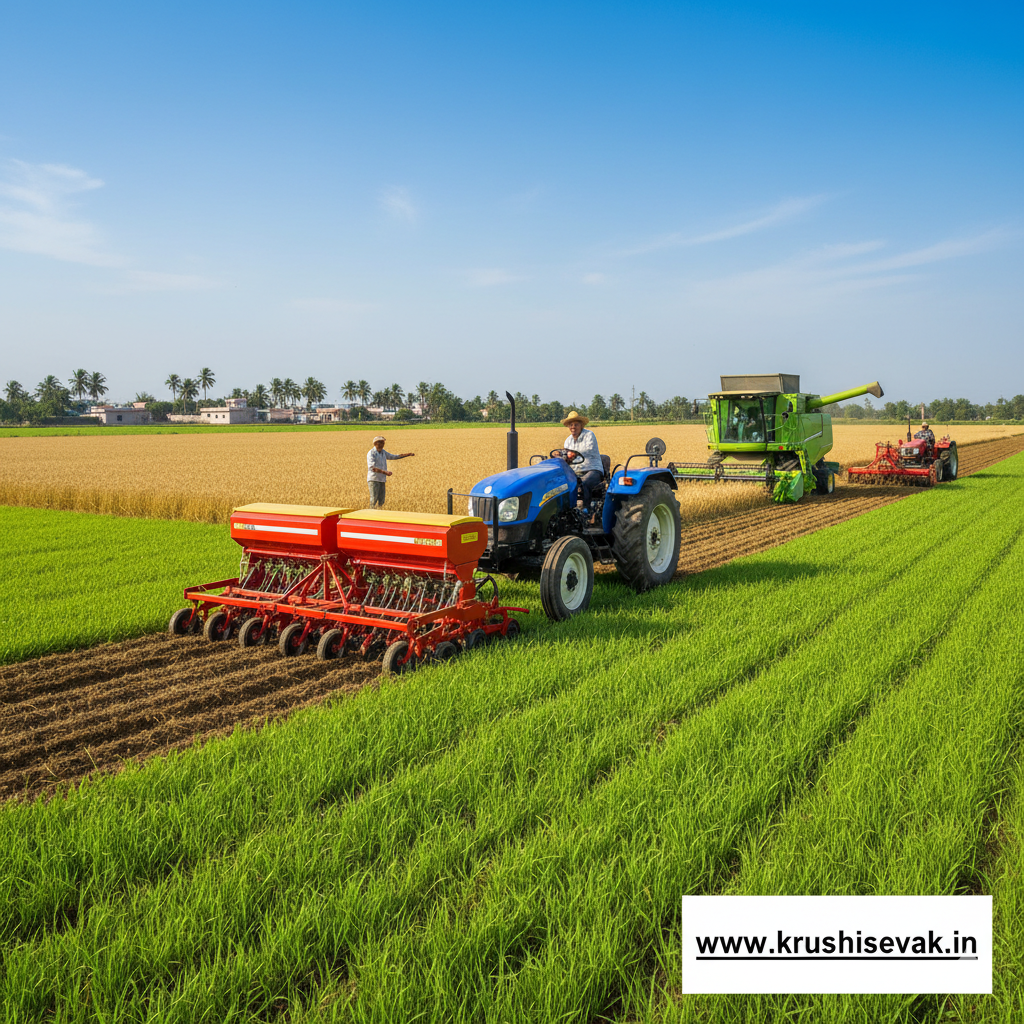
This implement features dual hoppers—one for seeds and one for chemical fertilizers. As the tractor drives forward, specific furrow openers create a trench, and a mechanical metering mechanism drops a precise amount of fertilizer, followed closely by the seed, at a consistent depth and spacing.
- Labor and Cost Reduction: Precise placement ensures every single seed has immediate access to nutrients and soil moisture, which improves germination uniformity and increases overall crop yields. This mechanical consistency eliminates the need for manual thinning or replanting, which are both highly labor-intensive tasks.
Pneumatic Precision Planters
For high-value crops like maize, cotton, or soybeans, every seed must be placed at exact intervals to prevent plants from competing with each other for sunlight and water. Pneumatic planters use vacuum suction tubes to pick up individual seeds and place them perfectly in the ground.
- Labor and Cost Reduction: These machines save money by minimizing seed waste from over-sowing. Furthermore, uniform crop rows make future mechanical tasks—like inter-cultivation, weeding, and automated harvesting—much easier to execute.
Phase 3: Crop Protection and Inter-Cultivation Implements
Once crops emerge from the ground, they must be protected from weeds, insects, and fungal diseases. Manual weeding and spraying are slow, tedious, and can expose farm workers to hazardous chemicals.
Tractor-Mounted Boom Sprayers
A boom sprayer consists of a large fluid tank (ranging from 400 to 1,000 liters) mounted on the tractor’s three-point hitch, connected to a long horizontal arm (boom) lined with specialized spray nozzles. Powered by a PTO-driven pump, the boom applies liquid pesticides, liquid fertilizers, or weedicides uniformly over a wide path.
- Labor and Cost Reduction: A manual worker using a backpack knapsack sprayer can cover only a small area per day and often applies chemicals unevenly. A tractor boom sprayer can cover dozens of acres in a single day, ensuring rapid crop protection during sudden pest outbreaks while reducing chemical waste by up to 30%.
Power Operated Inter-Cultivators
These attachments use narrow, adjustable tines that pass directly between standing crop rows. They uproot fast-growing weeds while loosening the surrounding soil to improve root aeration.
- Labor and Cost Reduction: Hand weeding is often the highest seasonal expense for small-to-medium farms. Mechanical inter-cultivators reduce this cost by up to 70%, allowing a single tractor operator to maintain clean, weed-free rows quickly and efficiently.
Phase 4: Harvesting and Post-Harvest Implements
The end of the agricultural cycle presents the narrowest operational window. Once a crop reaches maturity, it must be harvested immediately to avoid damage from birds, rodents, over-ripening, or unexpected rainstorms.
Tractor-Operated Reapers and Balers
While self-propelled combine harvesters are highly efficient, they are often too expensive for medium-scale farmers to purchase. Tractor-operated reapers offer a more accessible alternative, cutting crops like wheat and paddy cleanly at the base and arranging them neatly in rows. Once the grain is threshed, a tractor-operated straw baler picks up the remaining dry stalks, compressing and binding them into tight rectangular or round bales.
- Labor and Cost Reduction: Manual harvesting requires a large influx of seasonal workers, driving up wages during peak periods. A tractor-driven reaper eliminates this dependency entirely. Additionally, automated balers turn loose straw—which many farmers unfortunately burn, causing severe air pollution—into neat, transportable units that can be sold as profitable animal fodder or industrial biomass fuel.
Comparative Analysis: Manual Methods vs. Tractor-Operated Implements
To understand the economic impact of modern implements, it is helpful to contrast the inputs required for basic farm operations across a typical 5-acre property:
Manual & Animal-Powered Approach
- Time Requirements: Preparing, sowing, and weeding 5 acres can easily consume 2 to 3 weeks of intensive work.
- Labor Needs: Requires hiring large groups of seasonal laborers, making the farm vulnerable to sudden labor shortages or wage inflation.
- Input Utilization: High rate of seed and chemical waste due to human error and uneven manual distribution.
Tractor-Operated Mechanized Approach
- Time Requirements: The same operations can be completed in 1 to 2 days of targeted tractor operation.
- Labor Needs: Run entirely by a single tractor operator, with minimal support required for loading inputs.
- Input Utilization: Drastic reduction in seed and chemical costs due to calibrated, mechanical precision metering.
Proactive Maintenance Tips for Modern Implements
Modern agricultural implements are built to handle tough field environments, but their longevity and operational efficiency depend on consistent maintenance. An unexpected breakdown during a busy planting or harvesting window can result in expensive repairs and missed opportunities.
Daily Pre-Operation Checklist
Before heading out to the field, spend five minutes inspecting your attachments. Check all grease nipples and apply high-quality chassis grease to rotating shafts, universal joints, and disc hubs. Check for loose nuts and bolts, as the intense vibrations from working hard soil can loosen fasteners over time.
Gearbox and Hydraulic Fluid Maintenance
For PTO-driven implements like rotavators and balers, the internal gearbox operates under extreme pressure. Check the gear oil levels monthly and replace the fluid completely after every 250 operating hours or at the end of each season. Inspect hydraulic hoses on lifting attachments for any signs of cracking or leaks, as a sudden loss of pressure can cause heavy equipment to drop dangerously.
Blade Care and Sharpness
Tillage tines, plow shares, and reaper cutter teeth naturally dull as they work against abrasive soil and tough plant stalks. Inspect cutting edges regularly. Sharpen dull blades using a hand file or mechanical grinder, keeping the original factory angle. Replace severely worn, chipped, or bent blades immediately to prevent uneven field performance and reduce extra strain on your tractor’s engine.
Off-Season Storage Protocol
When an implement is done for the season, clean it thoroughly to remove all caked mud, crop residues, and wrapped weeds, which can trap moisture and accelerate rust. Spray a thin layer of anti-rust oil or apply general-purpose grease to all exposed metal cutting edges. Store your implements indoors or under a waterproof tarp, keeping them elevated on wooden blocks to prevent direct contact with damp soil.
Conclusion: Driving Long-Term Farm Profitability
The adoption of tractor-operated modern implements marks a turning point for sustainable agriculture. As rural labor shortages grow and input costs continue to rise, relying on manual methods path leaves farms economically vulnerable.
Machinery like rotavators, precision drills, boom sprayers, and balers allow farmers to complete key operations quickly and accurately. While purchasing these implements requires an initial financial investment, the long-term benefits—including lower labor expenses, reduced fuel consumption, and higher crop yields—provide a clear path to profitability. By embracing modern mechanization and committing to consistent equipment maintenance, farmers can secure a more resilient, efficient, and successful agricultural future.