
The global shift toward renewable energy sources and sustainable biofuels has placed non-edible oilseeds at the center of the green economy. Among these, Jatropha curcas—a hardy, drought-resistant perennial shrub—has emerged as a premier candidate for biodiesel production.
Because Jatropha cultivation requires a balance of land consolidation, initial capital, agronomic precision, and long-term supply chain agreements, a Joint Business Model is the most effective way to approach it. By forming a collaborative partnership—such as a joint venture, contract farming agreement, or farmer producer organization (FPO) paired with corporate investors—partners can minimize individual risks while optimizing the entire lifecycle from planting to industrial harvesting.
1. The Joint Business Framework for Jatropha Farming
Jatropha is a long-term investment that requires 2 to 3 years to yield its first commercial crop, but it continues producing oilseeds for up to 40 to 50 years. This timeline makes a collaborative joint business model highly advantageous compared to isolated independent farming.
The Corporate-Farmer Partnership Structure
In a standard Jatropha joint business model, stakeholders are split into two primary categories:
- The Land and Labor Partners (Farmers/Cooperatives): Local farmers contribute their land blocks (often marginal, degraded, or underutilized soils) and provide the day-to-day agricultural labor force.
- The Capital and Technology Partners (Corporate Investors/Agribusinesses): The corporate partner injects the necessary upfront capital, supplies high-yield hybrid seeds or cloned saplings, installs irrigation infrastructure, provides technical training, and offers a legally binding buyback guarantee at a predetermined floor price.
Advantages of the Joint Model
This symbiotic ecosystem solves the two largest historical hurdles of Jatropha farming: the lack of immediate cash flow for smallholder farmers during the initial vegetative years, and the supply security risk for biodiesel processing plants requiring a steady influx of raw seeds.
2. Botanical Profile and Site Selection
Understanding where and how Jatropha thrives is essential to choosing the right location for a joint business venture.
Climatic and Soil Tolerances
Jatropha is famous for its ability to survive in environments where traditional food crops fail.
- Temperature: It thrives in tropical and subtropical regions, preferring temperatures between 20°C and 32°C. Extreme frost can kill young plants and severely degrade seed yield.
- Rainfall: It is highly drought-tolerant, surviving on as little as 300 mm of annual rainfall. However, commercial viability and optimal oil yields require an annual rainfall between 600 mm and 1200 mm.
- Soil Type: Jatropha can grow in coarse, sandy, gravelly, or saline soils. However, for a commercial joint venture to achieve maximum profitability, partners should target well-drained, aerated sandy loam soils with a pH ranging from 6.0 to 8.0. It cannot tolerate waterlogged soils, which cause root rot.
3. Pre-Planting Operations and Field Establishment
A successful multi-decade plantation depends heavily on meticulous field preparation and correct planting density during the initial setup phase.
Land Preparation and Layout
The corporate partner should oversee mechanical site preparation to ensure uniformity across all combined land parcels. The land is cleared of wild brush and deep-tilled.
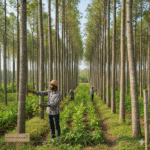
Following tilling, operators mark out precise planting grids. The standard commercial spacing for Jatropha is 3 \times 2 meters or 3 \times 3 meters. This density accommodates approximately 1,100 to 1,600 plants per hectare, leaving enough space for small tractors or automated weeding machinery to navigate between rows.
Propagation Methods
Jatropha can be propagated either via seeds or stem cuttings:
- Seed Propagation: Produces plants with a deep, structural taproot system, making them highly wind-resilient and excellent for long-term drought survival. Seeds are typically raised in nursery polybags for 2 to 3 months before field transplantation.
- Tissue Culture and Cloned Saplings: The corporate partner should ideally provide elite, high-yielding cloned saplings. These clones ensure uniform oil content across the entire plantation and accelerate the first fruiting cycle.
Pit Digging and Planting
Pits measuring 45 \times 45 \times 45 cm are dug according to the grid layout. Each pit is left to weather in the sun for two weeks to neutralize soil pathogens before being refilled with a mixture of topsoil, Farm Yard Manure (FYM), and a foundational dose of organic bio-fertilizers.
Transplanting is timed to coincide with the arrival of the local monsoon or rainy season to give the young saplings natural hydration during their critical initial rooting phase.
4. Canopy Management and Agronomic Care
To maximize seed production over a 40-year lifespan, the joint business must enforce strict, standardized canopy management guidelines across all partner farms.
The Art of Strategic Pruning
Left unmanaged, Jatropha grows into a tall, leggy tree with a sparse canopy, which makes manual harvesting difficult and reduces fruit yields. Jatropha bears fruit on the tips of its branches; therefore, more branches mean more seeds.
- First Pruning (Age 6 Months): When the young plant reaches a height of roughly 40 to 60 cm, the main terminal shoot is pinched or cut back. This forces the plant to throw out multiple lateral structural branches.
- Secondary Pruning (Age 1 Year): The secondary lateral branches are trimmed again to encourage a bushy, wide canopy structure, keeping the overall plant height capped at a manageable 2 meters for easy harvesting.
- De-Suckering: Removing weak, non-productive architectural shoots from the base of the trunk ensures that the plant channels its vital nutrients toward fruit-bearing branches.
Fertilizer and Nutrient Management
While Jatropha can survive without fertilizers, it will not produce commercially viable oil volumes without proper nutrition. The joint business should implement a systematic annual feeding schedule per plant:
- Organic Inputs: 2 to 5 kg of well-composted manure or press mud applied around the root zone annually before the rainy season.
- Chemical/Bio-inputs: Balanced applications of Nitrogen, Phosphorus, and Potassium (NPK), adjusted based on annual soil tests conducted by the corporate partner’s agronomic team.
Irrigation Practices
During the dry summer months, introducing micro-irrigation or drip irrigation systems—financed by the corporate partner’s capital fund—dramatically improves fruit setting and minimizes premature fruit drop. Drip irrigation prevents waterlogging while ensuring steady oil synthesis within the seed kernels.
5. Pest, Disease, and Weed Control
Maintaining structural biosecurity across all consolidated farming parcels prevents localized crop failures from spreading.
- Key Pests: The Jatropha Leaf Miner, Bark-Eating Caterpillars, and Blister Beetles can damage leaves and tender shoots.
- Control: The corporate partner should supply eco-friendly bio-pesticides, such as concentrated Neem oil sprays, to the farmers to keep pest populations below economic injury levels.
- Key Diseases: Root Rot (Macrophomina phaseolina) and Powdery Mildew are the primary threats.
- Control: Ensure clean field drainage to prevent water stagnation, and treat seeds or soil with biocontrol agents like Trichoderma viride during the planting phase.
- Weed Management: Regular mechanical or manual weeding between the rows is critical during the first 18 months. Once the Jatropha canopy closes, its natural shade suppresses weed growth, significantly reducing maintenance labor costs.
6. Harvesting and Post-Harvest Processing
Harvesting is the most labor-intensive component of the Jatropha business model and requires careful coordination to maximize oil extraction efficiency.
Recognizing Maturity Indicators
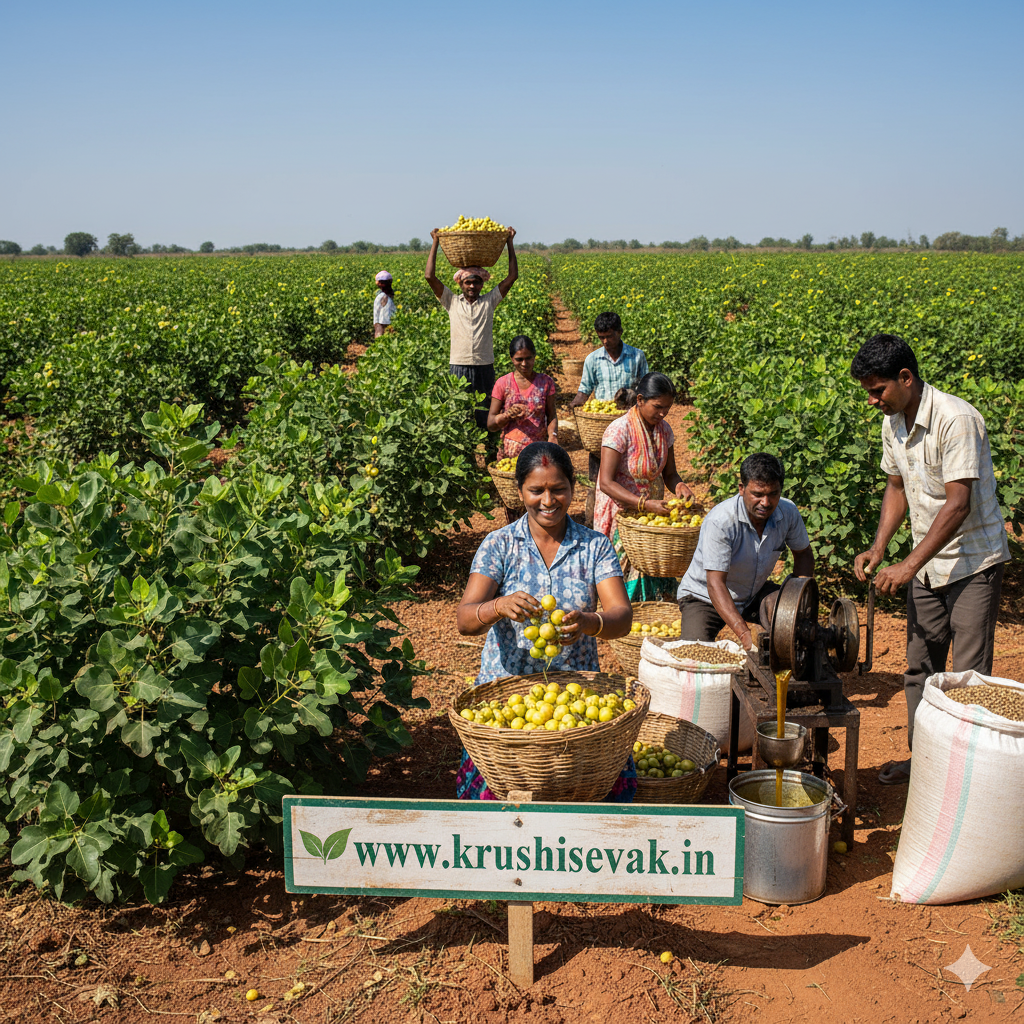
Jatropha fruits do not ripen simultaneously; a single branch can display flowers, green unripe fruits, and mature yellow fruits at the same time. This variation requires selective manual harvesting over a multi-week picking window.
- Immature Stage: Fruits are bright green, fleshy, and possess no extractable oil value.
- Harvest Window: Fruits turn from green to a distinct deep yellow or yellowish-brown. This indicates that the seeds inside have reached peak oil concentration and moisture equilibrium.
- Over-Ripe Stage: Fruits turn completely black and brittle, splitting open on the branch and dropping seeds onto the ground, where they can rot or be lost to pests.
De-Shelling and Seed Separation
Once harvested, the outer yellow/black hulls must be separated from the inner black seeds. In a joint business model, the corporate partner provides central mechanical de-shellers to the farming cluster. Mechanical de-shelling breaks open the outer hull without cracking the internal seed coat, which is vital for preserving oil quality. The discarded outer hulls are rich in nitrogen and organic matter and can be returned to the fields as excellent compost.
Drying and Storage Protocols
The extracted seeds contain high moisture levels that can lead to fungal growth and rancidity during storage.
- Sun-Drying: Seeds are spread out uniformly on elevated canvas tarps or clean concrete drying floors for 3 to 5 days until their inner moisture content drops below 7% to 8%.
- Storage Safekeeping: Dried seeds are packed into breathable, heavy-duty jute bags and stored in well-ventilated, moisture-free warehouses managed by the joint enterprise. Properly dried seeds can be stored safely for up to 12 months without any degradation in oil quality or volume.
7. Supply Chain Integration and Industrial Processing
The final phase of the joint business model transitions the raw agricultural product into commercial industrial energy.
Centralized Oil Extraction
The accumulated seed inventory from the farming cooperatives is transported to a centralized processing facility owned or contracted by the corporate partner.
The seeds are passed through industrial mechanical expellers. This process yields two primary commercial products:
- Crude Jatropha Oil (CJO): A thick, non-edible oil that undergoes filtration and chemical transesterification to produce commercial-grade biodiesel matching international ASTM D6751 standards.
- Jatropha Seed Cake: The solid residual byproduct left behind after pressing. Because Jatropha contains toxic phorbol esters, this cake cannot be used as animal feed. However, it is highly rich in nitrogen, phosphorus, and potassium, making it a premium organic fertilizer that can be sold back to mainstream agricultural markets or processed into biogas.
Conclusion
A Joint Business Model for Jatropha cultivation transforms a potentially risky alternative crop into a highly organized, profitable, and sustainable agribusiness. By matching the land and dedicated labor of local farmers with the financial security, technological systems, and industrial processing capacity of corporate investors, the enterprise mitigates individual risks while optimizing every stage of production.
With structured agronomic management, systematic canopy pruning, and proper post-harvest drying protocols, a Jatropha joint venture delivers stable, predictable returns for decades. At the same time, it reclaims degraded lands and contributes significantly to the global supply of clean, renewable energy.