
The health and nutrition of pregnant women, lactating mothers, and newborn babies remain a central pillar of state-driven welfare programs across India. One of the most effective and direct interventions in this sector is the Mukhyamantri Mahalakshmi Kit Yojana.
Implemented by the Department of Women and Child Development, this welfare scheme is designed to combat maternal malnutrition, provide post-natal care essentials, and support low-income families during childbirth. By offering a comprehensive hygiene and nutrition kit right after delivery, the government seeks to foster a healthier foundation for both mother and child.
Core Objectives of the Scheme
The implementation of the Mukhyamantri Mahalakshmi Kit Yojana is driven by several vital public health and socio-economic goals:
- Improving Maternal & Infant Health: Supplying critical nutritional items directly to breastfeeding mothers to facilitate postpartum healing and healthy lactation.
- Encouraging Institutional Delivery: Incentivizing families to prioritize safe deliveries at government hospitals, community health centers, or registered clinics over risk-prone home births.
- Promoting Post-Natal Hygiene: Minimizing neonatal infections and post-partum complications by provisioning standard personal hygiene and child-care essentials.
- Easing Financial Stress: Reducing immediate out-of-pocket medical and care expenses incurred by financially vulnerable households right after a baby is born.
Key Eligibility Criteria
To avail themselves of the benefits under the scheme, applicants must satisfy the following eligibility parameters set by the state department:
- Residential Requirement: The applicant must be a permanent resident or domicile holder of the implementing state (e.g., Uttarakhand).
- Income Limitations: The scheme targets economically weaker sections. Households with regular government/semi-government employment or those paying income tax are generally excluded. The household annual income threshold is capped (e.g., matching low-income parameters like ₹6,000 per month/₹72,000 annually).
- Anganwadi Enrollment: The expecting mother must be systematically registered at her local Anganwadi Centre.
- Parity Restrictions: The financial benefits and structural items under the kit are strictly applicable up to the birth of two live children per family.
- Gender Equality: While originally conceived with a focus on girl child welfare, the scheme provides kits for the birth of both girl and boy infants.
Complete Breakdown: What is Inside the Mahalakshmi Kit?
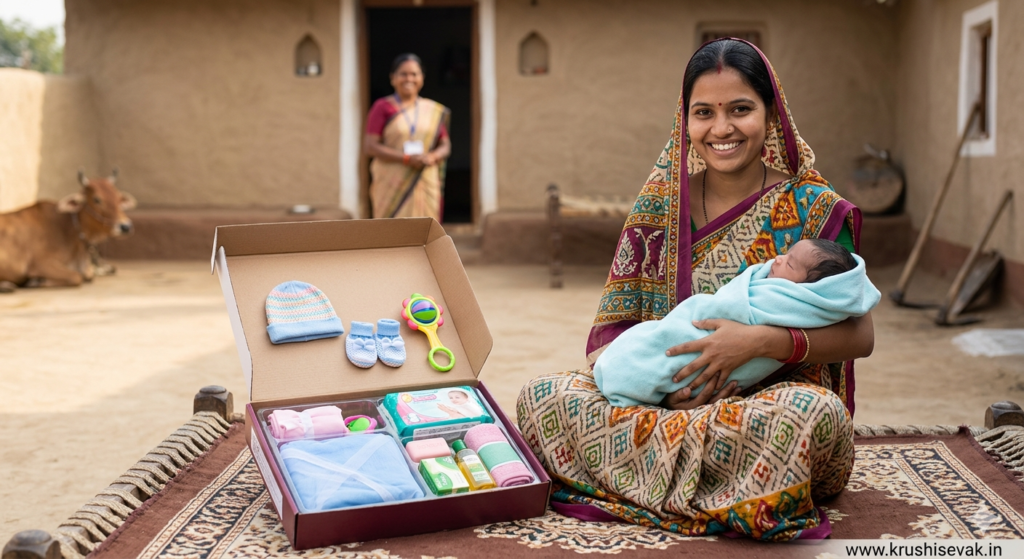
The scheme provisions a thoughtfully packaged assortment divided into two dedicated segments—one for the recovering mother and one for the protection and hygiene of the newborn.
A. Items for the Mother
This part of the kit focuses on nutritional recovery, thermal comfort, and personal hygiene:
| Category | Item Name | Quantity Provided |
|---|---|---|
| Nutrition | Dry Dates (Chhuara) | 500 Grams |
| Nutrition | Almonds (Badam) | 250 Grams |
| Cooking/Nutrition | Mustard Oil | 0.5 Litre |
| Apparel | Warm Shawl | 1 Piece |
| Apparel | Socks | 2 Pairs |
| Bedding | Bedsheets (with Pillow Covers) | 2 Pieces |
| Hygiene | Sanitary Napkins | 2 Packets |
| Hygiene | Bathing Soap | 4 Pieces |
| Hygiene | Laundry Soap | 4 Pieces |
| Hygiene | Towel | 1 Piece |
| Grooming | Nail Cutter | 1 |
B. Items for the Newborn Child
This segment includes clothing, bedding, and gentle skincare essentials tailored for early infant care:
- Clothing: 2 pairs of warm clothes alongside protective infant head caps and socks.
- Bedding & Protection: 1 warm baby blanket, 2 soft baby towels, and 1 protective rubber sheet.
- Hygiene & Diapering: 12 reusable cotton napkins (cloth diapers) and 10 single-use baby diapers.
- Infant Skincare: 3 bars of mild baby soap, 1 bottle of baby oil, 1 pack of baby powder, and 1 tube of baby cream.
Required Documents for Application
To verify eligibility and ensure that the welfare package reaches the genuine beneficiary, the following valid documents must be submitted digitally or physically:
- Identity & Residency Proof: Aadhaar Card of the mother (and preferably linked mobile number) along with the husband’s Aadhaar card.
- Domicile Status: Certificate proving permanent residence in the respective state.
- Maternal Health Record: Mother-Child Protection Card (MCP Card / MAMTA Card / Mother-Child Tracking register).
- Delivery Proof: Institutional Delivery Certificate or hospital discharge receipt confirming a safe, clinical birth.
- Income Proof: Certificate validating that the family does not exceed the threshold limit and does not pay income tax.
- Anganwadi Verification: A certificate or endorsement slip signed by the local Anganwadi Worker (AWW).
Step-by-Step Application Process
The administration has transitioned this program onto streamlined portals to increase transparency and eliminate middleman delays. The distribution pipeline operates through integrated grassroots channels:
#### Step 1: Preliminary Registration
During pregnancy, the woman must visit her local Anganwadi Centre or connect with her area’s ASHA/ANM worker. The ASHA worker registers the expecting mother immediately following her first Antenatal Care (ANC) checkup.
#### Step 2: Accessing the Online Portal
Once institutional delivery is complete, the applicant, a family member, or the designated Anganwadi Worker logs into the state’s dedicated Women and Child Development welfare portal (such as wecdukschemes.in).
#### Step 3: Data Entry and Document Upload
- The personal information, Aadhaar numbers, and residential coordinates are accurately filled out.
- Scanned copies of the institutional delivery receipt, MAMTA card, income declaration, and Anganwadi certificate are uploaded.
#### Step 4: Verification & Distribution
The submitted files undergo verification by the Women and Child Development Department authorities. Once approved, the physical Mahalakshmi Kit is dispatched to the beneficiary’s respective Anganwadi Centre, where it is formally handed over to the mother.