
Introduction
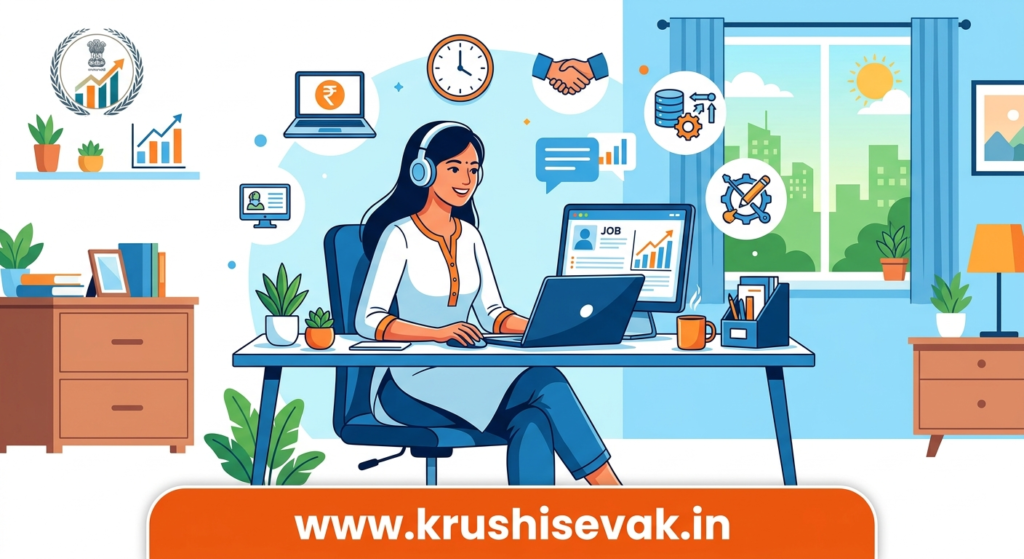
Empowering women and integrating them into the formal economy remains one of the defining goals of modern governance. While traditional employment models demand a physical presence in an office, personal responsibilities, safety concerns, and geographic restrictions often limit women from pursuing these roles. Recognizing these roadblocks, the Government of Rajasthan pioneered a unique and progressive initiative: the Mukhyamantri Work From Home – Job Work Yojana.
As we progress through 2026, this flagship initiative has scaled significantly to accommodate the evolving digital landscape and employment market. Designed primarily for women who cannot step outside their homes due to familial, social, or physical constraints, the program acts as a bridge between skilled female professionals and private/public sector organizations. This comprehensive guide outlines everything you need to know about the scheme in 2026, including its key objectives, target beneficiaries, core sectors, detailed online application process, and required documentation.
Key Highlights of Mukhyamantri Work From Home Yojana 2026
Before diving deep into the programmatic specifics, let us look at an analytical summary of the scheme:
| Feature | System Matrix / Scheme Details |
|---|---|
| Name of the Scheme | Mukhyamantri Work From Home – Job Work Yojana |
| Nodal Department | Department of Women Empowerment, Rajasthan |
| Target Beneficiaries | Female residents of Rajasthan (18+ years) |
| Primary Goal | Providing remote, flexible, and skill-based livelihood opportunities |
| Priority Categories | Widows, divorcees, abandoned women, victims of domestic violence, and specially-abled women |
| Application Mode | Online via the official integration portal / SSO ID |
| Financial Assistance/Incentives | Financial incentives of up to ₹3,000 for private companies training employees; direct wages via DBT |
Core Objectives of the Yojana
The fundamental concept behind the Mukhyamantri Work From Home Yojana revolves around economic self-reliance without uprooting women from their comfortable domestic settings. The primary objectives include:
- Enhancing the Female Labor Force Participation Rate (LFPR): Historically, female labor participation rates have lagged behind male counterparts. This initiative opens virtual avenues to actively bridge that gap.
- Economic Independence: Giving women the financial autonomy to contribute to their household expenditures, finance their children’s education, and build savings.
- Utilizing Dormant Skills: Millions of women across the state hold degrees in technology, finance, education, and healthcare but leave the workforce post-marriage or childbirth. The program re-mobilizes this talented talent pool.
- Social Security Net: By prioritizing vulnerable demographics like widows, single mothers, and victims of abuse, the government creates a safety net where these women can rebuild their lives securely from home.
Structural Framework: Sectors and Department Opportunities
The scheme does not limit remote work to basic data manipulation. It features cross-departmental coordination involving multiple corporate networks and government cells. This provides specialized remote jobs across various educational and technical proficiencies:
1. Information Technology & Communication (IT&C)
For women with tech backgrounds, engineering degrees, or certificates in computer science, this sector provides highly technical and standard digital roles:
- Software Development and Application Testing.
- Database Management and Analytics.
- Website Designing, UI/UX optimization, and ongoing maintenance.
- Content Writing, Translation Services, and Digital Marketing support.
2. Education Sector
Leveraging the pedagogical skills of qualified female teachers, lecturers, and graduates who are currently unemployed:
- Online tutoring, evaluation, and creating study materials.
- Stitching and production coordination of school uniforms (often outsourced as offline job-work to rural women collectives).
- Managing school databases and curriculum entry systems.
3. Healthcare Sector
Medical fields are integrated to offer telehealth solutions and operational support:
- Digital medical consultations by qualified female practitioners and AYUSH practitioners.
- Medical transcription and management of digital patient logs.
- Production and supply coordination of hospital linen and apparel via self-help groups (SHGs).
4. Finance & Accounting
For women with degrees in commerce, economics, business management, or certified qualifications like CA/ICWA:
- Bookkeeping and managing public sector accounting logs.
- Auditing support services for regional institutions.
- Data compilation for financial planning and state schemes.
5. Social and Household Counseling
Managed largely through the Department of Women Empowerment, this framework employs women to conduct remote psychological counseling, maternal advice, and government scheme awareness outreach right from their homes.
Comprehensive Eligibility Criteria for 2026
To keep the system highly targeted and ensure resources reach the citizens who need them most, the state government enforces clear eligibility parameters:
- Domicile Rule: The applicant must be a permanent resident/bonafide citizen of Rajasthan. Applicants from other states are strictly ineligible.
- Gender: The scheme is exclusively designed for female applicants.
- Age Limit: The minimum age requirement is 18 years. There is generally no strict upper limit, provided the candidate is physically and mentally fit to handle the digital work.
- Skill Prerequisites: While the scheme welcomes both freshers and experienced professionals, candidates must possess basic knowledge or relevant educational certifications matching the job role they apply for.
- Priority Metric: The portal prioritizes specific vulnerable profiles automatically when reviewing applications. These groups include:
- Widows
- Divorced or legally abandoned women
- Victims of domestic violence or social harassment
- Specially-abled (Divyangjan) women
- Aadhaar Card: For primary identity verification.
- Jan Aadhaar Card/Number: The essential unified family database number utilized across Rajasthan for verified direct benefit delivery.
- Domicile Certificate (Mool Niwas Praman Patra): To validate residency status.
- Age Proof Document: Birth certificate, Class 10 mark sheet, or any official identification showing date of birth.
- Educational Marksheets & Certificates: High school, Intermediate, Graduation, Post-Graduation, or specialized technical training diplomas.
- Work Experience Documents (If applicable): Appointment letters, relief letters, or experience certificates from previous employers.
- Special Category Certificate (Where applicable):
- Death certificate of the husband (for widows).
- Legal divorce decree/documents (for divorced/abandoned statuses).
- Disability certificate issued by a competent medical board (for specially-abled women).
- Active Mobile Number & Email ID: Critical for receiving login OTPs, system intimations, and interview links.
- Passport-Sized Photograph: Recent clear image for user profile generation.
- Personal and Category Details: Confirm your demographic metrics and select special categories if applicable (e.g., Widow, Divorced).
- Educational Matrix: Input your exact educational scores and university details. Scan and upload matching mark sheets.
- Skills & Experience Portfolio: Select your domains of expertise (e.g., Data Entry, Content Writing, Stitching, Coding) and attach proofs of work or previous experience certificates.
[Online Application Submitted]
│
▼
[Document Verification by Nodal Officer]
│
▼
[Skill Matching & Employer Screening]
│
▼
[Short Interview / Assessment (If required)]
│
▼
[Final Selection & Offer Letter Issuance]
- Data Scrutiny: The application passes to the Nodal Officers under the Department of Women Empowerment for document verification.
- Employer Shortlisting: Private corporations and government partners access lists of eligible candidate profiles whose skills match their business needs.
- Interviews and Selection: For technical or financial roles, companies may hold short online screening tests or virtual video interviews.
- Training Period: Once selected, if the job role requires system training, corporations provide structured onboarding. The government supports this phase by offering financial training incentives directly to private units to offset the costs of upskilling the women candidates.
- Direct Benefit Transfer (DBT): All salary payments, work-from-home compensation, and training stipend credits clear directly into the bank account linked with the candidate’s Jan Aadhaar number.
Corporate and Institutional Benefits: Partnering with the Scheme
The success of the Mukhyamantri Work From Home Yojana relies heavily on building a robust ecosystem between the government and private enterprises. To incentivize corporations to list remote roles on the portal, the state offers several corporate perks:
- Financial Onboarding Incentives: For any private business offering legitimate remote employment options with monthly payouts exceeding ₹5,000, the state provides a direct financial training incentive of ₹3,000 per female trainee.
- Free Media and Corporate Publicity: The state actively highlights businesses employing large volumes of female professionals under this yojana across official press releases and promotional portals, boosting the enterprise’s corporate social responsibility (CSR) standing.
- Pre-Vetted Talent Pool: Companies save significant human resource screening costs, as they gain immediate access to an organized database of educated, localized professionals categorized by skill and experience level.