
While traditional investment portfolios heavily emphasize equities, bonds, real estate, and digital assets, savvy investors are increasingly diversifying into alternative tangible assets. Timber farming—the deliberate cultivation, management, and harvesting of forest trees for commercial timber production—stands out as one of the oldest yet most resilient asset classes available.
Unlike annual crops, timber farming operates on long-term biological timelines. It offers a unique intersection of low correlation to volatile public stock markets, built-in protection against inflation, and clear environmental, social, and governance (ESG) advantages.
1. The Core Investment Thesis of Timber
Investing in timber differs fundamentally from almost any other financial asset because its primary value driver is biological growth. Trees grow regardless of macroeconomic recessions, Wall Street fluctuations, or geopolitical conflicts.
Biological Growth as a Wealth Accumulator
In a typical timber investment, trees grow in volume and value over time. A unique feature of this asset class is its price-size relationship. As a tree gets older and larger, its volume doesn’t just increase linearly; its economic classification upgrades.
Small, young trees are harvested as low-value pulpwood used for paper. As they grow into mid-sized logs, they are classified as chip-and-saw timber. Finally, when they reach mature diameters, they become premium sawtimber or veneer logs used in high-end construction and furniture. Thus, biological growth exponentially multiplies the asset’s dollar value.
Market Flexibility (Storage on the Stump)
One of the greatest risks in traditional agriculture is that crops must be harvested and sold immediately upon maturity, regardless of current market prices. Timber farming solves this problem through a mechanism called “storage on the stump.”
If global timber prices crash during an economic downturn, a timberland owner can simply choose not to harvest. The trees do not rot or spoil; they remain safely rooted in the ground, continuing to grow and accumulate volume while waiting for market prices to recover.
Inflation Hedging and Low Correlation
Historically, timberland has shown a strong positive correlation with inflation. Because wood is a foundational material for housing, infrastructure, and packaging, its price tends to rise alongside consumer price indices. Furthermore, timber returns have historically demonstrated low correlation with equities and bonds, making it an excellent diversifier to smooth out overall portfolio volatility.
2. Species Selection and Rotation Cycles
The success of a timber investment depends heavily on selecting the right tree species. This choice determines your initial capital requirements, the geographic region for your operations, and the length of your investment horizon (rotation cycle).
Short-Rotation Timber (Fast-Growing Species)
- Species: Eucalyptus, Poplar, Bamboo, Malabar Neem (Melia dubia), and Willow.
- Rotation Cycle: 5 to 10 years.
- End-Use Market: Predominantly harvested for the pulp and paper industries, engineered plywood cores, biomass pellets, and structural poles.
- Investment Profile: This option provides faster liquidity and quicker cash flow distributions, making it highly attractive for private individual investors or corporate entities looking for shorter investment horizons.
Medium-Rotation Timber (Softwoods)
- Species: Loblolly Pine, Radiata Pine, Slash Pine, and Douglas Fir.
- Rotation Cycle: 20 to 30 years.
- End-Use Market: Structural lumber, dimensional construction timber, framing, and medium-density fiberboard (MDF).
- Investment Profile: This is the bedrock of institutional timber investing, commonly utilized by Timberland Investment Management Organizations (TIMOs) and Real Estate Investment Trusts (REITs). It involves systematic silvicultural management, including periodic thinning cycles that yield interim cash flows.
Long-Rotation Timber (Hardwoods and Luxury Woods)
- Species: Teak, Oak, Walnut, Mahogany, Cherry, and Red Sanders.
- Rotation Cycle: 30 to 60+ years.
- End-Use Market: Luxury furniture, premium interior flooring, marine decking, musical instruments, and high-end architectural veneers.
- Investment Profile: This category requires significant patience and high upfront capital, but it yields the highest profit margins per cubic meter. It serves as an excellent multigenerational wealth transfer vehicle.
3. Silvicultural Management: The Lifecycle of a Timber Farm
A successful timber farm requires active, scientific management to maximize tree health and structural timber quality.
Phase 1: Site Preparation and Establishment (Year 0)
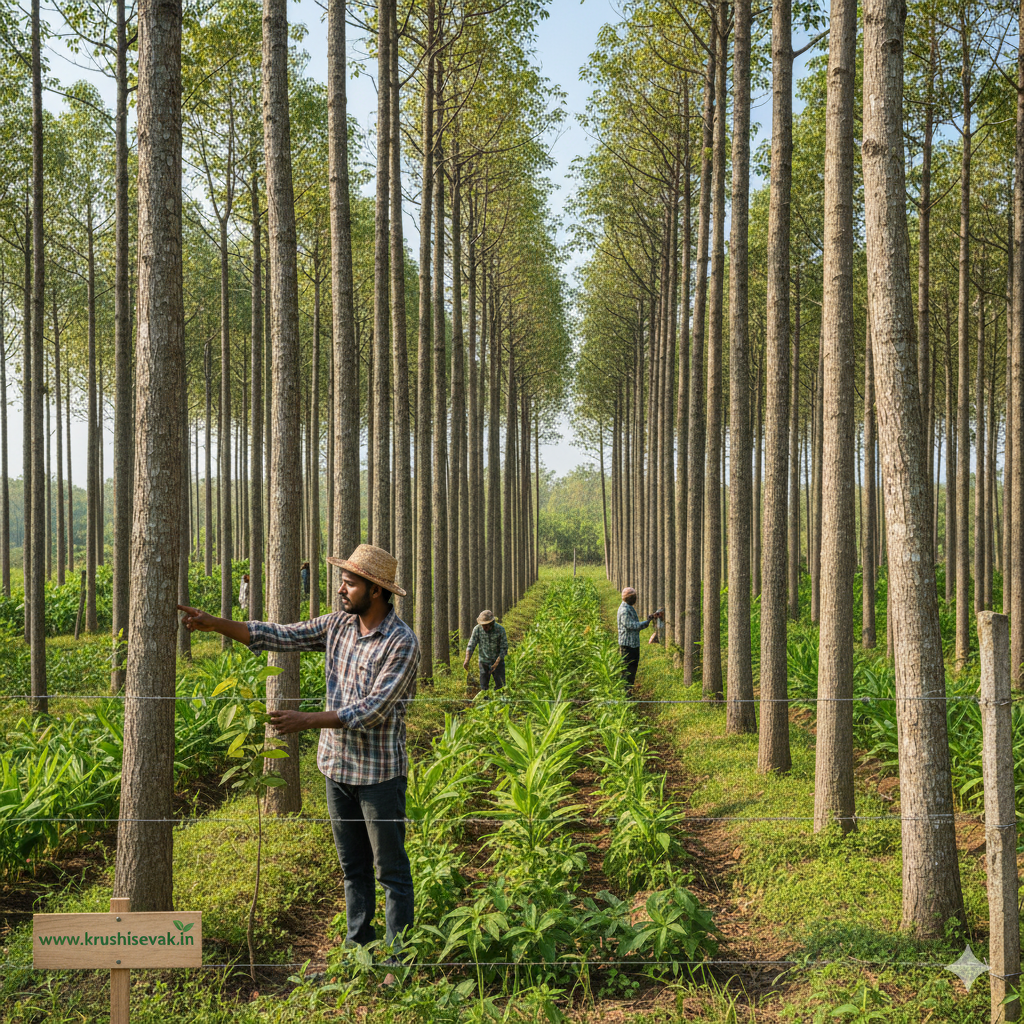
The lifecycle begins with thorough site preparation. This involves clearing competing wild vegetation, tilling or bedding the soil to enhance root aeration, and implementing drainage systems if necessary. High-quality, genetically superior seedlings are then planted at precise spacing patterns (e.g., a 10 \times 10 foot grid) to ensure optimal access to sunlight and soil nutrients.
Phase 2: Competition Control and Early Maintenance (Years 2 to 5)
During the first few years, young saplings are highly vulnerable to being choked out by faster-growing weeds and brush. Managers apply targeted, eco-friendly herbicides or utilize manual weeding and mulching. Pruning lower branches during this phase is also critical for hardwood species; it forces the tree to grow upward without knots, producing clean, straight, premium logs.
Phase 3: Commercial and Non-Commercial Thinning (Years 12 to 22)
As the forest canopy closes, trees begin to compete intensely with one another for sunlight and water, which slows down their overall growth rate. To solve this, managers perform periodic “thinning” cycles:
- First Thinning (Around Year 12 to 15): The lowest-quality, crooked, or stunted trees are removed, reducing the stand density by roughly 30% to 50%. These removals are sold as pulpwood, generating an interim cash flow that often covers previous management costs.
- Second Thinning (Around Year 18 to 22): Another round of selective logging removes mid-sized trees, which are sold into chip-and-saw markets. The remaining trees now have maximum space, sunlight, and nutrients to rapidly put on diameter.
Phase 4: Final Harvest / Clear-Cutting (Years 25 to 30+)
Once the remaining crop reaches full physiological maturity and enters the premium sawtimber class, the final clear-cut harvest is executed. Loggers harvest the entire stand, and the timber is sorted by grade on-site before being trucked to regional sawmills. The land is then cleared, prepared, and replanted, kicking off the next investment cycle.
4. Financial Architecture: Investment Vehicles, Costs, and Returns
Timber investments can be structured in several ways depending on an investor’s available capital, risk tolerance, and time horizon.
Directly Purchasing Timberland
High-net-worth individuals or family offices can directly purchase physical timber tracts. This approach grants complete operational control over management choices, harvesting schedules, and alternative land uses (such as leasing hunting rights or selling conservation easements). However, it requires significant capital and specialized forestry expertise.
Timberland Investment Management Organizations (TIMOs)
TIMOs act as specialized investment managers that source, acquire, and manage large-scale timberland portfolios on behalf of institutional investors, such as pension funds and university endowments. They typically require a high minimum investment (often upwards of $1 million to $5 million) and lock up capital for 10 to 15 years.
Timber Real Estate Investment Trusts (REITs)
For retail investors seeking everyday liquidity, publicly traded Timber REITs own and manage vast swaths of forestland. Investors can buy and sell shares instantly on major stock exchanges, enjoying regular dividend payouts derived from timber sales without needing a massive upfront capital layout.
Cost Structure Breakdown
- Capital Expenses (CapEx): Land acquisition costs, initial site clearing, infrastructure setup (building access roads and firebreaks), and purchasing high-yield seedlings.
- Operating Expenses (OpEx): Annual property taxes, forest management fees, insurance premiums, fire protection measures, and ongoing pest/weed control.
- Harvesting and Logistics Costs: Professional forestry consulting fees, logging crew wages, and flatbed transportation costs to local sawmills.
5. Risk Factors and Mitigation Strategies
While timber is generally a stable and predictable asset class, it is not completely risk-free. Successful timber farmers must actively identify and mitigate several environmental and economic risks.
Physical and Natural Perils
- Forest Fires: A single wildfire can devastate decades of biological growth in a matter of hours.
- Mitigation: Establish comprehensive, wide dirt firebreaks around and throughout the property. Perform regular understory clearing, and secure specialized standing-timber insurance policies.
- Pests and Disease: Outbreaks of insects like the Southern Pine Beetle or fungal infestations can sweep through monoculture tree farms.
- Mitigation: Avoid monocultures where feasible by maintaining natural buffer zones. Prioritize planting genetically resilient, disease-resistant seedling varieties, and conduct regular drone-based health monitoring.
- Extreme Weather: Hurricanes, ice storms, and severe tornadoes can cause widespread windfall damage.
- Mitigation: Diversify timberland portfolios across distinct geographic regions and weather zones.
Market and Liquidity Perils
- Illiquidity: Physical timberland is a highly illiquid asset that can take months or even years to sell at a fair market valuation.
- Mitigation: Only invest capital that you do not need access to for the short or medium term. Alternatively, utilize Timber REITs to maintain liquidity.
- Monopsony Risk (Local Mill Dependence): Because logs are heavy and expensive to transport, your target market is usually limited to sawmills within a 50-to-100-mile radius. If the closest local sawmill closes, your transportation costs will rise significantly.
- Mitigation: Before purchasing land, conduct thorough due diligence to verify that multiple active, competitive mills operate nearby.
6. The Modern Catalyst: Carbon Credits and the Green Economy
In the modern economic landscape, timber farming is no longer valued solely for the physical wood it produces. The rise of environmental markets has created entirely new revenue streams for timberland owners.
Carbon Sequestration and Carbon Offsets
Growing trees act as highly efficient natural carbon sinks, absorbing carbon dioxide (CO_2) from the atmosphere and storing it safely within their biomass. Under modern carbon offset frameworks, timberland owners can enroll their forests into voluntary or compliance carbon markets.
By committing to Improved Forest Management (IFM) practices—such as extending harvest rotation cycles or delaying clear-cuts—owners generate verified carbon credits. These credits can then be sold to corporations looking to offset their carbon footprints, creating a steady stream of annual income without cutting down a single tree.
Biomass and Wood-Based Bioplastics
As global industries shift away from fossil fuels and single-use plastics, the demand for renewable wood fiber is accelerating. Modern timber farms supply raw feedstocks for next-generation biomass energy generation, cross-laminated timber (CLT) for eco-friendly high-rise construction, and wood cellulose used to manufacture biodegradable bioplastics and textiles.
Conclusion
Timber farming represents a premier long-term investment strategy for patient, forward-thinking investors. By anchoring a portfolio to the predictable, compounding law of biological growth, timber insulates capital from the erratic highs and lows of the broader financial markets.
While it demands a disciplined timeline, careful silvicultural oversight, and proactive risk management, the structural advantages of timber farming are clear. It provides predictable cash flows through thinning, steady asset appreciation through growth, and flexible harvesting timelines. Combined with modern opportunities in carbon credits, timber farming is uniquely positioned to deliver both robust financial returns and positive environmental impact for generations to come.