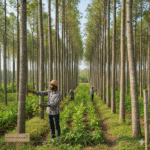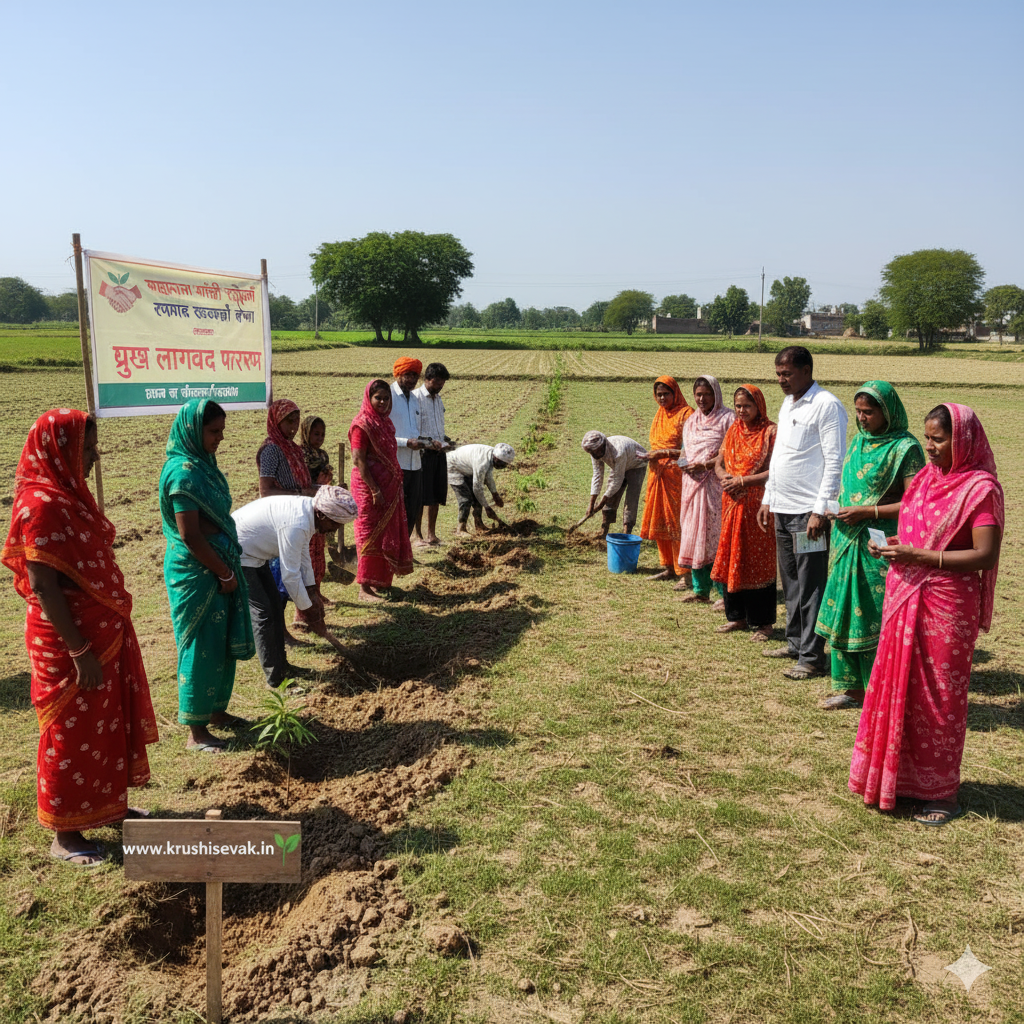

The Mahatma Gandhi National Rural Employment Guarantee Act (MGNREGA), enacted by the Government of India, is widely recognized for its dual focus on providing livelihood security to rural households and building durable community infrastructure. Among the most transformative initiatives permitted under the Act is the Tree Plantation Scheme.
This multi-faceted scheme aims to reverse environmental degradation, mitigate the impacts of climate change, and create recurring, sustainable income sources for small and marginal farmers, vulnerable families, and local communities. By combining rural asset creation with ecological conservation, the program transforms fallow, degraded lands into productive green zones.
1. Objectives of the MGNREGA Tree Plantation Scheme
The Tree Plantation Scheme is systematically built to achieve both environmental resilience and economic empowerment in rural areas.
- Livelihood Generation and Asset Creation: The scheme pays direct wages to job card holders for planting activities. Over the long term, fruit-bearing or timber trees serve as a permanent income-generating asset for individual or community owners.
- Enhancing Green Cover: The scheme focuses on afforestation and agroforestry to reclaim degraded or fallow lands, combat desertification, and help achieve India’s national climate goals.
- Soil and Water Conservation: Tree roots stabilize local soil, reducing topsoil erosion caused by heavy rains. Planting trees along canal bunds and water bodies also improves groundwater recharge.
- Fostering Biodiversity: By prioritizing native, region-specific saplings, the scheme establishes micro-ecosystems that support local wildlife, pollinators, and beneficial microorganisms.
2. Permissible Categories of Plantation Works
MGNREGA classifies plantation projects into specific categories based on land ownership and layout to maximize economic returns and environmental benefits.
Individual Beneficiary Land Plantation (Agro-Forestry & Horticulture)
This sub-scheme allows small-scale and marginal farmers to convert portions of their personal farmland or fallow homesteads into orchards or timber plots.
- Permissible Area: Ranges from a minimum of 0.25 acres up to a maximum of 5 acres per household or job card.
- Focus: Perennial horticulture fruit crops such as Mango, Cashew, Guava, Sapota, Coconut, Tamarind, Pomegranate, and Jamun. High-yield multi-purpose trees like Moringa (drumstick) are also promoted.
Avenue / Roadside Plantation
Trees are planted linearly on both sides of public rural roads, state highways, and national highway margins running through rural sectors.
- Focus: Shade-giving, resilient, and non-browsable species (trees that cattle do not graze on) such as Neem, Tamarind, Mahogany, and Gulmohar.
Bund Plantation (Field Boundary Planting)
This category enables farmers to grow high-value timber or medicinal trees along the existing boundary walls or mud bunds of their active agricultural fields without sacrificing core crop acreage.
- Focus: Structural or commercial wood species like Teak, Red Sanders, Malabar Neem, or Bamboo.
Community / Block Plantation on Public Lands
Targeted at village common lands, revenue wastelands, panchayat bhawan parameters, burial grounds, school campuses, and tank foreshores.
- Focus: A mix of dense community orchards, medicinal plants, and traditional deep-rooted trees like Banyan or Peepal to enhance local biodiversity and village infrastructure.
3. Financial and Funding Architecture
The financial structure of the MGNREGA Tree Plantation Scheme relies on a strictly monitored funding split and performance metrics.
Wage and Material Ratio
Following standard MGNREGA mandates, the funding pattern maintains a healthy balance between manual labor and material expenses across the district:
- 100% Central Funding for Unskilled Labor: Wages for activities like site clearance, digging pits, mixing manure, and watering are covered completely by the Central Government.
- 75:25 Shared Material Component: Costs for procurement of high-yielding saplings, organic manure, bio-pesticides, and tree guards are shared between the Central and State Governments on a 75:25 ratio.
Multi-Year Maintenance Support
Unlike infrastructure works that conclude upon physical structural completion, tree plantation is a dynamic, long-term commitment.
Important Rule: MGNREGA funds maintenance activities (weeding, mulching, watering, and replacing dead saplings) for up to 3 to 5 years post-plantation, ensuring high plant survival rates.
The Survival Metric for Direct Benefit Transfer (DBT)
For individual land plantations, financial subsidies or maintenance wages are linked directly to plant survival. Beneficiaries must maintain a minimum plant survival rate of 80% at the end of the first year and 90% by the end of the second year to remain fully eligible for subsequent maintenance payouts via Direct Benefit Transfer.
4. Eligibility Criteria for Beneficiaries
While community land plantations benefit the entire village, individual land plantation schemes prioritize vulnerable and historically marginalized rural households.
- Valid Job Card: The applicant household must possess an active, verified MGNREGA Job Card issued by the local Gram Panchayat.
- Target Groups: Primary preference is allocated to:
- Scheduled Castes (SC) and Scheduled Tribes (ST) households.
- Nomadic tribes and denotified communities.
- Women-headed households.
- Persons with disabilities (specially-abled heads of families).
- Small and marginal farmers as defined by agricultural land ceilings.
- Beneficiaries of rural housing schemes (e.g., Pradhan Mantri Awas Yojana).
- Clear Land Title: For individual schemes, the farmer must hold clear, undisputed land possession documents (7/12 extract, 8-A document, or local land patta) indicating that the land is free of litigation.
Step 1: Document Preparation and Application Submission
The interested applicant must collect a physical plantation application form from the Gram Panchayat office or download it from their respective State’s online DBT/MGNREGA portal. Fill in personal details, choice of plant species, and total target land area. Attach the required documentation:
- A photocopy of the active MGNREGA Job Card.
- Aadhar Card copy (linked securely to a bank account).
- Land ownership certificates (7/12, 8-A, or mutation copy).
- Soil suitability certificate (if mandatory in the specific district).
Step 2: Deliberation and Passing of the Gram Sabha Resolution
Every proposed plantation project—individual or community—must be presented before the Gram Sabha during its planning meetings (usually held before August 15th for the upcoming fiscal cycle). The Gram Sabha compiles these proposals into the annual Annual Action Plan (AAP) and passes an official resolution authorizing the work.
Step 3: Technical Inspection and Administrative Sanction
Once included in the AAP, the Junior Engineer (JE) or Technical Assistant (TA) assigned to the block visits the proposed site. They verify land boundaries, cross-check the feasibility of the selected plant species against regional agro-climatic conditions, and draw up a detailed technical layout plan and monetary cost estimate. This estimate is uploaded to the central NREGASoft portal to generate the formal Technical Sanction (TS) and Administrative Sanction (AS).
Step 4: Generation of Muster Roll and Project Execution
After receiving approvals, the Program Officer (PO) issues a unique Work ID and activates the electronic Muster Roll (e-MR). The Gram Panchayat allocates unskilled work days to the job card holders to begin clearing the site, digging pits, and initiating the plantation workflow.
7. Monitoring, Transparency, and Social Audits
To maintain public transparency and eliminate corruption, the plantation scheme uses modern digital tracking tools.
- Geo-Tagging (GeoMGNREGA): Every single plantation plot or avenue line undergoes multi-stage mandatory geo-tagging via mobile applications. Photos of the site are captured and uploaded before work begins, during the active planting phase, and annually to monitor plant growth and survival rates.
- Citizen Information Boards: At every community or large-scale block plantation site, a permanent 3 \times 4 feet information board must be constructed. This board displays the project name, unique Work ID, total estimated cost, allocation of labor vs. material expenses, and the total names of the targeted beneficiaries.
- Mandatory Social Audits: Section 17 of the MGNREGA Act requires regular, independent public social audits. The local community inspects the muster rolls, verifies worker attendance logs, evaluates physical plant survival on-site, and matches expenditures against ground-level results to ensure absolute accountability.
By carefully following this process, rural households can leverage the MGNREGA Tree Plantation Scheme to transform their underutilized land into a dependable source of green income, paving a sustainable path toward regional economic stability.