
The cashew nut (Anacardium occidentale) is one of the most premium and sought-after agricultural commodities globally. Moving far beyond its traditional identity as a simple party snack, the cashew has established itself as a cornerstone of the modern plant-based movement, finding massive utility in vegan dairy alternatives, confectionery, cosmetics, and gourmet culinary applications.
Setting up a cashew processing unit represents a highly lucrative agro-based industrial opportunity. However, turning raw cashew nuts (RCN) into export-grade, edible kernels is a delicate, multi-step process that requires careful structural planning, precise technical knowledge, and strategic financial architecture. This comprehensive guide details the technical, operational, logistical, and financial blueprint required to establish and run a successful commercial cashew processing facility.
1. Market Dynamics and Industry Potential
Before laying down the bricks of a processing plant, it is vital to understand the market ecosystem. The global cashew market is characterized by a unique geographical divide: the vast majority of raw cashew nuts are grown in West Africa and parts of Southeast Asia, while processing hubs have historically been concentrated in countries like India and Vietnam.
Drivers of Market Demand
- The Plant-Based Revolution: The explosion of veganism has turned cashews into a critical raw material for manufacturing plant-based milk, vegan cheeses, spreads, and butter due to their high fat content and neutral, creamy texture.
- Snacking Trends: Consumers are shifting heavily toward healthy, nutrient-dense snack options. Cashews are packed with monounsaturated fatty acids, magnesium, vitamins, and plant proteins.
- By-Product Utilization: The economic viability of a cashew plant is significantly enhanced by its by-products. The cashew shell contains Cashew Nut Shell Liquid (CNSL), a valuable industrial raw material used in manufacturing brake linings, paints, resins, and laminated products.
2. Technical Blueprint: The Processing Methodology
Processing raw cashew nuts is a highly sophisticated mechanical and thermal exercise. The primary objective is to extract the delicate whole kernel from its tough, corrosive outer shell without causing damage or breakage, as whole kernels command a massive premium over broken pieces.
Phase 1: Raw Material Procurement and Sun Drying
The journey begins with the sourcing of Raw Cashew Nuts (RCN). Freshly harvested raw nuts possess a high moisture content, hovering between 15% to 20%. If stored directly in this condition, the nuts will rot, develop fungal mold, or suffer internal spoilage.
- Process: The raw nuts are spread out evenly on large concrete drying yards under direct sunlight for two to three days.
- Objective: This sun-drying process reduces the moisture content to a safe level of 8% to 10%.
- Storage: Once dried, the RCN are packed into gunny bags and stored in well-ventilated, moisture-free warehouses. Properly dried RCN can be stored safely for up to a year, ensuring a steady supply for the factory even during the off-season.
Phase 2: Steam Cooking (Conditioning)
The raw cashew shell is incredibly hard and contains a hazardous, caustic liquid called CNSL. Direct cracking of a raw nut is impossible without damaging the inner kernel and contaminating it with this corrosive fluid.
- Process: The sun-dried nuts are loaded into a vertical steam boiler or autoclave. They are subjected to steam cooking under a pressure of 4 to 5 kg/cm² for a duration of 20 to 30 minutes.
- Objective: Steaming expands the outer shell, softening it slightly, and coaxes the internal kernel to shrink away from the inner shell wall. This makes the eventual separation significantly cleaner. After steaming, the nuts are allowed to cool down in the open air for 12 to 24 hours to stabilize.
Phase 3: Shelling and Cutting
This is the most critical stage where the processing facility’s efficiency is truly tested.
- Process: The conditioned nuts are fed into shelling machines. While manual foot-operated cutters were long preferred for minimizing breakage, modern units rely heavily on automatic mechanical shelling lines. These machines use precision-aligned dual blades to split the outer shell open longitudinally.
- Objective: To separate the outer shell from the inner kernel while maintaining the maximum percentage of “Wholes” (unbroken kernels). The detached shells are collected separately for CNSL extraction or utilized as boiler fuel within the plant.
Phase 4: Borma Drying (Kernel Baking)
At this stage, the recovered kernel is still clad in a thin, reddish-brown inner skin known as the testa. Furthermore, the kernel contains excessive internal moisture, making it pliable and leathery rather than crisp.
- Process: The unpeeled kernels are placed on large perforated trays and loaded into a specialized hot-air chamber known as a Borma dryer. The kernels are baked uniformly at temperatures ranging between 70°C and 80°C for approximately 6 to 8 hours.
- Objective: This intense thermal treatment serves a dual purpose. It reduces the moisture content of the kernel to an optimal 3% to 4%, giving it the desired shelf-life and crisp texture. Simultaneously, it causes the testa to become dry, brittle, and loose, making it incredibly easy to peel.
Phase 5: Peeling
Once the kernels emerge from the Borma dryer, they are left in a humidification room or allowed to cool slightly to stabilize.
- Process: The brittle testa is removed using pneumatic peeling machines. These machines use controlled, high-velocity blasts of compressed air to gently strip the flaky skin away from the smooth white kernel.
- Objective: To achieve completely clean, white cashew kernels. Any residual bits of skin left on the kernels are manually scraped off during quality check intervals.
Phase 6: Grading
The commercial value of the finished product is entirely determined by its grade. Cashews are categorized strictly according to international standards based on size, color, and structural integrity.
- Wholes: These are whole, unbroken kernels. They are designated by the letter ‘W’ followed by a number indicating how many kernels make up one pound (454 grams). For example, W180 (large and expensive, known as the “King of Cashews”), W210, W240, W320 (the global commercial standard), and W450.
- Brokens: Kernels that break during processing are sorted into categories such as Splits (halves cleaved longitudinally), Butts (halves broken crosswise), Large Pieces, and Small Pieces.
- Sorting Mechanism: Modern facilities utilize advanced electronic color sorters equipped with high-resolution cameras to categorize the kernels instantly by size and color gradient, eliminating manual errors.
Phase 7: Fumigation, Humidification, and Packaging
Before final sealing, the graded cashews must undergo specific preservation steps to ensure they survive long-distance transit.
- Fumigation: The sorted kernels are passed through a certified fumigation chamber to eradicate any potential insect eggs, larvae, or microbial contaminants.
- Humidification: Because Borma drying makes the nuts incredibly brittle, they are lightly exposed to a controlled humid environment right before packing. This restores a fractional amount of moisture (around 5%), rendering them elastic enough to withstand the vibrations of shipping without fracturing.
- Vita Pack System: The cashews are packed in multi-layered, flexible barrier pouches or tin containers. The air inside is completely evacuated and replaced with a gas flush of carbon dioxide (CO_2) and nitrogen (N_2) via a vacuum packaging machine. This prevents oxidation and rancidity, ensuring a shelf life of up to 24 months.
3. Infrastructure and Infrastructure Planning
The structural design of a cashew processing unit dictates its logistical efficiency and hygiene standards. Because this is a food-processing facility, the plant layout must comply with strict sanitary standards to prevent cross-contamination.
Plant Layout and Zoning Strategy
The plant layout must strictly follow a linear, one-way workflow. Raw, unwashed agricultural material must never cross paths with finished, sterilized food products.
- The Dirty Zone: Located at the front entrance of the facility. This includes the open concrete sun-drying yard, the raw cashew nut warehouse, and the steam boiling section. This zone deals with high dust, soot from boilers, and dirt from farm sacks.
- The Semi-Clean Zone: This encompasses the shelling room, the Borma drying section, and the mechanical peeling unit. It bridges the heavy industrial part of the plant with the food-handling part.
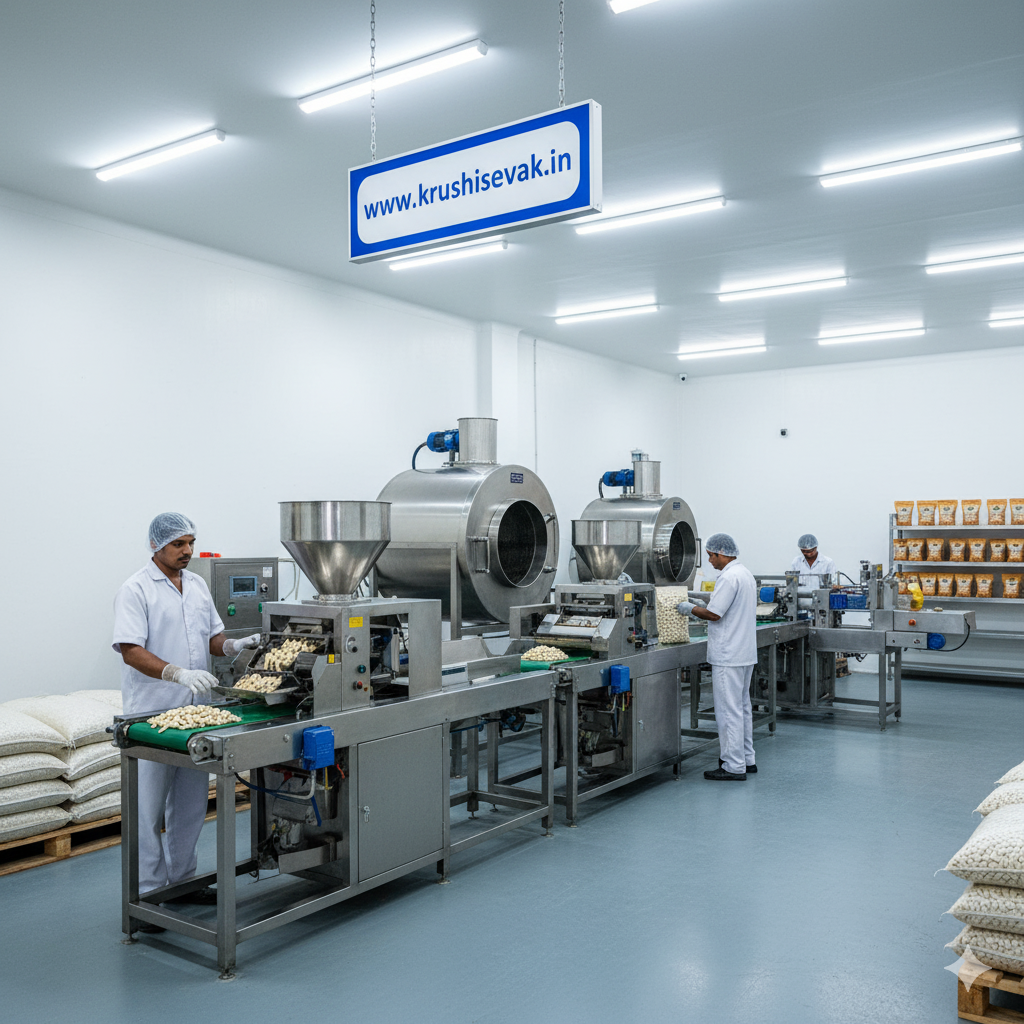
- The High-Care Clean Zone: This is a strictly controlled environment containing the grading lines, color sorters, manual inspection tables, and the final packaging unit. Employees entering this zone must undergo rigorous sanitization protocols, including hairnets, face masks, clean coats, and footwear changes. The air here should ideally be positive-pressured and air-conditioned to maintain low humidity levels.
Land and Building Requirements
To run a mid-sized cashew processing plant with an output capacity of approximately 2 to 5 metric tons of raw nuts per day, a total land area of 10,000 to 15,000 square feet is recommended. The built-up structure should cover around 5,000 to 7,000 square feet, strategically divided into:
- Raw Material Warehouse
- Steam Boiling Yard (outdoor or semi-enclosed shed)
- Main Processing Hall (Shelling, Peeling, Grading)
- Finished Goods Air-Conditioned Storage Room
- Administrative Office and Employee Amenities (washrooms, changing rooms)
Utility Requirements
- Power Supply: A commercial three-phase power connection ranging from 30 kW to 50 kW is required, depending on the scale of automation. A heavy-duty backup diesel generator (DG set) is mandatory, as any power failure mid-way through a Borma drying or steam-cooking cycle can ruin entire batches of product.
- Water Consumption: Water is primarily needed for the steam boiler and worker sanitation. A clean, treated water supply yields better boiler efficiency and prevents scale buildup in piping.
- Fuel Requirements: The steam boiler requires a fuel source. Fortunately, the discarded cashew outer shells obtained after the cutting stage can be recycled as excellent, high-calorific boiler fuel, significantly cutting down operational fuel costs.
4. Equipment and Machinery Selection
Investing in the right machinery is the line item that dictates whether a factory remains profitable or goes under. A prospective entrepreneur must choose between three operational formats: manual, semi-automatic, or fully automatic lines. For a modern, competitive setup, a semi-automatic or fully automatic configuration is highly recommended.
Core Machinery Checklist
- Steam Boiler and Cooking Vessels: A wood/shell-fired boiler capable of producing high-pressure steam, paired with food-grade stainless steel autoclaves.
- Automatic Shelling Machines: Multi-line automatic cutters fitted with adjustable sensor arrays to accommodate varying nut sizes without crushing the internal kernel.
- Borma Dryers (Steam or Electric Heated): Thermostatically controlled chambers with heavy insulation to minimize heat loss, complete with internal air-circulating fans for uniform drying.
- Pneumatic Peeling Line: Complete with an air compressor, receiver tank, and air dryers to strip the testa cleanly.
- Color Sorter and Grader: An optical sorting machine to sort wholes from pieces based on pre-programmed parameters.
- Heavy Duty Chamber Vacuum Packaging Machine: Capable of executing nitrogen flushing and impulse sealing.
5. Financial Architecture and Economic Feasibility
A cashew processing venture is highly capital-intensive, particularly from a working capital perspective. While fixed asset costs are predictable, raw material costs fluctuate wildly based on global harvest cycles.
Critical Operational Insight: Raw cashew nuts are highly seasonal, with harvests occurring over a 3-to-4 month window globally. However, your factory must run year-round to retain skilled labor and meet client delivery contracts. This means a substantial portion of your capital will be locked up in buying and storing massive volumes of raw materials during the harvest season.
Fixed Capital Expenditure (CapEx)
This involves one-time investments that form the baseline infrastructure of the company:
- Civil Structures: Construction of the factory shed, concrete drying yards, and specialized clean rooms.
- Plant and Machinery Procurement: The cost of buying, transporting, installing, and calibrating all production line machinery.
- Pre-Operative Expenses: Costs associated with licensing, legal fees, architecture consulting, trial runs, and initial marketing setups.
Operational Expenditure (OpEx) and Working Capital
These are the rolling costs required to keep the wheels of the factory turning month after month:
- Raw Material Cost: This will consistently represent 75% to 85% of your total recurring monthly expenses.
- Labor and Wage Structure: Cashew processing, even when automated, requires manual touchpoints—particularly for final sorting inspection and machine monitoring. Wages must account for skilled operators, production floor managers, and packaging hands.
- Utilities and Consumables: Electricity bills, backup fuel costs, packaging materials (nitrogen gas, multi-layer bags, cartons), and maintenance lubricants.
Revenue Model and Product Diversification
Profitability in this sector relies heavily on optimizing the product yield mix. The main revenue streams are:
- Premium Whole Kernels (W180 – W320): This is where your highest profit margins lie. These are targeted toward premium grocery chains, export markets, and high-end nut-mix manufacturers.
- Broken Kernels: Sold at a lower price point to the commercial baking, confectionery, ice cream, and chocolate manufacturing industries, or processed into cashew paste/butter.
- Cashew Nut Shell Liquid (CNSL): The liquid extracted from the discarded shells can be sold directly to chemical and industrial manufacturing plants, acting as an excellent secondary revenue stream that pads the unit’s net margins.
6. Regulatory Framework and Quality Compliance
Operating a food facility requires compliance with stringent regulatory standards to legally access domestic and global retail shelves.
- Food Safety and Standards: The facility must secure licensing from relevant national food safety authorities (e.g., FSSAI in India, FDA compliance for the US market, or EFSA for Europe). This involves designing the factory according to strict Good Manufacturing Practices (GMP) and Good Hygiene Practices (GHP).
- Hazard Analysis Critical Control Point (HACCP) & ISO 22000: Implementing an HACCP plan ensures that physical, chemical, and biological hazards are monitored at every stage of production—from checking raw nuts for aflatoxins to running finished kernels through industrial metal detectors before packaging.
- Environmental Clearances: Because the processing of cashew shells and the running of steam boilers can produce emissions, obtaining a clear ‘No Objection Certificate’ (NOC) from local Pollution Control Boards regarding air emissions and solid waste management is an absolute necessity.
7. Risk Management and Strategic Overview
Common Risk Factors
- Price Volatility: RCN prices can shift dramatically based on weather anomalies in key growing regions like Côte d’Ivoire or Vietnam. A sharp drop in the market price of finished kernels while you are holding expensive raw material inventory can crush profit margins.
- High Kernel Breakage Rate: Poorly calibrated machinery or inadequate steam conditioning can increase the percentage of broken kernels, turning a highly profitable batch into a break-even or loss-making enterprise.
Mitigating Strategies
To insulate your processing unit from market disruptions, establish direct relationships with farmer cooperatives in sourcing origins to secure consistent pricing. Invest heavily in training machine operators; a well-calibrated factory line that pushes the “Wholes” yield past 80% is inherently built to survive market downturns. Additionally, implement robust inventory tracking to ensure old stock is processed first, maintaining product freshness and preventing losses from rancidity.