
The Saakshar Bharat Mission (Saakshar Bharat Yojana) is one of the most significant adult education and literacy initiatives launched by the Government of India. Formulated on International Literacy Day, September 8, 2009, by the Department of School Education and Literacy under the Ministry of Human Resource Development (now the Ministry of Education), the scheme was designed to address a critical national challenge: adult illiteracy, particularly among women and marginalized communities.
While primary education initiatives like the Sarva Shiksha Abhiyan (now Samagra Shiksha) focused on checking the accretion of illiteracy at the childhood level, millions of adults who had missed the formal schooling loop due to socio-economic hardships remained structurally left behind. Saakshar Bharat was created to offer these adults a vital second chance at education. It aims to build a well-rounded literate society by combining functional literacy, formal basic education equivalency, vocational training, and ongoing educational pathways into a single program.
Vision and Primary Objectives
The core vision of Saakshar Bharat is to promote and strengthen adult education through a lifelong learning perspective, establishing a permanent, institutionalized framework parallel to the formal education system.
The scheme set out to achieve several key programmatic targets:
- Achieving High National Literacy: Raising the national literacy rate to 80% and significantly reducing regional, social, and gender imbalances.
- Narrowing the Gender Gap: Lowering the persistent disparity between male and female literacy rates to a gap of no more than 10 percentage points.
- Targeted Demographics: Focusing on 70 million non-literate adults aged 15 years and older. The program dedicated 60 million of these slots specifically to women.
- Social Equity Focus: Prioritizing structurally marginalized populations across rural areas, including Scheduled Castes (SCs), Scheduled Tribes (STs), Minorities, and other socio-economically disadvantaged groups.
Four Functional Pillars of the Scheme
The operational framework of Saakshar Bharat is built upon four clear, interlinked components designed to take a learner from absolute illiteracy to self-reliance.
1. Functional Literacy and Numeracy
This pillar focuses on imparting basic, practical skills in reading, writing, and micro-arithmetic. Learners are taught to read public signs, posters, and newspapers, write simple letters, and handle basic calculations like counting currency, calculating wages, and managing household or farm finances.
This component includes a heavy emphasis on financial and civic literacy, teaching adults about their fundamental constitutional rights, electoral processes, and how to access state welfare programs.
2. Basic Education Equivalency
Literacy is viewed as a starting point rather than an end destination. Saakshar Bharat establishes an equivalency framework in partnership with institutions like the National Institute of Open Schooling (NIOS) and State Open Schools.
Neo-literates who complete basic literacy courses can seamlessly enter formal education tracks, taking structured exams equivalent to Classes 3, 5, and 8. This provides a clear path back into mainstream education for individuals who dropped out early in life.
3. Vocational Skills Development (Skill Development)
To ensure the program directly supports rural livelihoods, it integrates with specialized training centers like the Jan Shikshan Sansthans (JSS). Non-literates and neo-literates receive practical, hands-on training in local trades, such as tailoring, carpentry, electronics repair, organic farming, candle-making, and food processing.
Linking literacy with economic productivity helps adult learners improve their employment opportunities, increase household incomes, and achieve true self-reliance.
4. Continuing Education for a Lifelong Learning Society
To prevent neo-literates from sliding back into illiteracy due to a lack of reading materials, the scheme sets up permanent village-level learning hubs known as Lok Shiksha Kendras (Adult Education Centers).
These centers serve as rural public libraries and community spaces, providing access to newspapers, magazines, brochures on modern farming techniques, and books on health, sanitation, and civic life. They also host community discussions, group reading sessions, and awareness campaigns.
Institutional Framework and Coverage Area
Saakshar Bharat was purposefully restricted to rural areas within districts that exhibited a low female literacy rate—specifically, districts where the adult female literacy rate was 50% or below according to the 2001 Census. This targeted approach focused resources on the regions with the greatest need, including districts affected by Left-Wing Extremism (LWE).
The administration of the scheme relies on a decentralized, multi-tiered framework designed to maximize local accountability and community ownership:
- National Level: The National Literacy Mission Authority (NLMA), an autonomous wing under the Ministry of Education, serves as the apex body responsible for policy formulation, funding distribution, and national monitoring.
- State Level: The State Literacy Mission Authority (SLMA) coordinates programmatic execution across various districts, adapting general guidelines to match regional linguistic and socio-cultural needs.
- District Level: The District Lok Shiksha Samiti supervises literacy allocations, conducts large-scale enrollment drives, coordinates with banks for funding, and reviews progress across blocks.
- Gram Panchayat Level: The Gram Panchayat Lok Shiksha Samiti forms the base of the scheme. Saakshar Bharat is executed as a program of, for, and by the people directly under the local village panchayat, bypassing bureaucratic delays by routing operational funds straight to panchayat-managed bank accounts.
The Role of the Lok Shiksha Kendra and Preraks
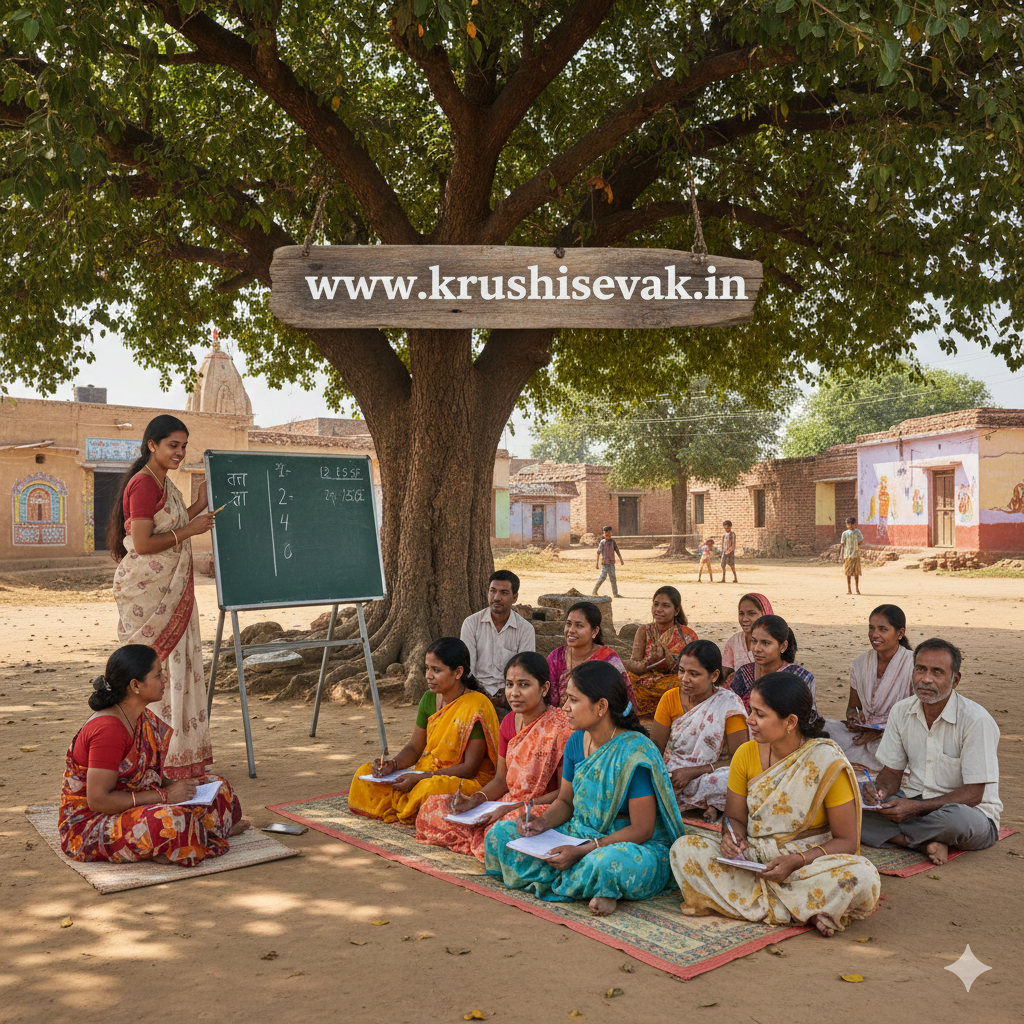
The Lok Shiksha Kendra (Adult Education Center – AEC) serves as the operational center for Saakshar Bharat at the grassroots level. Typically set up within existing Gram Panchayat buildings, schools, or community halls, each AEC is responsible for mapping non-literate individuals within its jurisdiction, distributing teaching-learning materials, and managing the local reading room.
To run these centers, the program appoints local coordinators known as Preraks (Volunteers). Each center is managed by two Preraks, with guidelines stipulating that at least one must be a woman.
Preraks act as community mobilizers rather than just traditional instructors. Their responsibilities include:
- Conducting door-to-door surveys to identify non-literate adults.
- Formulating local batch schedules that match the spare hours of rural laborers and homemakers.
- Motivating reluctant adults to overcome the social stigma associated with learning late in life.
- Coordinating with local schools, self-help groups (SHGs), and educated youth volunteers who offer their time to teach adult batches.
Funding Pattern and Fiscal Architecture
Saakshar Bharat is implemented as a Centrally Sponsored Scheme, utilizing a shared financial framework between the Union and the States:
- General States: Costs are shared on a 75:25 basis between the Central Government and the State Government.
- North-Eastern and Himalayan States: The cost-sharing ratio shifts to 90:10, with the Center covering the vast majority of the budget to support these geographically challenging areas.
The financial model ensures direct, electronic routing of funds to the implementing Gram Panchayats. This setup allows local committees to quickly settle honorariums for Preraks, buy library books, and maintain classroom lighting and seating infrastructure without facing long administrative delays.
How to Apply: The Process for Learners and Volunteers
Because Saakshar Bharat is a community-driven, decentralized campaign rather than a rigid individual-subsidy scheme, there is no complex digital application portal or processing fee for adult learners. The entry and application pathways are divided into two distinct streams: one for adult learners and one for volunteer teachers or Preraks.
For Adult Learners (Enrollment Process)
Step 1: Community Mapping and Door-to-Door Identification
The primary way learners enter the program is through the mandatory Literacy Survey conducted by local Preraks and Gram Panchayat members. These coordinators visit every household in the village to list individuals aged 15 and older who cannot read or write.
Step 2: Self-Walk-in and Registration
If an individual was missed during the initial household survey, they can directly visit the local Lok Shiksha Kendra at the Gram Panchayat building. The applicant provides basic identification details, such as their name, age, Aadhaar card or Ration card number, and social category (SC/ST/Minority), to the Prerak.
Step 3: Batch Allocation and Schedule Finalization
Once registered, the learner is assigned to a local learning group, which usually consists of 8 to 10 peers. To accommodate seasonal farming cycles and household demands, the Prerak and the volunteer teacher coordinate with the learners to set flexible timings—often meeting for 1 to 2 hours in the early afternoon for women or late evening for agricultural laborers. All learning materials, workbooks, and stationery are provided completely free of charge.
For Volunteers and Preraks (Application Process)
Educated rural youth, retired professionals, and college students looking to serve as Volunteer Teachers or apply for the paid position of a Prerak must navigate a structured local selection process:
Step 1: Reviewing Local Notifications
When vacancies for Preraks open up or new adult education centers are approved, the respective Gram Panchayat Lok Shiksha Samiti publishes a physical notice on the Gram Panchayat board and through local community channels.
Step 2: Document Submission
Interested candidates must submit a physical application form to the Gram Panchayat office along with supporting documents, including:
- Educational certificates (the minimum requirement for a Prerak is typically a Class 10 or 12 pass, depending on state specific rules).
- Proof of age and local residence (to ensure the applicant lives within the same Gram Panchayat area).
- Categorization certificates, if applicable, to support diversity in selection.
Step 3: Selection and Training
The Gram Panchayat Committee reviews the submissions and selects coordinators based on merit, local reputation, and community engagement skills. Once chosen, the selected Preraks and core volunteer teachers attend a mandatory multi-day orientation program organized by the District Resource Unit (DRU) or State Resource Center (SRC). This training teaches them specialized methods for adult instruction, how to use the target curriculum, and techniques for tracking student progress.
Assessment, Certification, and Quality Control
To give official recognition to the efforts of adult learners, Saakshar Bharat features a structured assessment and certification process. The National Literacy Mission Authority, in partnership with the National Institute of Open Schooling (NIOS), conducts nationwide Basic Literacy Assessments twice a year (typically in March and August).
- The Examination Format: The assessment is designed specifically for adults, featuring a practical, stress-free structure. It tests three core areas: Reading (understanding public notices and short paragraphs), Writing (writing simple sentences and filling out official forms), and Numeracy (basic addition, subtraction, and understanding currency values).
- The Certification: Learners who successfully pass the evaluation receive a joint literacy certificate from NIOS and the NLMA. This certificate serves as an official document proving functional literacy, allowing individuals to apply for formal employment where basic literacy is a prerequisite, open personal bank accounts, or enter advanced open-schooling courses.
Impact on Rural Communities and Social Dynamics
Over its implementation lifecycle, Saakshar Bharat has driven significant positive changes across rural India, demonstrating that adult literacy is a powerful tool for broader social development:
- Empowerment of Rural Women: By focusing heavily on female literacy, the scheme has given millions of women the confidence to step outside their homes. Literate women participate more actively in Gram Sabha meetings, manage Self-Help Group (SHG) ledger books independently, and reduce their dependence on middlemen.
- Improved Educational Outcomes for Children: A direct link exists between adult literacy and child education. Literate parents, particularly mothers, are far more likely to enroll their daughters in schools, monitor their children’s homework, and interact confidently with teachers during school management committee meetings.
- Financial and Digital Inclusion: Learning basic numeracy allows neo-literates to confidently use ATMs, understand mobile banking notifications, and protect themselves from predatory local moneylenders who use fraudulent bookkeeping practices.
Current Evolution and the Way Forward
As the country’s development needs have progressed, the foundational lessons and infrastructure built under Saakshar Bharat have evolved into newer institutional frameworks. Recognizing the importance of digital literacy alongside basic reading and writing, the Government of India has transitioned its adult education strategies into modern programs like the New India Literacy Programme (NILP) / ULLAS (Understanding Lifelong Learning for All in Society).
Running through the mid-2020s, this modern evolution builds directly on the grassroots network established by Saakshar Bharat. It expands the curriculum to include vital 21st-century skills, such as digital literacy (using smartphones, making digital payments, and navigating online public services), commercial financial literacy, and disaster management awareness.
Conclusion
The Saakshar Bharat Mission has served as a vital tool for social change by showing that education is a lifelong journey rather than a path reserved exclusively for youth. By focusing on rural areas with low female literacy and leveraging the local leadership of Gram Panchayats, the scheme has successfully brought millions of marginalized adults into the literate mainstream.
As the program continues to evolve into digital-first adult education initiatives like ULLAS, its core focus remains unchanged: empowering every citizen with the fundamental tools of literacy and numeracy, ensuring that no individual is left behind in the country’s social and economic progress.