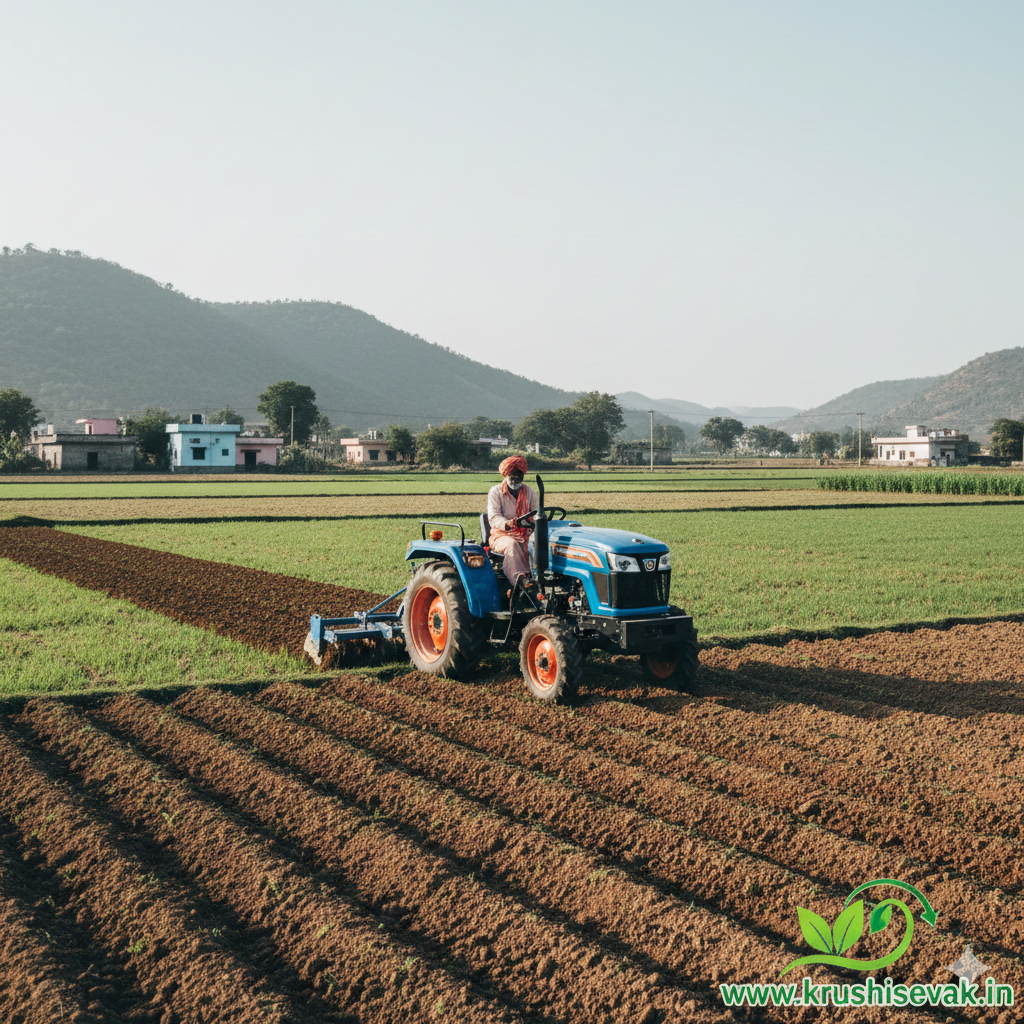

Agricultural mechanization is a key driver for improving farm productivity and reducing labor dependency. However, for a vast majority of Indian farmers who fall into the small and marginal categories (holding less than two hectares of land), purchasing a standard, high-horsepower tractor is financially unfeasible. Furthermore, large tractors are often structurally unsuited for navigating small, fragmented plots, dense orchards, or narrow greenhouse corridors.
To bridge this operational gap, the Government of India, in coordination with various state governments, actively promotes the deployment of mini tractors (typically defined as tractors below 20 to 30 Horsepower). Distributed under structural frameworks like the Sub-Mission on Agricultural Mechanization (SMAM) and the Rashtriya Krishi Vikas Yojana (RKVY), the Mini Tractor Subsidy Scheme provides substantial financial aid. This program lowers upfront procurement costs by 40% to 50%—and up to 90% in specific community-driven categories—making modern farming technology accessible to smallholders.
Core Objectives of the Mini Tractor Subsidy
The initiative is designed to address specific technical, structural, and financial challenges in modern agriculture:
- Enhancing Farm Power Availability: The scheme aims to increase national farm power availability to an optimal ratio of 2.5\text{ kW/ha}, ensuring timely seedbed preparation and harvesting.
- Targeting Small and Marginal Landholdings: Standard tractors can cause severe soil compaction on smaller plots and are difficult to maneuver. Mini tractors offer an agile, lightweight alternative that preserves soil structure while handling essential tasks like tilling, weeding, and hauling.
- Reducing Input Costs: By automating labor-intensive processes in narrow-row crops (such as cotton, sugarcane, vegetables, and orchards), mini tractors lower production costs and reduce reliance on manual labor or draught animals.
- Promoting Social Equity: The scheme uses tiered subsidy allocations to prioritize women farmers, Scheduled Caste (SC), Scheduled Tribe (ST), and economically weaker sections (EWS) of the farming community.
Subsidy Structure and Financial Incentives
The financial assistance provided for purchasing a mini tractor is not a flat cash payout. Instead, it is systematically calculated based on the applicant’s demographic category, geographic region, and the specific technical rating of the machine.
Central vs. State Cost-Sharing Architecture
As a Centrally Sponsored Scheme, the funding for tractor subsidies under SMAM is distributed through a shared fiscal partnership:
- General States: Costs are shared on a 60:40 basis between the Central Government and the State Government.
- North-Eastern and Himalayan States: The cost-sharing ratio shifts to 90:10 to account for challenging regional terrain and limited state revenues.
- Union Territories: The Central Government provides 100% of the funding.
Category-Wise Subsidy Distributions
The standard subsidy percentages and financial caps are generally structured as follows:
- Small, Marginal, SC, ST, and Women Farmers: Eligible for a 50% capital subsidy on the purchase price, typically capped between ₹2,00,000 and ₹2,50,000 depending on the exact horsepower class (below 20 HP vs. 20–30 HP).
- General Category Farmers: Eligible for a 40% capital subsidy, with a standard financial cap limited to ₹1,50,000 or ₹2,00,000.
- Community-Based Self-Help Groups (SHGs) and FPOs: Under specialized state variants designed to promote Custom Hiring Centers (CHCs) or Farm Machinery Banks, community groups can secure an 80% to 90% subsidy. For instance, certain state programs offer a 90% subsidy on mini tractors to registered SHGs where a significant majority of members belong to marginalized communities, helping them run the machinery as a localized rental business.
Financial Reality Check: How the Subsidy is Applied
It is vital to understand that the subsidy is capped. If a mini tractor costs ₹5,00,000 and the state scheme specifies a “50% subsidy capped at ₹2,00,000,” the farmer will receive a maximum credit of ₹2,00,000, not ₹2,50,000. The remaining ₹3,00,000 must be covered by the farmer through personal savings or a bank term loan. Additionally, auxiliary expenses such as commercial registration, road tax, and comprehensive insurance are not covered by the subsidy and must be paid out-of-pocket.
Strict Eligibility Framework
To maintain fiscal accountability and prevent the commercial resale of subsidized machinery, agricultural departments enforce strict eligibility rules:
- Landholding Verification: The applicant must hold clear, unencumbered agricultural land registered under their name. Validated records such as the Record of Rights (RoR), Khasra, Khatauni, or state-specific documents like the 7/12 and 8-A extracts are required.
- Prior Benefit Restriction: Neither the applicant nor any immediate family member should have received a government subsidy for a tractor or major farm machinery within the last seven years.
- Family Limitation: Only one individual per farming household (defined as a nucleus family sharing a common ration card) can apply for the scheme.
- Bank Alignment: The applicant must maintain an active, single-operated bank account linked to their validated Aadhaar number to facilitate secure Direct Benefit Transfer (DBT) processing.
Required Documentation Matrix
Applicants must prepare a comprehensive set of digital documents before initiating the online application process. Incomplete or illegible paperwork is the primary cause for application rejection.
- Identity & Domicile Proofs: A valid Aadhaar Card (fully updated and linked to an active mobile number), along with secondary identity proofs like a Voter ID or PAN card. A state-issued Domicile Certificate is required to confirm regional residency.
- Land Ownership Records: Up-to-date land revenue documents (issued within the current financial year) displaying the exact acreage and location of the farm plots.
- Authorized Dealer Quotation: A formal, itemized price quotation for the selected mini tractor model, sourced exclusively from an empanelled, government-approved dealer.
- Caste Certificate: A valid certificate issued by a competent revenue authority, required for SC, ST, or OBC applicants to access higher subsidy tiers and priority routing.
- Financial and Personal Records: A clear photocopy of the bank passbook showing the IFSC code and account details, a passport-sized photograph, and a signed self-declaration form certifying adherence to all scheme terms.
Step-by-Step Online Application Process
Most states have transitioned from traditional paper applications to centralized digital portals, such as the national AgriMachinery Portal (agrimachinery.nic.in) or state-specific hubs like MahaDBT or UP Agriculture.
Step 1: Initial Registration and Profile Setup
- The farmer visits the designated state or central agricultural mechanization portal.
- They select the “Farmer Registration” module and input their Aadhaar number to trigger an automated biometric or OTP-based e-KYC verification through UIDAI.
- Upon successful authentication, the system populates the user’s basic profile details. The applicant then creates a unique username, password, and Farmer ID.
Step 2: Entering Profile Details and Uploads
- The farmer logs into the system to complete their comprehensive profile, entering permanent address details, landholding measurements, specific Khasra numbers, and bank account information.
- The system requires the high-resolution upload of all scanned supporting documents (e.g., land records, bank passbook, and caste certificate) in PDF or JPEG formats, typically restricted to a file size under 500 KB.
Step 3: Selecting the Scheme and Equipment Variant
- From the active application dashboard, the user navigates to the “Sub-Mission on Agricultural Mechanization (SMAM)” or the relevant “Agricultural Equipment Grant Scheme” tab.
- The user selects the tractor category, specifies “Mini Tractor (Below 20 HP)” or “Tractor (20–30 HP),” and selects their preferred tractor model from the list of government-certified, tested machinery.
- The farmer enters the specific details from the authorized dealer’s quotation and submits the application. The portal then generates a unique Application Tracking ID.
Post-Submission Verification, Procurement, and Disbursement
Submitting the online application begins a multi-tiered administrative and verification process:
1. Administrative Sorting and Pre-Sanction Approval
Historically, allocations were decided via a lottery system. However, many modern state portals have transitioned to a transparent “First-Come, First-Served” policy based on electronic timestamps to reduce processing delays. The district agricultural officer reviews the digital dossier, checks the land documents against revenue servers, and issues an official Pre-Sanction Letter (Purva Sammati).
Crucial Warning for Farmers: Applicants must not purchase the mini tractor before receiving the formal Pre-Sanction Letter. Any purchases made prior to this official approval will disqualify the applicant from receiving the subsidy.
2. Sourcing and Physical Delivery
Upon receiving the Pre-Sanction Letter, the farmer has a strict, state-mandated window (usually 15 to 30 days) to complete the purchase. The farmer visits the chosen empanelled dealer, pays the full commercial amount (or arranges a bank loan for the non-subsidy component), and takes physical delivery of the mini tractor. The dealer then uploads the official commercial invoice, the machine’s unique engine and chassis numbers, and laser-engraved manufacturing details directly to the government portal.
3. Field Verification and Geotagging
A designated regional agricultural supervisor or junior engineer conducts an on-site inspection at the farmer’s property. The official verifies the physical tractor against the submitted invoice, confirms the engine and chassis stamps, and takes a joint photograph with the farmer and the machine. This photo is uploaded to the tracking app alongside real-time GPS geotagging coordinates to confirm the tractor’s physical presence on the farm.
4. Direct Benefit Transfer (DBT) Payout
Once the physical verification report is digitally approved by the District Committee, a secure payment file is generated. The approved subsidy amount is released via the Public Financial Management System (PFMS) and credited directly into the farmer’s Aadhaar-seeded bank account. In some alternative state models, with the farmer’s prior written consent, the subsidy may be paid directly to the financing bank to immediately reduce the outstanding principal of the tractor loan.
Operational Best Practices for Applicants
To ensure a smooth application process and avoid delays, farmers should follow these key operational guidelines:
- Cross-Verify Aadhaar Linkages: Ensure that your name matches exactly across your Aadhaar card, bank account, and land revenue records. Even minor spelling discrepancies can cause the automated system to flag the application during verification.
- Confirm Equipment Testing Certificates: Only purchase mini tractors that hold a valid commercial test report from central testing institutions like the Central Farm Machinery Training and Testing Institute (CFMTTI), Budni. Empanelled dealers are required to provide this certification.
- Adhere to the Resale Lock-In Period: Subsidized mini tractors are subject to a strict regulatory lock-in period (typically 5 to 7 years). The agricultural department retains the right to conduct random annual spot checks. If a farmer is found to have rented out the machine commercially outside of guidelines or sold it to a third party within this window, the government can initiate legal recovery procedures to reclaim the entire subsidy amount with interest.
Conclusion
The Mini Tractor Subsidy Scheme under SMAM is an effective structural tool for driving agricultural modernization across India. By offering substantial financial assistance to small, marginal, and historically underserved segments of the farming community, the program lowers the entry barriers to mechanization.
Transitioning the application process to transparent, digital portals ensures that smallholders can easily secure pre-sanctions, purchase certified equipment, and receive their subsidies directly through secure DBT channels. When properly utilized alongside matched implements, the mini tractor serves as an efficient tool to optimize inputs, reduce manual labor costs, and improve long-term crop yields and farm incomes.