
The global population is expected to reach nearly 10 billion by 2050. With this rapid growth comes a massive challenge: how do we feed everyone when arable land is shrinking, water scarcity is rising, and climate change is making traditional farming unpredictable?
The answer lies in agricultural innovation, and at the forefront of this revolution is Hydroponic Farming.
Imagine growing fresh, juicy tomatoes, crisp lettuce, and fragrant herbs without a single handful of soil. It sounds like science fiction, but it is a reality transforming modern agriculture. Here is a detailed look into the world of hydroponics, how it works, its various systems, and why it represents the future of farming.
What is Hydroponic Farming?
The word “hydroponics” comes from two Greek words: hydro (meaning water) and ponos (meaning labor). Literally translated, it means “water-working.”
Definition: Hydroponics is a method of growing plants without soil. Instead of searching through the ground for nutrients, plants receive all their essential minerals and elements through a nutrient-rich, water-based solution delivered directly to their roots.
In traditional farming, soil acts as a reservoir for nutrients and water, and it anchors the plant’s roots. In a hydroponic system, the soil is completely eliminated. The mechanical support is provided by an inert, sterile growing medium, while the nutrition is completely controlled through water.
How Does Hydroponics Work? The Core Science
To understand hydroponics, we must understand what a plant actually needs to grow. Plants do not inherently need soil; they need the nutrients, water, and oxygen trapped inside the soil.
In a hydroponic setup, plants are suspended in a controlled environment. Their roots are either submerged in or regularly misted with a water solution mixed with essential plant nutrients (like Nitrogen, Phosphorus, Potassium, Calcium, Magnesium, and trace elements).
Because the roots don’t have to expand and “fight” through dense soil to find food, the plant can direct all its genetic energy toward growing upwards, producing bigger leaves, faster flowers, and more abundant fruit.
The Role of Growing Mediums
While soil isn’t used, plants still need something to hold them upright. Hydroponic farmers use inert growing mediums. “Inert” means the medium does not decompose or provide any nutrition of its own; it simply holds the plant and retains moisture/oxygen. Common mediums include:
- Coco Coir: Made from coconut husks, excellent for water retention.
- Rockwool: Melted basalt rock spun into fiber bundles.
- Perlite & Vermiculite: Volcanic rocks that are heated until they expand into lightweight pebbles.
- Clay Pebbles (Hydroton): Small, porous clay balls that allow high oxygen flow to roots.
The 6 Main Types of Hydroponic Systems
Not all hydroponic farms look the same. Depending on the crop, budget, and space, growers use different system designs. Here are the six standard types:
1. Wick System
The simplest, passive system that requires no electricity, pumps, or timers.
- How it works: The plant sits in a container filled with a medium. A fabric wick (like a candle wick) connects the growing medium to a reservoir of nutrient solution below. Capillary action draws the liquid up to the roots naturally.
- Best for: Small houseplants, herbs, and educational school projects.
2. Deep Water Culture (DWC)
A highly popular and easy-to-manage system.
- How it works: Plants are placed in net pots filled with clay pebbles, resting on a floating platform (usually styrofoam). The roots hang directly down into the nutrient reservoir. An air pump with an air stone is placed in the water to constantly bubble oxygen into the liquid so the roots don’t drown.
- Best for: Water-loving plants like lettuce, spinach, and kale.
3. Nutrient Film Technique (NFT)
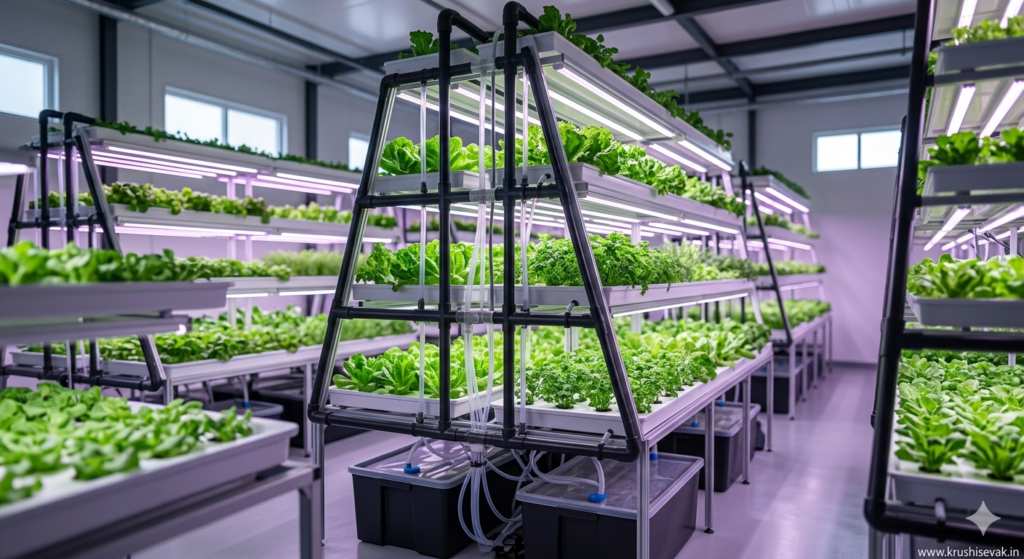
This is the system most commonly seen in commercial vertical farms.
- How it works: Plants are placed in long, slightly sloped channels. A continuous, very thin stream (a “film”) of nutrient solution is pumped from a reservoir to the high end of the channel. It flows down past the tips of the roots and drains back into the reservoir.
- Best for: Fast-growing, lightweight plants like herbs, strawberries, and lettuce.
4. Ebb and Flow (Flood and Drain)
A highly versatile system that can handle larger plants.
- How it works: The plants are hosted in a large grow tray. A timer activates a water pump, filling the tray with nutrient solution up to a certain level, soaking the roots. After a few minutes, the pump shuts off, and the water naturally drains back down into the reservoir. This cycle repeats several times a day.
- Best for: Root vegetables, tomatoes, and cucumbers.
5. Drip System
The most widely used hydroponic method for commercial operations globally.
- How it works: A timer controls a pump that sends nutrient solution through small tubes directly to the base of each individual plant. Drip emitters slowly release the liquid onto the growing medium around the roots. Excess water can either be drained away or recycled.
- Best for: Larger, long-term crops like bell peppers, tomatoes, and zucchini.
6. Aeroponics
The most high-tech and advanced hydroponic method.
- How it works: The roots hang freely in the air inside a sealed chamber. High-pressure nozzles mist the roots with a fine spray of nutrient solution every few minutes. Because the roots are exposed to maximum oxygen, plants grow exceptionally fast.
- Best for: High-value crops and leafy greens.
Major Advantages of Hydroponic Farming
Why are farmers shifting from traditional soil to hydroponics? The benefits are immense:
| Advantage | How Hydroponics Achieves It |
|---|---|
| Up to 90% Less Water Use | Traditional farming loses water to evaporation and deep soil drainage. Hydroponics recycles water within a closed loop system, using a fraction of the amount. |
| Maximized Space (Vertical Farming) | Plants can be stacked in vertical layers, allowing growers to produce up to 10 times more food per square meter than traditional farming. |
| Faster Growth Rates | Because nutrients and oxygen are perfectly delivered, plants grow roughly 30% to 50% faster than they do in soil. |
| No Pesticides / Fewer Pests | Soil-borne diseases, weeds, and underground pests are completely eliminated, drastically reducing or deleting the need for chemical pesticides. |
| Year-Round Production | When set up indoors or in automated greenhouses, hydroponics removes dependence on weather, seasons, and climate shifts. |
The Challenges of Hydroponics
While the benefits are highly attractive, hydroponics is not without its limitations:
- High Initial Cost: Setting up pumps, reservoirs, pipes, grow lights, and automated monitoring systems is far more expensive than buying a plot of traditional farmland.
- Dependency on Power: Most systems rely heavily on electricity for water pumps, timers, and lights. A prolonged power outage can dry out and kill an entire crop within hours.
- Technical Knowledge Required: You cannot simply “plant and forget.” Farmers must constantly monitor pH levels (acidity) and EC levels (electrical conductivity/nutrient strength) of the water.
- Rapid Disease Spread: If a water-borne plant pathogen enters a closed-loop system, it can infect every single plant sharing that water reservoir within a day.
Conclusion: Is Hydroponics the Future?
Hydroponic farming is no longer just an experiment; it is a vital pillar of the future of food security. By decoupling agriculture from fertile land and heavy water consumption, it allows us to grow fresh food in the middle of deserts, crowded urban cities, and cold northern climates where farming was previously impossible.