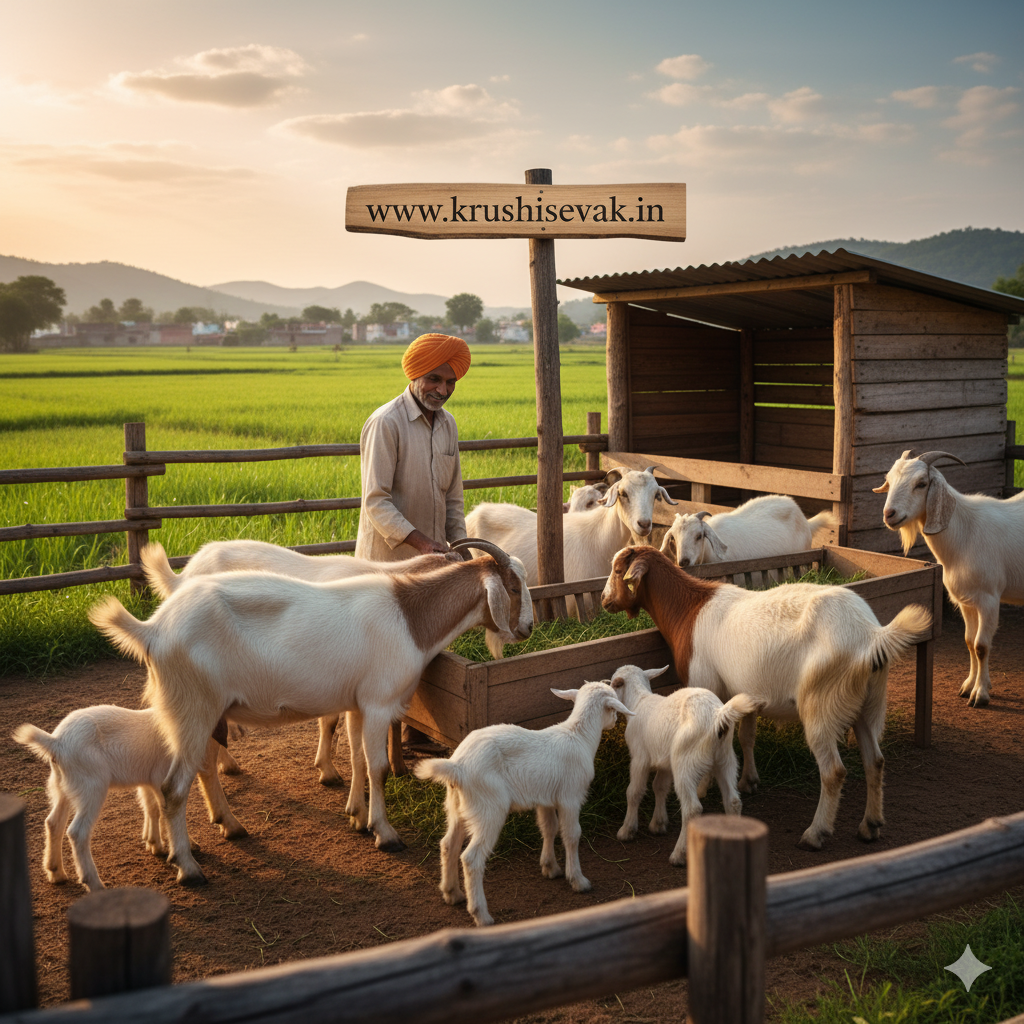

Goat rearing, often hailed as the “poor man’s cow,” plays a transformative role in the rural economy of India. It serves as a resilient and highly profitable livelihood option for smallholders, marginal farmers, and landless laborers. Recognizing the vast socioeconomic potential of this micro-livestock sector, the Government of India, along with various state animal husbandry departments, has rolled out robust financial assistance programs under the Goat Rearing Scheme (2025-26).
The primary national vehicle driving this transformation is the National Livestock Mission (NLM), specifically its Entrepreneurship Development Programme (EDP), alongside state-specific credit-linked subsidy initiatives like Maharashtra’s State Level Innovative Scheme and Madhya Pradesh’s Goat Unit Scheme. These institutional frameworks aim to shift goat farming from traditional, unorganized backyard rearing into a modern, organized commercial industry. By providing direct capital subsidies, structured bank loans, and scientific breed management, the 2025-26 scheme empowers rural entrepreneurs to build sustainable businesses, enhance meat and milk productivity, and secure long-term financial independence.
Core Pillars and Objectives of the Scheme
The operational blueprint of the Goat Rearing Scheme is designed around boosting livestock infrastructure and creating rural employment. The foundational objectives include:
- Rural Entrepreneurship Creation: Transitioning traditional sub-optimal grazing into intensive semi-stall-fed or stall-fed commercial entities.
- Genetic and Breed Improvement: Incentivizing the establishment of certified breeding farms that focus on high-yielding indigenous breeds—such as Osmanabadi, Jamunapari, Sirohi, Barbari, and Sojat—to increase meat and milk yields.
- Job Creation for Vulnerable Demographics: Prioritizing educated unemployed youth, women-led Self-Help Groups (SHGs), and individuals from Scheduled Castes (SC) and Scheduled Tribes (ST) to provide secondary income channels.
- Fodder and Healthcare Security: Integrating scientific feed management and heavily subsidized livestock insurance directly into the credit layout to protect capital investments from natural hazards or disease outbreaks.
Technical Framework and Scale of Operations
Under the central National Livestock Mission framework, the financial layout is determined by the specific scale and unit size of the proposed goat farm. Rather than encouraging arbitrary purchasing, the government categorizes projects into structured operational tiers.
Small-Scale Breeding Units
This entry-level commercial tier features a unit configuration of 100 breeding females (does) and 5 high-quality breeding males (bucks). The project layout is aimed at progressive farmers looking to build an initial breed-multiplication base.
Medium-Scale Breeding Units
This mid-tier infrastructure level scales the operational layout to 200 breeding females and 10 breeding males. It requires an established semi-stall-fed housing structure and automated feeding machinery.
Large-Scale Commercial Breeding Farms
The highest tier under the flagship entrepreneurial layout mandates a minimum of 500 breeding females and 25 premium breeding males. These units function as major regional distribution centers for high-genetic-merit livestock.
Financial Assisstance, Subsidies, and Funding Models
The financial mechanism of the 2025-26 scheme relies on a credit-linked capital subsidy model, reducing the initial financial burden on rural entrepreneurs.
Flagship Central Subsidies (NLM-EDP)
The central government provides a direct 50% capital subsidy across all eligible project tiers, capped at a maximum financial ceiling of ₹50 Lakhs. The subsidy funding flows directly through the Small Industries Development Bank of India (SIDBI) to the beneficiary’s loan account to ensure structural transparency.
State-Specific Variations and Inclusions
Many state animal husbandry departments offer localized variations that integrate seamlessly with central assistance. For example, smaller individual distributions (such as a 10+1 goat unit) receive a 40% to 50% subsidy for general category applicants, which rises to 60% or 75% for SC/ST beneficiaries.
Eligible vs. Excluded Costs
The subsidy applies directly to foundational assets, including shed construction (kid sheds, adult pens, isolation units), purchasing core breeding livestock, internal machinery (chaff cutters, feed mixers), and initial veterinary infrastructure. However, the cost of purchasing or leasing land, personal utility vehicles, and fluid everyday working capital are entirely excluded from the subsidy calculation and must be covered by the entrepreneur’s margin money.
Strict Eligibility Criteria
To maintain fiscal accountability and ensure project viability, applicants must meet the following criteria:
- Eligible Entities: Individual farmers, rural entrepreneurs, registered Self-Help Groups (SHGs), Joint Liability Groups (JLGs), Farmer Producer Organizations (FPOs), and Section 8 companies.
- Age and Domicile: Applicants must be resident Indian citizens, typically aged between 18 and 65 years, holding valid state domicile credentials.
- Financial Credibility: A clean credit history is mandatory. Banks evaluate the applicant’s CIBIL score, and any active defaults with financial institutions will result in immediate disqualification.
- Land and Infrastructure Command: The applicant must possess clear title deeds or a registered long-term lease agreement (typically for a minimum of 7 to 10 years) for a plot of land scaled appropriately to the chosen unit size. This land must also feature an assured source of clean water and electricity.
- Skill Certification: Prior basic training in scientific goat husbandry from a recognized government facility, KVK (Krishi Vigyan Kendra), or State Agricultural University is highly preferred. Lacking formal certification, the applicant must formally commit to hiring certified veterinary supervisors.
Required Documentation Matrix
A complete and thoroughly verified documentation file is essential for timely approvals from both the state implementing agencies and partner financial institutions.
- Detailed Project Report (DPR): A comprehensive, multi-year business blueprint detailing the technical parameters, structural designs of the sheds, feed schedules, asset depreciation charts, and clear financial projections (including Internal Rate of Return and Debt Service Coverage Ratio).
- Identity and Domicile Proofs: Digital copies of Aadhaar Card, PAN Card, Voter ID, and a valid Domicile Certificate.
- Land Ownership Verification: Original land registry papers, 7/12 extract documents, or formal lease agreements, along with non-encumbrance certificates.
- Financial Credentials: Income proof documents, past 6 months’ formalized bank account statements, and an active PAN-linked tax registration if applying as a corporate entity.
- Category and Training Certification: A valid caste certificate for applicants seeking specialized SC/ST allocations, alongside formal training completion certificates from an authorized animal husbandry institute.
Step-by-Step Online Application Process
The application flow for the 2025-26 operational year is highly digitized to reduce bureaucratic delays and eliminate middleman interventions.
Step 1: Portal Registration and Profile Creation
The applicant visits the official NLM Udyam Mitra web portal or their respective state’s dedicated animal husbandry application platform. Select the “Register Entrepreneur” module and create a profile using an Aadhaar-linked mobile number to complete multi-factor OTP authentication.
Step 2: Form Completion and Scheme Selection
Log into the portal and navigate to the “Sub-Mission on Breed Development (Small Ruminant Sector)” tab. Complete the comprehensive digital application form by entering personal demographics, exact geographic coordinates of the farm site, and the targeted unit size tier.
Step 3: Document Uploading and DPR Attachment
Upload high-resolution PDF copies of all identity proofs, land documents, and training certificates. The Detailed Project Report (DPR) must be attached to the application, as it forms the basis for the subsequent technical evaluation.
Step 4: Submission and Multi-Tier Review Flow
Review the data entries and submit the digital application. The workflow moves through a structured screening process:
- Stage A: The State Implementing Agency (SIA) evaluates the application for basic eligibility and technical feasibility.
- Stage B: Following initial clearance, the file moves to the applicant’s chosen commercial bank for rigorous financial credit appraisal and loan sanctioning.
- Stage C: Once the bank formally sanctions the loan, the State Level Executive Committee (SLEC) issues the final approval, clearing the path for the phased release of the capital subsidy.
Banking Interface, Loan Structures, and Repayment
Because the scheme operates on a credit-linked structure, commercial financial institutions manage the base funding through standard agricultural credit lines.
- Loan-to-Margin Ratio: For projects valued above ₹1 Lakh, banks require an entrepreneur margin contribution ranging between 15% and 25% of the total project cost. The remaining amount is disbursed as a formal agricultural term loan.
- Interest Framework: Loans generally carry competitive, government-regulated interest rates—often aligned with Kisan Credit Card (KCC) frameworks—averaging around 7% per annum, subject to timely repayment incentives.
- Repayment and Gestation Terms: The loan repayment structures are designed around the natural reproductive cycles of livestock. The typical loan tenure ranges from 4 to 5 years, which includes an initial grace or gestation period of 12 months. This ensures that borrowers are not pressured to make principal repayments before the herd produces its first commercial generation of progeny.
Integrated Risk Mitigation and Livestock Insurance
To protect smallholder investments against environmental threats and endemic diseases like Peste des Petits Ruminants (PPR), the 2025-26 guidelines introduce a simplified, heavily subsidized Livestock Insurance component.
The financial burden on the farmer has been lowered to a uniform premium contribution of just 15%. The remaining 85% of the insurance premium is co-funded by the central and state governments. The coverage capacity allows up to 10 cattle units per household, where 1 single cattle unit is structurally equivalent to 10 small ruminants (goats/sheep). This ensures that a baseline flock of up to 100 goats can be comprehensively insured against mortality losses at a minimal out-of-pocket cost to the rural entrepreneur.
Conclusion
The Goat Rearing Scheme (2025-26) offers an excellent avenue for building a modern, high-yield enterprise in India’s agricultural sector. By utilizing the 50% capital subsidies provided by the National Livestock Mission and combining them with structured bank credit and comprehensive livestock insurance, entrepreneurs can minimize market risks while maximizing long-term profitability.
Success in commercial goat farming depends on careful preparation, including completing certified training programs, preparing an accurate Detailed Project Report (DPR), and maintaining strong financial health to secure bank approvals. For farmers and rural youth ready to adopt scientific livestock management practices, this scheme provides the necessary financial foundation to establish a profitable and sustainable business.
For a complete breakdown of the application process and requirements under this initiative, you can watch this Detailed National Livestock Mission Guide. This walkthrough provides useful guidance on creating an acceptable Detailed Project Report (DPR), avoiding common documentation errors, and managing bank loan approvals smoothly.