
Introduction to Organic Recycling
In sustainable agriculture, the transformation of organic waste into nutrient-rich soil conditioners is essential for long-term soil health. Among various organic resources, cow dung remains an exceptional substrate due to its microbial diversity and balanced chemical composition. While traditional composting of cow dung is effective, integrating earthworms accelerates the decomposition process and elevates the nutritional quality of the end-product.
This specialized biological process yields two distinct, highly potent organic inputs: Cow Dung Vermicompost (a solid organic fertilizer) and Vermiwash (a liquid extract rich in nutrients and growth-promoting substances). Together, they form a complete plant-nutrition and soil-management system, reducing dependence on synthetic chemical inputs while fostering a resilient soil ecosystem.
Understanding Cow Dung Vermicompost
The Biological Mechanism
Vermicomposting is an eco-biochemical process where earthworms and microorganisms work synergistically to break down, stabilize, and transform organic matter. The earthworms ingest organic waste, grinding it mechanically in their gizzard. As the material passes through the earthworm’s digestive tract, it is exposed to an array of enzymes (including cellulase, amylase, lipase, and protease) and a diverse community of symbiotic intestinal microbes.
The excreted material, known as vermicasts, forms the basis of vermicompost. These casts are rich in humic acids, plant growth regulators, and beneficial microbes. They are physically structured into stable water-retaining aggregates that outperform standard thermal compost in both physical stability and biochemical activity.
Selecting the Right Earthworm Species
Not all earthworm species are suited for this process. Earthworms are ecologically classified into three distinct categories based on their feeding and burrowing habits:
- Epigeic Species (Surface Dwellers): These worms live near the surface and feed almost exclusively on decaying organic matter rather than mineral soil. They have high reproduction rates, tolerate varying environmental conditions, and are ideal for vermicomposting. The most preferred species are Eisenia fetida (Red Wiggler) and Eudrilus eugeniae (African Nightcrawler).
- Endogeic Species (Shallow Burrowers): These worms live in upper soil layers and feed primarily on a mixture of soil and organic debris. They are unsuited for composting piles.
- Anecic Species (Deep Burrowers): These worms create deep, permanent vertical burrows and pull organic material down into the lower soil profile (e.g., Lumbricus terrestris).
The Step-by-Step Production Process
Phase 1: Pre-Digestion and Thermophilic Stabilization
Raw cow dung cannot be fed to earthworms immediately. Fresh dung generates intense heat, volatile ammonia gas, and organic acids during its initial decomposition stage, creating a toxic environment that can be fatal to the worms. To make it safe:
- Fresh cow dung is piled in a shaded area and turned periodically for 10 to 15 days.
- Water is sprinkled regularly to cool the mass and dissipate trapped gases.
- This pre-digestion phase allows thermophilic bacteria to break down complex compounds, lowering the temperature and ensuring the material is soft and palatable for the earthworms.
Phase 2: Bed Preparation and Layout
Vermicompost beds are typically constructed in dimensions of 3 feet in width, 2 to 3 feet in height, and varying lengths depending on available space.
- The Basal Layer: A 3- to 4-inch layer of high-carbon, slowly decomposing material (such as dry leaves, chopped paddy straw, or coconut coir) is laid down to ensure proper drainage and aeration.
- The Core Layer: The pre-digested, cooled cow dung is placed on top of the basal layer.
- Introducing the Worms: Once the bed is prepared, earthworms are introduced at a standard rate of roughly 1 to 2 kilograms of live worms per meter of bed length. The worms naturally burrow down into the material to avoid direct light.
Phase 3: Environmental Management and Maturation
The beds must be kept under constant shade, using thatch roofs or green agro-netting, to protect the worms from predatory birds and direct sunlight.
- Moisture Control: Moisture levels must be strictly maintained between 50% and 60%. If a handful of the material feels like a wrung-out sponge without dripping excess water, the moisture level is ideal.
- Aeration: The beds should be turned gently every two weeks without injuring the earthworms, helping maintain aerobic conditions and preventing foul odors.
- Harvesting: Within 60 to 75 days, the top layer of the bed turns into a dark brown, loose, granular material resembling tea leaves. Water is withheld for two to three days prior to harvesting, causing the earthworms to move down into the lower layers. The upper, crumbly vermicompost layer can then be gently raked off, sieved through a 2mm mesh to separate any remaining cocoons or juvenile worms, and packed for use.
Exploring Vermiwash: The Liquid Gold
What is Vermiwash?
Vermiwash is a clear, pale yellow to dark brown liquid extract collected after water passes through a dynamic vermicomposting system. It contains a collection of plant nutrients, vitamins, enzymes (like protease and amylase), amino acids, and beneficial microorganisms. Additionally, it carries natural plant growth hormones including Auxins, Gibberellins, and Cytokinins, which are excreted by both the earthworms and their associated microflora.
Setting Up a Vermiwash Collection System
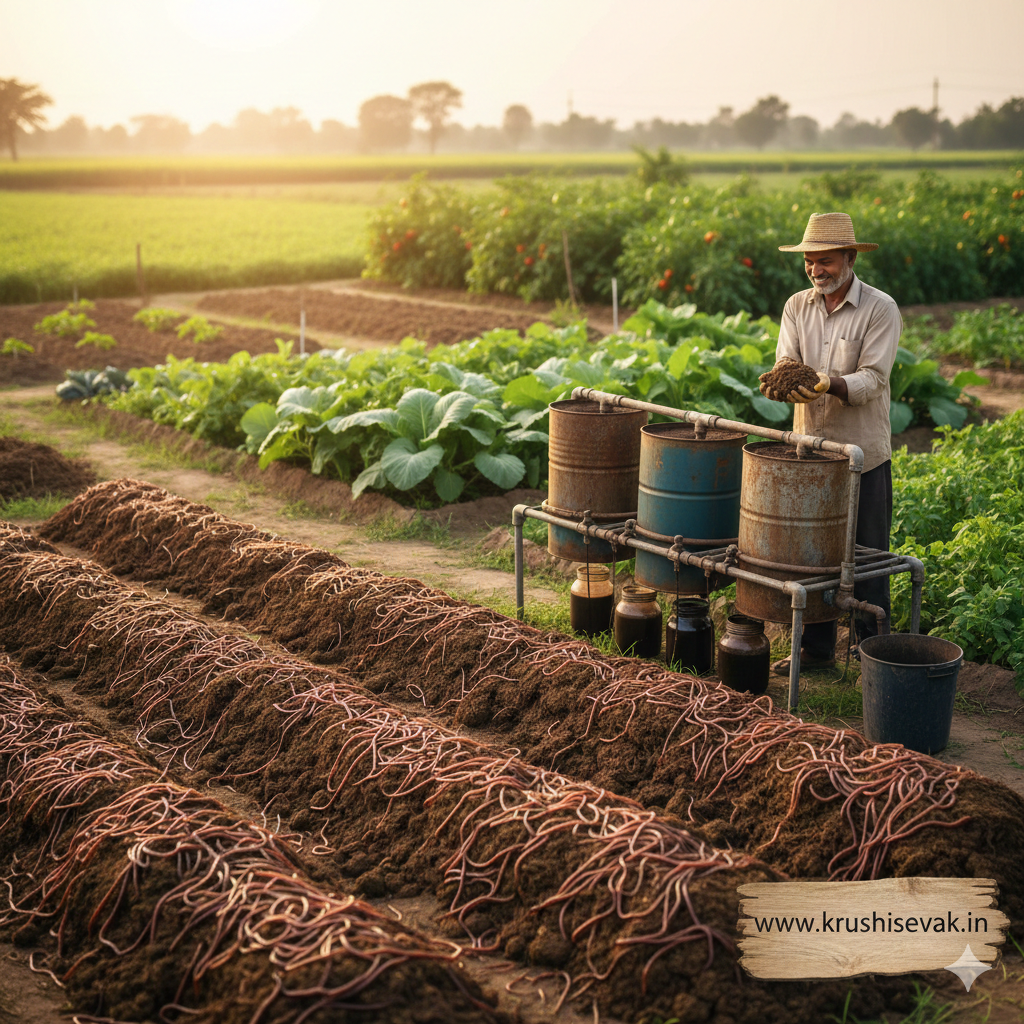
Creating a reliable vermiwash extraction unit requires a simple, gravity-fed system, often constructed using a 50- to 100-liter plastic drum or a traditional clay container.
- The Tap Installation: A drainage tap is fitted at the very bottom of the container to regulate liquid flow.
- The Base Filter Layers: To prevent clogging and ensure clear extraction, a 4-inch layer of broken bricks or small pebbles is placed at the bottom, followed by a 3-inch layer of coarse river sand.
- The Bioreactor Layer: A layer of pre-digested cow dung mixed with active earthworms (Eisenia fetida) is placed over the sand layer.
- The Feeding Layer: Fresh, pre-digested organic waste or well-moistened cow dung is layered on top to serve as a continuous food supply for the active worm population.
- The Water Delivery Mechanism: A small water pot with fine perforations at its base is suspended directly over the main container. Water drips slowly and evenly across the top layer without flooding the bed. As this water filters through the earthworm-rich environment, it washes over the worms’ bodies and through the vermicasts, collecting nutrients, mucus, and microbial metabolites before accumulating at the base.
- Collection: The bottom tap is opened slightly to allow a slow, continuous drop-by-drop collection of pure vermiwash.
Biochemical Profiling and Nutritional Assets
Nutritional Profile of Cow Dung Vermicompost
Vermicompost is a well-balanced, slow-release biofertilizer. Its nutrient profile stands out because its elements are highly bioavailable, bound in stable organic matrices that prevent leaching into groundwater.
- Macronutrients: It contains significant concentrations of nitrogen (N), phosphorus (P), and potassium (K). The action of earthworm enzymes converts complex nitrogen into plant-absorbable nitrates, while microbial activity solubilizes fixed phosphorus.
- Micronutrients: It is rich in essential trace elements like zinc (Zn), iron (Fe), copper (Cu), manganese (Mn), and boron (B), which are vital for enzyme activation and chlorophyll synthesis in plants.
- Carbon-to-Nitrogen (C:N) Ratio: Raw cow dung has a relatively wide, variable C:N ratio. The vermicomposting process reduces this ratio to an ideal range of 12:1 to 15:1. A narrow C:N ratio ensures that when the compost is added to soil, it immediately releases nutrients to plants rather than immobilizing them.
Biochemical Profile of Vermiwash
While vermiwash contains dilute macro- and micro-nutrients, its primary value lies in its high concentration of bio-active compounds:
- Phytohormones: It features measurable levels of Auxins (which drive root elongation and structural cell division), Gibberellins (which promote stem elongation and seed germination), and Cytokinins (which delay plant aging and boost leaf expansion).
- Microbial Load: It acts as a liquid culture of beneficial soil bacteria, including nitrogen-fixing species (Azotobacter and Azospirillum) and phosphate-solubilizing microbes.
- Mucus and Coelomic Fluid: As water passes over earthworms, it picks up secretions from their body walls. This coelomic fluid contains antimicrobial peptides that help plants resist pathogens.
Agricultural and Horticultural Applications
Soil Amendment and Ground Application
Vermicompost is primarily used to improve the soil matrix. It can be applied across various agricultural setups:
- Field Crops: Broad-spectrum application of 5 to 6 tons per hectare during initial land preparation.
- Horticultural Crops: Direct application of 1 to 2 kilograms per tree around the active root zone of fruit orchards twice a year.
- Potted Plants and Home Gardens: Mixing vermicompost with regular garden soil and sand in a balanced 1:1:1 ratio provides an excellent potting medium for ornamental and vegetable plants.
Foliar Spraying and Liquid Fertigation with Vermiwash
Because vermiwash is a concentrated biological liquid, it should be diluted before application to avoid leaf scorch:
- Foliar Application: Dilute vermiwash with water at a 1:5 or 1:10 ratio, filtering it through a fine cloth before pouring it into spray equipment. Spraying the leaves thoroughly during the early morning or late evening maximizes nutrient absorption through the stomata.
- Root Drenching: Diluted vermiwash can be poured directly into the root zone to stimulate rapid root development, which is especially beneficial for nursery seedlings during transplanting.
Impact on Soil Health and Crop Dynamics
Enhancing Soil Physical Architecture
Regularly applying cow dung vermicompost helps repair degraded soil structures:
- Bulk Density and Porosity: It lowers soil bulk density and improves overall porosity, creating a loose soil structure that allows roots to expand easily.
- Water-Holding Capacity: The organic matter in vermicompost acts like a sponge, significantly improving water retention in sandy soils while enhancing drainage and aeration in heavy clay soils.
Elevating Soil Biochemical Quality
Vermicompost acts as a long-term carbon sink, stimulating the native soil biology:
- Microbial Hotspots: Introducing vermicompost increases the population of beneficial fungi, actinomycetes, and bacteria, restoring microbial life to over-fertilized or chemical-burned soils.
- Cation Exchange Capacity (CEC): High levels of humic and fulvic acids increase the soil’s Cation Exchange Capacity, allowing it to hold onto positively charged nutrient ions (like Ca^{2+}, Mg^{2+}, and K^{+}) and prevent them from leaching away during heavy rains.
Boosting Plant Growth and Disease Resistance
The combination of vermicompost and vermiwash triggers systemic changes in growing crops:
- Improved Seed Germination: Pre-treating seeds with a dilute vermiwash solution softens the seed coat and accelerates germination.
- Enhanced Crop Quality: Crops grown with these organic inputs typically show higher brix values (sugar content), improved flavor profiles, longer shelf lives, and increased resistance to post-harvest decay.
- Biocontrol and Pest Deterrence: Soluble humic fractions and coelomic fluids create a protective barrier on plant tissues. Regular foliar sprays of vermiwash help suppress common fungal infections like powdery mildew and deter sap-sucking insects like aphids, mites, and thrips.
Comparative Analysis: Traditional Farmyard Manure vs. Vermicompost
Understanding the differences between standard Farmyard Manure (FYM) and cow dung vermicompost highlights the efficiency of the earthworm-mediated approach:
- Nutrient Concentration: FYM undergoes passive, often uneven anaerobic decomposition, leading to significant nitrogen loss through ammonia volatilization. In contrast, vermicompost is a structured aerobic process that preserves nutrients, resulting in significantly higher concentrations of available nitrogen, phosphorus, and potassium.
- Weed and Pathogen Control: Raw or poorly composted FYM often carries viable weed seeds and harmful pathogens like E. coli or Salmonella. The multi-stage vermicomposting process, combined with the sterile environment of the earthworm digestive tract, neutralizes these pathogens and degrades weed seeds, yielding a clean, hygienic end-product.
- Production Timeframes: Traditional composting pits often require 5 to 6 months to yield fully matured manure. The mechanical and enzymatic action of earthworms speeds up this timeline, producing rich vermicompost in 60 to 75 days.
Conclusion and the Path Forward
The production of Cow Dung Vermicompost and Vermiwash offers a practical, highly efficient method for recycling agricultural waste. By pairing the microbial richness of cow dung with the processing power of epigeic earthworms, farmers can produce both a premium solid soil conditioner and a bio-active liquid foliar spray from a single organic source.
Integrating these two inputs into modern agricultural systems helps restore degraded soils, improves water conservation, and enhances crop quality. As global agriculture shifts toward sustainability, adopting closed-loop organic recycling tools like vermicomposting is essential for protecting soil health, cutting production costs, and ensuring long-term food security.