
Introduction: The Significance of the Rabi Season and the Financial Burden of High-Quality Seeds
Agriculture remains the economic backbone of rural communities, with seasonal crop lifecycles dictating the financial health of millions of smallholder and marginal farmers. In countries like India, the farming year is fundamentally split into two dominant seasons: Kharif (monsoon crops) and Rabi (winter crops). As the monsoon recedes, fields are prepared for the crucial Rabi season, which typically spans from October to March. Major crops grown during this period, such as gram (harbhara), wheat, sorghum (jowar), safflower, and mustard, are essential for securing both food supplies and farm incomes.
However, the transition from one crop season to the next places a heavy financial burden on growers. After investing significant capital into harvesting their Kharif crops, farmers must immediately purchase inputs for Rabi cultivation. The single most important input for a successful harvest is certified, high-quality, disease-resistant seed.
Unfortunately, premium seed varieties developed by state agricultural universities and national seed corporations often come with a high price tag. For a small or marginal farmer with limited access to credit, buying high-yielding certified seeds at retail market rates can be a major challenge. Many are forced to use saved grain from previous harvests, which often has low germination rates and high vulnerability to pests, leading to poor field productivity.
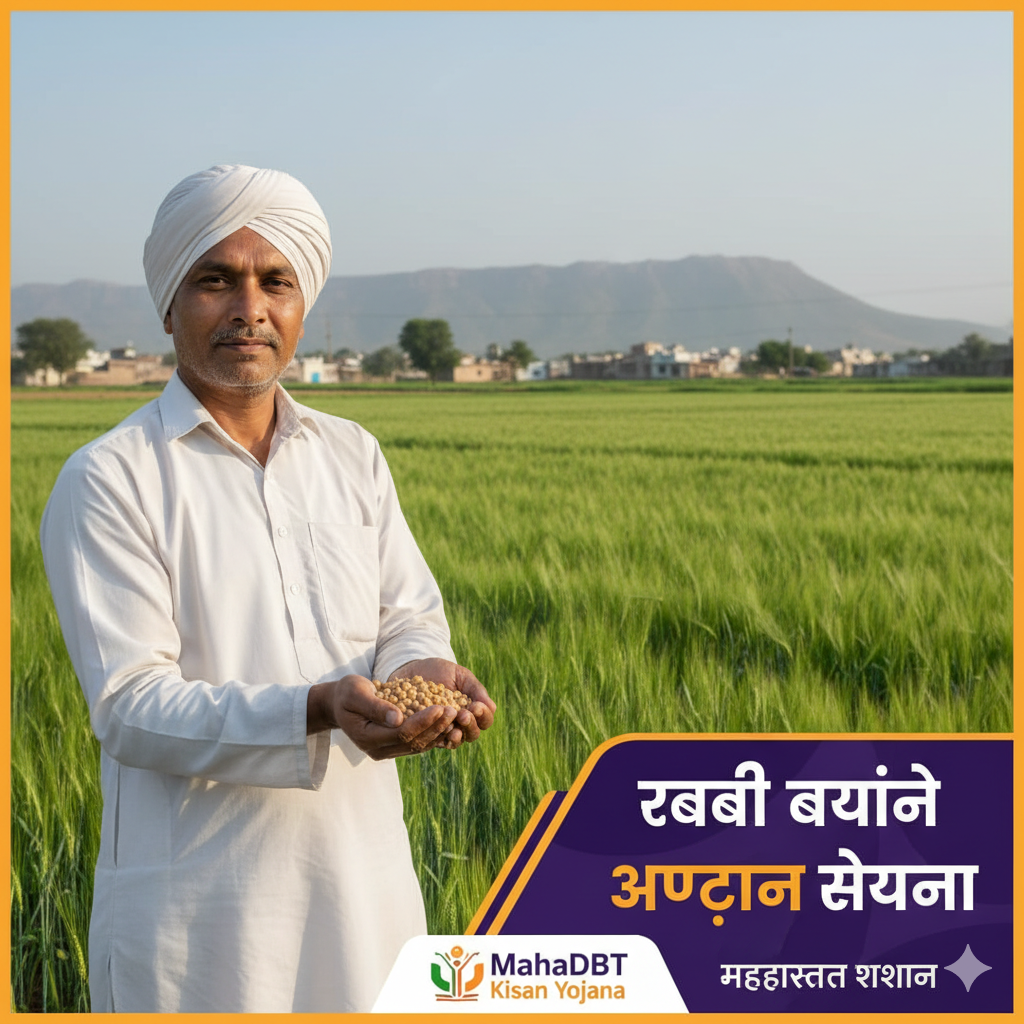
To bridge this resource gap, the Department of Agriculture introduces seasonal seed subsidy initiatives, widely known as the Rabi Seed Subsidy Scheme or Rabbi Biyane Anudan Yojna. Operating under broader frameworks like the National Food Security Mission (NFSM), this scheme ensures that quality-certified seeds reach the most remote farms at subsidized or highly reduced prices.
By reducing upfront input costs, the government aims to encourage the adoption of modern crop varieties, boost per-acre productivity, and protect smallholders from high retail prices.
Key Objectives of the Rabbi Biyane Anudan Yojna
The implementation of the Rabi Seed Subsidy Scheme serves multiple socio-economic and agricultural goals designed to strengthen rural economies:
- Promoting Seed Replacement Rate (SRR): One of the primary goals of agricultural extensions is to increase the seed replacement rate. This means replacing old, farm-saved seeds with newly certified, scientifically tested varieties every season. Certified seeds offer better germination and uniform growth, which helps boost overall regional output.
- Providing Financial Relief: By offering direct subsidies on seed bags, the government reduces the immediate cash flow pressures that farmers face at the start of the winter sowing window.
- Encouraging Modern Agricultural Practices: The scheme often provides mini-kits or specialized modern crop varieties for demonstrations, giving farmers hands-on experience with new agricultural technologies and crop resilience without risking their own capital.
- Enhancing National Food Security: Boosting the production of critical winter staples like pulses (gram) and oilseeds (safflower/mustard) helps reduce the nation’s reliance on expensive food imports.
- Promoting Fair Distribution: Moving application channels to centralized digital portals prevents local corruption and ensures that marginal, Scheduled Caste (SC), and Scheduled Tribe (ST) farmers receive equal access to state resources.
Eligible Crops and Core Subsidy Frameworks
The scheme focuses heavily on major staples, pulses, and oilseed crops that grow well in dry winter environments with minimal residual moisture. The specific subsidy amounts are often determined by the age of the seed variety, prioritizing newer, more resilient crops:
- Gram / Chickpea (Harbhara): Gram is the primary pulse crop of the Rabi season. The subsidy structure divides varieties into two age brackets to encourage modern seed adoption. For newly developed certified varieties (less than 10 years old), farmers can receive a substantial subsidy of up to 5,000 Rupees per quintal. For older certified varieties (more than 10 years old) that are still widely trusted, the subsidy is set at roughly 2,500 Rupees per quintal.
- Wheat (Gahu): As a core food staple, certified wheat seeds receive financial support to help farmers access high-yield varieties that can withstand late-season heat stress.
- Sorghum (Rabi Jowar): Highly valued for both human consumption and livestock fodder, rabi jowar seeds are subsidized to ensure food security in drought-prone and rainfed areas.
- Oilseeds (Safflower, Mustard, and Sunflower): To increase domestic oil production, the scheme heavily subsidizes oilseed crop distributions and field demonstrations, helping farmers lower their input costs while diversifying their fields.
Detailed Benefits for Participating Farmers
Enrolling in the Rabi Seed Subsidy Scheme offers several direct advantages that help improve a farm’s bottom line:
- Lower Production Costs: Seeds represent a significant portion of early-season expenses. Securing a 50% or higher price reduction via government distribution networks allows farmers to reallocate their limited capital toward other essential inputs, like micro-irrigation or organic fertilizers.
- Access to Authentic, Certified Quality: Buying seeds from open, unregulated local markets carries the risk of accidental purchase of counterfeit or low-quality supplies. Seeds distributed under this scheme are verified by state organizations like the Maharashtra State Seeds Corporation (Mahabeej), guaranteeing high germination rates and physical purity.
- Higher Yield Potential: Certified seed varieties are systematically selected for genetic purity, higher disease resistance, and better tolerance to drought. This results in healthier crop stands and larger harvest volumes.
- Simplified Direct-Benefit Deliveries: Modern digital administration prevents the need to chase down manual rebates. The scheme either allows farmers to buy seeds directly at a subsidized price from certified distributors or deposits the subsidy directly into their linked bank accounts via Direct Benefit Transfer (DBT).
Comprehensive Eligibility Criteria
To ensure that state funds reach genuine, hardworking farmers rather than commercial entities, the Department of Agriculture enforces clear eligibility requirements:
- Land Ownership Requirements: Applicants must own cultivable agricultural land in the implementing state. Their names must be explicitly recorded on official land documents, such as the 7/12 extract and 8-A certificates.
- Inclusion of Farmer Collectives: The scheme accepts individual applications, but it also extends benefits to registered self-help groups (SHGs), Farmer Producer Organizations (FPOs), and joint liability cooperative farming groups to support community-wide crop demonstrations.
- Operational Area Limitations: To distribute benefits equitably, individual land allocations are capped. A single farmer typically receives subsidy benefits for a minimum of 0.20 hectares (20 Gunthe) up to a maximum limit of 1.0 to 2.0 hectares. This ensures large commercial operations do not absorb the entire state budget.
- Mandatory Digital Identity Linking: Farmers must have a valid Aadhaar card linked directly to an active bank account to receive approval and secure electronic fund payments.
- Farmer ID Integration: According to modern administrative updates, applicants must possess a verified Farmer ID registered through the regional AgriStack digital network to access agricultural schemes.
Mandatory Documents Required for Application
To apply through the online portal, you must gather and scan the following core identification and land records:
- Aadhaar Card: Used as your primary biometric identity and verification document.
- Recent 7/12 Extract and 8-A Land Certificate: These documents verify your exact land ownership, survey numbers, and total cultivable area. Ensure these records are updated and clearly show your name.
- Active Bank Passbook or Canceled Cheque: This must show your bank’s name, branch address, account number, and clear IFSC codes to ensure error-free direct subsidy payments.
- Caste Certificate: Required only for applicants belonging to Scheduled Caste (SC) or Scheduled Tribe (ST) communities to access specialized reservation quotas or higher subsidy rates.
- Self-Declaration Form: A simple, signed document confirming that you have not claimed similar seed subsidies for the same land plot from other government programs during the same fiscal cycle.
- Registered Mobile Number: Your mobile number must be active and linked to your Aadhaar card to receive vital One-Time Passwords (OTPs) and application status updates.
Step-by-Step Online Application Process via the MahaDBT Portal
In states like Maharashtra, the entire application process is centralized on the automated MahaDBT Farmer Portal. This platform allows farmers to apply for seeds, fertilizers, and machinery through a single digital profile. Follow these steps to complete your submission:
### Step 1: Portal Access and Initial Registration
Open your internet browser and navigate to the official MahaDBT Farmer Portal website. If you are a new user who has never used the platform, look for the “New Applicant Registration” option on the homepage. The system will ask if you possess an Aadhaar card. Select “Yes” and enter your 12-digit Aadhaar number.
Choose “OTP Authentication” as your preferred verification method. The system will send a secure security code to your registered mobile number. Enter this code into the portal to automatically populate your basic identity details from the official UIDAI registry.
### Step 2: User Account Creation
After verifying your identity, the system will prompt you to create a unique Username and Password. Pick a memorable username and a strong password that meets the security requirements. Keep these credentials safe, as you will need them to track your application status and apply for future agricultural programs.
### Step 3: Completing Your Profile Information
Log into the portal using your new username and password. You must complete your profile details before applying for specific schemes. Navigate through the profile sections to fill in your precise permanent address, caste category, and bank details.
Next, go to the “Land Information” tab and input your specific geographic details, including your district, taluka, village name, land survey number, and total acreage. Upload your scanned copies of the 7/12 extract and 8-A certificates to verify your land ownership.
### Step 4: Selecting the Seed Subsidy Component
Once your profile is complete, return to the main dashboard and click on the link labeled “Apply Schemes” or “Submit Application”. Look for the Agriculture Department Schemes section. Under this category, select the tile or link labeled Seed Distribution, Demonstrations, and Fertilizer Components.
The portal will open a specific form where you must select your intended crop (such as Gram, Wheat, or Safflower) along with your desired seed quantity, keeping within your allowable land limits.
Step 5: Prioritizing Your Selection and Submitting
If you are applying for multiple items—such as farm machinery, micro-irrigation tools, and seeds—the portal will ask you to rank your preferences. Make sure to set the Rabi Seed component as your top priority to ensure it is processed before the planting season begins. Review your information for accuracy, click “Submit,” and pay the nominal processing fee (typically around 20 to 30 Rupees) using a digital payment method to finalize your application.
Modern Selection Mechanism: First Come, First Served (FCFS)
In recent administrative updates, the Department of Agriculture has updated its selection process to make it faster and more transparent. Previously, applications were held for long periods until a centralized lottery draw was executed.
Starting with recent crop cycles, the portal uses a First Come, First Served (FCFS) approach for seed distributions and demonstration kits. The portal logs a precise digital timestamp the moment an application is submitted. Applications are then reviewed and approved in the exact order they were received until the regional subsidy budget is fully allocated.
Because seed distribution has a direct impact on seasonal success, farmers are encouraged to apply as soon as the portal opens for the Rabi season. This helps avoid missing out due to local budget limits.
Seed Distribution and the Final Disbursement Process
Once your application is reviewed and approved by local agricultural officers, you will follow a clear process to receive your subsidized seeds:
- Receiving the Selection Alert: The portal will send an automated SMS confirmation to your registered phone, and an official Pre-Sanction letter will be generated within your user dashboard.
- Visiting Authorized Distributors: Print out your pre-sanction letter and take your original 7/12 extract and Aadhaar card to an authorized state seed distributor, such as your local Mahabeej center or a government-approved agricultural cooperative venue.
- Verification of Identity: The dealer will verify your unique Farmer ID or scan your documents to confirm your identity against the state’s approved beneficiary list.
- Direct Delivery of Benefits: Depending on the current system framework, you will either pay the discounted price directly at the counter (with the government reimbursing the dealer), or you will pay full price upfront and receive your subsidy as a direct deposit into your bank account via the DBT network within a few weeks.
Proactive Tips for a Successful Application
To avoid processing delays or rejection, keep these practical tips in mind when navigating the application process:
- Apply Early: With the shift to a First Come, First Served system, applying on the opening day gives you the best chance of securing a subsidy before funds run out.
- Verify Your Aadhaar Link: Double-check that your Aadhaar card is properly linked to your primary bank account. If your bank records do not match your identity documents, the automated system may reject your direct subsidy payment.
- Keep Your Land Records Updated: Make sure your 7/12 and 8-A digital certificates are current and match the names on your identity cards. Older, handwritten documents can cause verification issues on the online portal.
- Monitor Your Dashboard Status: Do not rely solely on text notifications. Log into the portal weekly to check your “My Applied Schemes” tab for any requests for additional information or updates from your local agricultural officer.
Conclusion: Empowering Farms Through Strategic Mechanization and Support
The Rabi Seed Subsidy Scheme (Rabbi Biyane Anudan Yojna) is a vital resource for smallholder and marginal farmers. By lowering upfront costs and providing access to high-quality, certified seeds, the program helps farmers manage seasonal financial pressures while improving their overall crop yields.
The transition to a digital portal ensures a fair, transparent application process, protecting growers from market price volatility and ensuring resources are distributed equitably. To maximize the benefits of this program, farmers should ensure their digital profiles are updated, gather their land documents early, and submit their applications promptly as soon as the seasonal registration window opens.
For a visual walkthrough of the online application steps, required crop documents, and the distribution process, you can watch this guide on MahaDBT Seed Subsidy Scheme Updates, which details how to navigate the portal and secure your certified winter crop allotments.