
Introduction to the Rashtriya Gokul Mission
The livestock sector forms an indispensable cornerstone of rural livelihoods, economic resilience, and dietary security across India. Within this domain, indigenous cattle and buffalo breeds hold distinct advantages due to their natural climate resilience, ability to thrive on low-input feed, and inherent resistance to localized tropical diseases. However, for decades, the productivity of these native bovine populations remained constrained due to unstructured breeding, an inadequate network of artificial insemination, and a general shortage of high-genetic-merit bulls.
To systematically address these bottlenecks, the Department of Animal Husbandry and Dairying (DAHD) under the Ministry of Fisheries, Animal Husbandry, and Dairying running the Rashtriya Gokul Mission (RGM). This flagship national initiative is structured under the umbrella of the Rashtriya Pashudhan Vikas Yojna. The mission is specifically engineered to drive the development and conservation of indigenous bovine breeds, accelerate genetic upgradation across the non-descript cattle population, and optimize overall milk production and productivity to make dairy farming highly remunerative for small, marginal, and entrepreneurial livestock keepers.
The strategy of the Rashtriya Gokul Mission shifts away from older, slow-yielding subsistence methods toward advanced, biotechnology-driven models. RGM achieves its targets by incentivizing private entrepreneurship, expanding modern doorstep reproductive technologies, and subsidizing complex processes like In-Vitro Fertilization (IVF), the use of sex-sorted semen, and the establishment of dedicated Breed Multiplication Farms.
For livestock owners, rural youths, and agribusiness companies looking to tap into this institutional support, understanding the specific application processes across the mission’s diverse operational pathways is a critical step toward securing financial backing and technical integration.
Core Pillars and Eligible Application Schemes under RGM
The administrative structure of the Rashtriya Gokul Mission is divided into multiple components, each offering a distinct application track tailored to different target groups—ranging from individual smallholder dairy farmers to large-scale rural entrepreneurs, cooperative bodies, and self-employed rural youth.
1. Breed Multiplication Farms (BMF) — Entrepreneurship Model
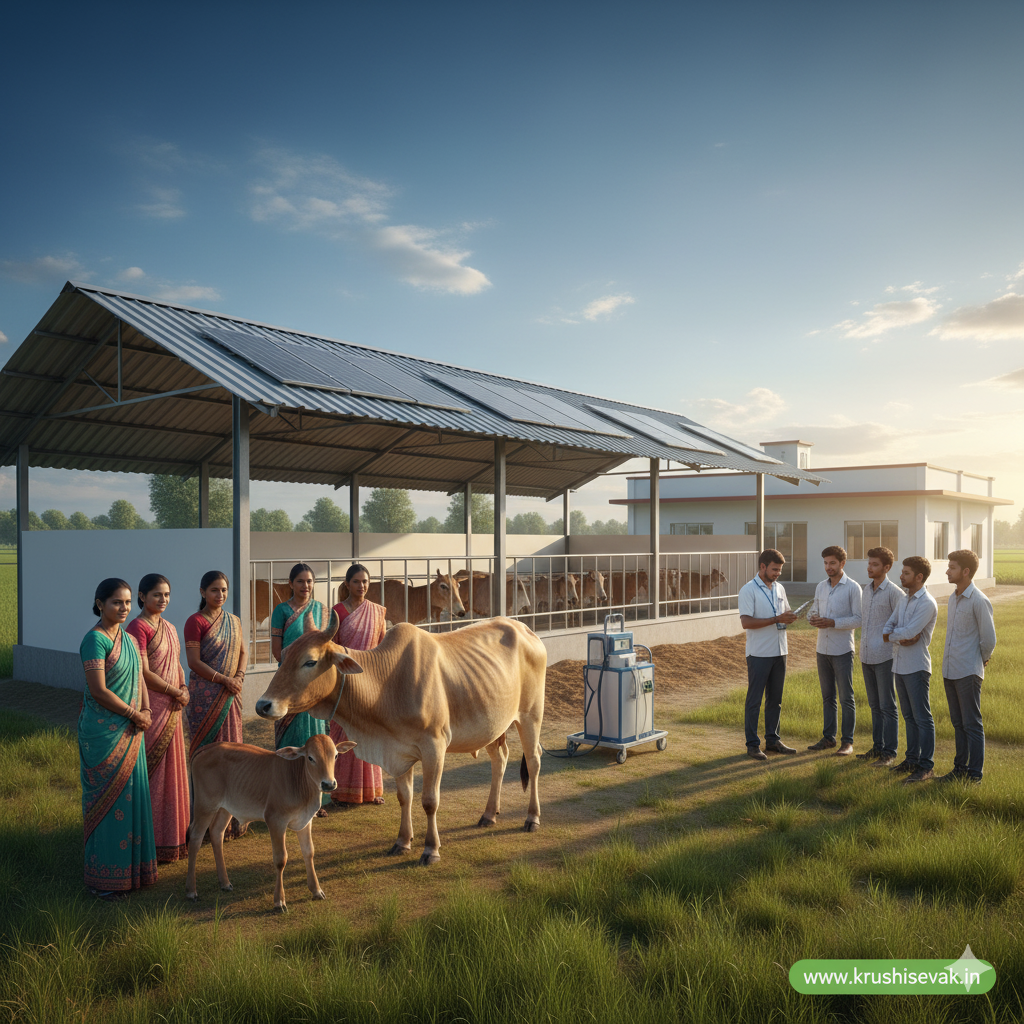
The general shortage of disease-free, high-yielding heifers or pregnant cows remains a major structural challenge for farmers looking to establish commercial dairy units. Under this component, the government promotes the establishment of private Breed Multiplication Farms to act as regional hubs for producing and distributing elite bovine germplasm.
The scheme incentivizes private individuals, Farmer Producer Organizations (FPOs), Self-Help Groups (SHGs), Joint Liability Groups (JLGs), and Section 8 companies to build state-of-the-art breeding hubs. The central government provides a massive 50% capital subsidy (up to a maximum of ₹2 Crore) to approved entrepreneurs to offset the setup costs of cattle housing, automated machinery, and elite bull mother procurement.
2. Multipurpose Artificial Insemination Technicians in Rural India (MAITRI)
To expand reproductive services to the literal doorstep of rural households, RGM finances the creation of a vast network of self-employed artificial insemination operators known as MAITRIs. This track targets educated, unemployed rural youth.
Selected applicants undergo an intensive, fully funded multi-month training course covering artificial insemination, basic veterinary first aid, and livestock management. Upon successful graduation, they are equipped with an AI kit, biological cryo-containers, and liquid nitrogen storage tanks to establish a self-sustaining, fee-for-service doorstep business model.
3. Accelerated Breed Improvement Programme (ABIP) — IVF and Sex-Sorted Semen
For individual dairy farmers, RGM offers direct subsidies to accelerate the genetic potential of their existing cattle herds. This includes a 50% subsidy on the cost of utilizing sex-sorted semen, which ensures a 90% probability of producing female calves, thereby eliminating the economic burden of managing unwanted male calves.
Furthermore, the mission provides a direct financial subsidy of ₹5,000 per successful pregnancy achieved via In-Vitro Fertilization (IVF) technology, allowing ordinary smallholders to access advanced embryo transfer procedures at a fraction of the market cost.
Detailed Application Process for Breed Multiplication Farms (BMF)
The establishment of a Breed Multiplication Farm under the entrepreneurship model follows a rigorous, digitized, and highly structured application cycle managed at the national level through the National Dairy Development Board (NDDB), which serves as the primary implementation agency.
Step 1: Portal Sign-Up and Initial Registration
Interested entrepreneurs, corporate entities, or cooperative groups cannot submit physical paperwork directly to the ministry. The process begins online via the dedicated Expression of Interest (EOI) portal developed by the National Dairy Development Board.
- The applicant navigates to the official NDDB EOI tracking portal ([https://eoi.nddb.coop/](https://eoi.nddb.coop/)).
- The applicant clicks on the “Register/Sign Up” option, entering their basic personal or organizational details, valid email address, and an active mobile number.
- Upon verifying the mobile number through a secure One-Time Password (OTP), the unique user credentials (Username and Password) are generated and sent to the applicant.
Step 2: Form Completion and Profile Assembly
After logging into the EOI portal, the applicant clicks on the link titled “Apply for Breed Multiplication Farmer.” The system opens a multi-stage digital application form:
- Applicant Identification: Captures the legal status of the applicant (Individual/FPO/SHG/Section 8 Company) along with permanent address coordinates and PAN card details.
- Land Particulars: The applicant must input the exact location, survey numbers, and total acreage of the land designated for the farm. The scheme mandates that the entrepreneur must possess clear ownership or hold a registered, unencumbered long-term lease deed for a land parcel sufficient to house at least 200 milch animals.
- Technical Experience: The portal requires uploading proof of appropriate background experience in livestock rearing, breeding management, or generalized agricultural entrepreneurship.
Step 3: Submission of a Bankable Project Report (DPR)
The most critical requirement of the online BMF application is uploading a comprehensive, professional Detailed Project Report (DPR). The system will automatically reject incomplete or informal summaries. The bankable DPR must structurally detail:
- The chosen native cattle or buffalo breeds targeted for propagation (e.g., Gir, Sahiwal, Tharparkar, Murrah, Jaffrabadi).
- The civil engineering blueprints for modern, climate-smart cattle sheds, milking parlors, and calving paddocks.
- The technical specifications of intended mechanization equipment, such as automated TMR (Total Mixed Ration) mixers, chaff cutters, and bulk milk coolers.
- A clear financial estimation sheet outlining the total projected capital cost (excluding land value), an explicit plan to secure the remaining 50% bank loan matching fund, and projected operational profit-and-loss accounts over a five-year horizon.
Step 4: First-Tier Screening by the Implementing Agency (NDDB)
Once the completed form and bankable DPR are submitted online, the file goes to the expert screening cell at the NDDB. The NDDB reviews the proposal to verify land suitability, experience credentials, and the economic viability of the project design. If discrepancies or missing technical details are identified, the NDDB routes the file back to the applicant’s online dashboard with a specific timeline to submit clarifications.
Step 5: Bank Tie-Up and Project Recommending
Because the central government subsidy covers up to 50% of the project cost, the applicant must secure the remaining 50% as a formal commercial bank loan or prove equivalent institutional equity.
Eligible projects cleared by the NDDB are recommended digitally to the applicant’s chosen scheduled commercial bank or financial institution (such as NCDC or NABARD). The bank performs its independent credit appraisal, inspects the physical land site, and issues a formal Loan Sanction Letter.
Step 6: Final Tripartite Approval and Multi-Stage Subsidy Release
The bank-sanctioned proposal is uploaded back to the central tracking system for final clearance by the Project Approval Committee of the DAHD. Once approved, the 50% subsidy is disbursed to the beneficiary’s loan account in a phased manner via the NDDB:
- **First Installment (50% of the subsidy amount): Automatically released into the applicant’s bank account once the project is formally cleared and the commercial bank releases its initial loan tranche to commence civil works.
- Second Installment (25% of the subsidy amount): Released after a joint inspection team confirms that the full physical infrastructure (sheds, clinics, parlors) is structurally complete and the core breeding animals have been safely inducted.
- Third Installment (Remaining 25% balance): Disbursed once the farm records confirm that the births of at least 10% of the calves from the inducted herd have been successfully completed using advanced breeding technologies.
Application Process for the MAITRI Program
The application track for the Multipurpose Artificial Insemination Technicians in Rural India (MAITRI) model operates at the state level under the direct supervision of the respective State Livestock Development Boards (SLDBs).
Step 1: Monitoring Official State Notifications
State Livestock Development Boards periodically assess regional gaps in artificial insemination coverage and publish localized advertisements calling for applications. These notices are made available on the official state animal husbandry portals (e.g., maitriupldb.in in Uttar Pradesh or corresponding SLDB portals across other states).
Step 2: Online or Offline Form Submission
Interested rural youth must register during active application windows. The candidate fills out a detailed form requiring:
- Proof of minimum educational qualification (Mandatorily 10+2/Intermediate passed with Biology as a core subject).
- Age declaration confirming the applicant falls within the prescribed age bracket (typically 18 to 40 years on the date of application).
- Permanent residence documentation proving the applicant belongs to the specific rural district or village block where the MAITRI center vacancy has been officially declared.
Step 3: District-Level Screening and Physical Verification
Applications are screened by a selection committee headed by the district’s Chief Veterinary Officer. Candidates who clear the initial document screening are called for a physical interview and cross-verification of documents.
Preference during this process is systematically given to livestock owners, children of traditional dairy farmers, and candidates holding prior experience or basic certifications from recognized veterinary or artificial insemination training centers.
Step 4: Institutional Training and Kit Allocation
Selected candidates are formally enrolled in an intensive, multi-week instructional course conducted at an accredited regional training institute. The curriculum blends classroom theory with intensive hands-on practical training in bovine anatomy, cryo-container handling, proper semen straw thawing protocols, and basic veterinary first-aid.
Upon successfully passing the final competency examination, the graduate receives their official MAITRI certification, along with a state-subsidized startup kit comprising an AI gun, protective gear, and a fully filled biological container to launch their field operations.
How Individual Farmers Benefit: IVF and Sexed Semen
Individual smallholder farmers do not need to compile complex corporate project reports or navigate entrepreneurship portals to access the benefits of the Accelerated Breed Improvement Programme under RGM. The application process for ordinary producers is simplified and integrated into existing dairy cooperative systems.
Registering for In-Vitro Fertilization (IVF) Services
Farmers interested in executing advanced embryo transfers to upgrade their herd genetics must follow a localized application path:
- The farmer registers their interest with the local village Dairy Cooperative Society (DCS), the regional Milk Union, or directly with the nearest state veterinary clinic linked to the National Digital Livestock Mission.
- The field veterinarian inspects the farmer’s cow to ensure the animal is healthy, structurally sound, and meets the reproductive criteria required to serve as an embryo recipient.
- The service provider performs the IVF procedure using high-genetic-merit embryos. The farmer pays the baseline subsidized fee, and the central government delivers the ₹5,000 incentive subsidy directly to the operating agency or the farmer’s loan tracker via the NDDB upon verification of a confirmed, successful pregnancy.
Availing Sex-Sorted Semen Dose Incentives
To purchase sex-sorted semen at a highly subsidized rate, the farmer coordinates with their local artificial insemination technician (including MAITRI workers or cooperative vets).
The technician records the unique identification number of the breedable female animal via the Bharat Pashudhan digital portal. The subsidy (up to 50% of the market cost of the specialized sexed semen straw) is adjusted at the point of sale or service delivery, allowing the farmer to secure an assured female pregnancy with minimal out-of-pocket expenditure.
Mandatory Documentation Checklist for RGM Schemes
To ensure smooth processing on national and state portals, applicants across all major RGM tracks must compile a clean dossier of supporting credentials.
For Entrepreneurial Schemes (Breed Multiplication Farms)
- Identity Proof: PAN Card, Aadhaar Card, or registered Incorporation Certificate of the applicant firm.
- Land Ownership Records: Up-to-date Land Title Deeds, 7/12 extracts, or a legally registered, long-term lease agreement spanning a minimum of 10 to 15 years, proving explicit control over a land parcel suitable for housing 200 animals.
- Detailed Project Report (DPR): A bankable project plan detailing technical parameters, breed selection profiles, civil designs, and clear financial viability projections.
- Financial Documents: Audited balance sheets of the firm (if applicable), proof of equivalent margin money matching fund availability, and a formal Loan Sanction Letter from a scheduled bank.
- Experience Credentials: Certificates or formal training logs validating the entrepreneur’s or the farm manager’s expertise in running animal husbandry or dairy production units.
For Grassroots Technical Schemes (MAITRI Applicants)
- Educational Certificates: Marksheets and certificates confirming successful completion of 10+2/Intermediate education with Biology as a mandatory subject.
- Age and Residence Proof: Aadhaar Card, Voter ID, and a valid domicile or residential certificate issued by the competent local revenue authority.
- Caste Certificate: Required for applicants seeking reservation benefits or targeted training slots designated for SC/ST or marginalized rural categories.
- Medical Fitness Certificate: A health fitness document issued by a registered government medical officer, confirming the applicant’s physical capability to handle heavy field equipment and livestock animals safely.
Systematic Verification and Accountability Framework
To eliminate leakage, prevent dual-subsidization fraud, and maintain absolute institutional financial discipline, the Rashtriya Gokul Mission links all its application streams with digital tracking networks.
Integration with the Bharat Pashudhan/NDLM Portal
Every single animal inducted into an approved Breed Multiplication Farm, utilized as an embryo donor, or inseminated via subsidized sexed semen straws must be tagged with an official, tamper-proof 12-digit polyurethane ear tag embedded with a unique identification number.
All diagnostic checks, reproductive cycles, and subsequent calvings are logged in real-time onto the Bharat Pashudhan database under the National Digital Livestock Mission framework. Subsidies are held or blocked by the public financial tracking system if the corresponding livestock assets are not properly digitized on the national database.
Physical On-Site Audits
Before releasing the secondary and final installments for heavy entrepreneurship models like Breed Multiplication Farms, a joint monitoring team comprising central animal husbandry officers, NDDB experts, and state veterinary directors conducts unannounced on-site physical audits.
The team verifies that the civil infrastructure matches the uploaded blueprints, inspects the health and disease-free certification profiles of the herd, and confirms the functional operation of the automated machinery. Once the field verification report is digitally signed and geotagged, the central government clears the Direct Benefit Transfer (DBT) mechanism to release the remaining financial assistance directly into the entrepreneur’s linked bank account.