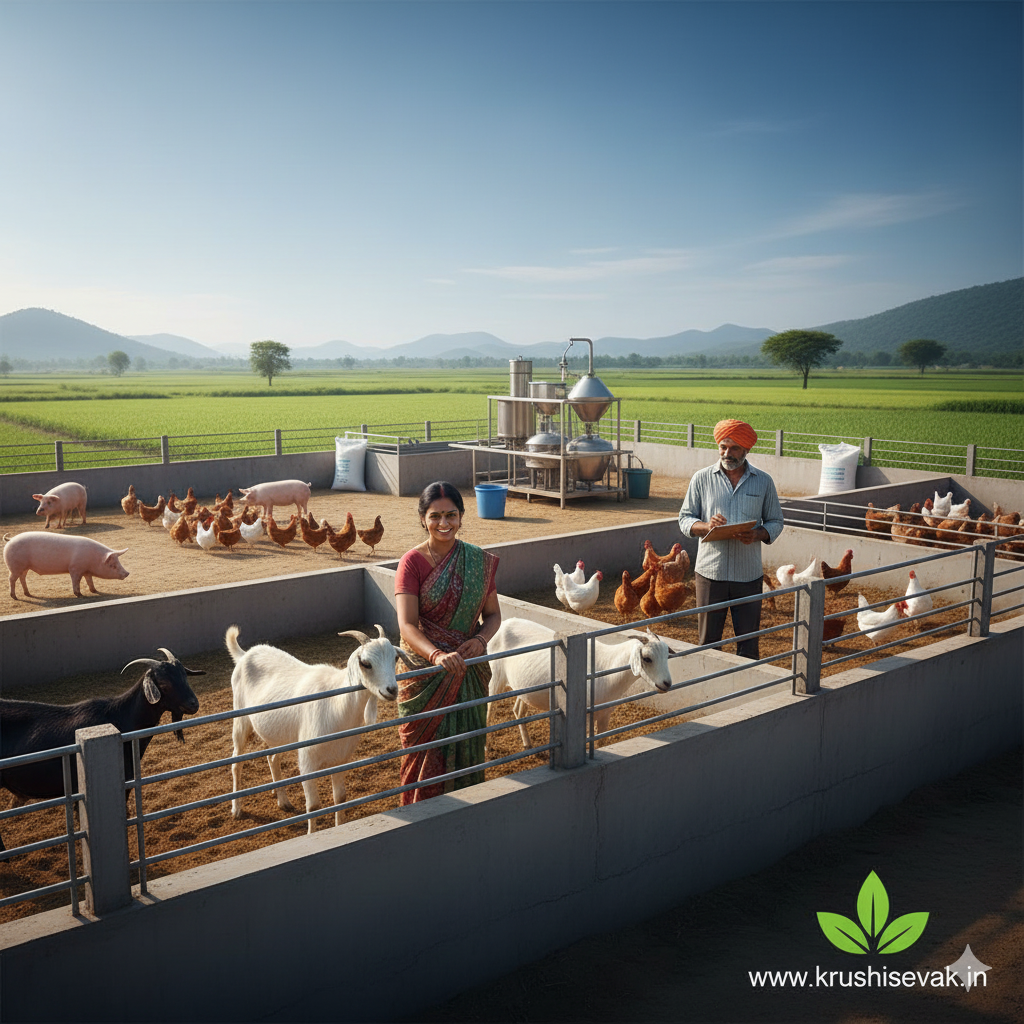

In India, animal husbandry is a vital sector that provides sustainable livelihoods, nutritional security, and structural economic stability to millions of rural households. While public discussions frequently mention a singular “PM Pashupalan Subsidy Scheme,” the Government of India actually drives rural animal husbandry through a structured portfolio of credit-linked subsidy initiatives managed by the Department of Animal Husbandry and Dairying (DAHD).
The primary central pillars of these livestock development efforts include the National Livestock Mission (NLM), the Animal Husbandry Infrastructure Development Fund (AHIDF), the Rashtriya Gokul Mission (RGM), and the highly accessible Pashu Kisan Credit Card (PKCC) scheme.
These programs are engineered to transition traditional livestock rearing into commercially viable enterprises. They provide direct financial subsidies ranging from 25% to 50% alongside back-ended bank credit, lowering the entry barriers for smallholder farmers, self-help groups, and rural entrepreneurs looking to establish dairy, poultry, piggery, or small ruminant (goat and sheep) farms.
Core Pillars of Capital Subsidy Schemes
The Union Government structures its primary financial subsidies under specific development missions, each tailored to a particular segment of the livestock ecosystem.
1. National Livestock Mission (NLM)
The National Livestock Mission focuses heavily on entrepreneurship development and breed improvement. Under the NLM framework, individuals and corporate groups can secure substantial direct capital subsidies:
- Poultry Entrepreneurship: Subsidies are provided for establishing parent farm units, low-input technology hatcheries, and rearing units for country chickens. The scheme provides a 50% capital subsidy up to ₹25 lakh.
- Sheep and Goat (Small Ruminant) Breeding: Financial support for setting up breeding farms with a typical unit size of 500 females and 25 males. Entrepreneurs are eligible for a 50% back-ended capital subsidy up to ₹50 lakh.
- Piggery Entrepreneurship: Aimed at establishing breed multiplication units with 100 sows and 10 boars, offering a 50% capital subsidy capped at ₹30 lakh.
- Fodder and Feed Development: Subsidies for setting up silage-making units, fodder block-making units, or mechanized fodder farms to bridge the national feed deficit, offering a 50% subsidy up to ₹50 lakh.
2. Animal Husbandry Infrastructure Development Fund (AHIDF)
The AHIDF is a ₹15,000 crore incentivization fund designed to encourage private investment, MSMEs, and Farmer Producer Organizations (FPOs) to build post-harvest processing infrastructure. Eligible activities include dairy processing plants, meat processing units, animal feed manufacturing facilities, and cold-chain logistics networks.
Instead of a direct upfront cash payout, the financial subsidy here manifests as a 3% interest subvention on bank loans, paired with a credit guarantee covering up to 25% of the borrowed principal through NABARD.
3. Pashu Kisan Credit Card (PKCC)
Modeled after the successful crop-centric Kisan Credit Card, the PKCC satisfies the operational working capital requirements of livestock rearers. It allows small farmers to secure loans up to ₹1.60 lakh without collateral (and up to ₹3 lakh with land/asset mapping) at highly subsidized effective interest rates—often as low as 4% after accounting for central prompt-repayment incentives. This facility ensures farmers can consistently purchase high-quality feed, veterinary medicines, and artificial insemination services.
Eligibility Criteria and Targeted Beneficiaries
To ensure fiscal resources are allocated equitably and to minimize non-performing assets (NPAs) within commercial banks, the implementing ministries enforce strict eligibility parameters.
Individual Applicants
- Age & Citizenship: The applicant must be an Indian citizen aged between 18 and 65 years.
- Skill Base: Priority is given to individuals who hold formal diplomas, degrees, or structured training certificates in animal husbandry, dairy technology, or veterinary science from certified State Agricultural Universities or Krishi Vigyan Kendras (KVKs).
- Land Ownership: The applicant must possess valid land ownership records (Jamabandi/RoR) or a legally registered, long-term lease agreement (typically spanning a minimum of 7 to 10 years) suitable for establishing animal sheds and cultivating green fodder.
Institutional Entities
- Cooperative Societies & FPOs: Registered Dairy Cooperative Societies, milk unions, and Farmer Producer Organizations are highly eligible, especially for larger breed multiplication and processing units.
- Self-Help Groups (SHGs) & Joint Liability Groups (JLGs): Women-led SHGs promoted under the National Rural Livelihoods Mission (NRLM) receive distinct priority scoring during the screening process.
Essential Documentation Matrix
A complete documentation matrix is vital for navigating the multi-tiered verification process conducted by both government officials and commercial lending institutions.
Identity and Domicile Proofs
- Aadhaar Card: Must be systematically linked to the applicant’s active mobile number and bank account for Direct Benefit Transfer (DBT) processing.
- PAN Card: Mandatory for evaluating CIBIL credit scores and executing commercial bank loan agreements.
- Domicile Certificate: Issued by competent state authorities (Tehsildar/Revenue Officer) confirming regional residential status.
Land and Technical Documents
- Land Title Deeds/Lease Agreements: Explicit proofs showcasing that the designated plot is free from prior encumbrances and satisfies local rural zoning regulations.
- Detailed Project Report (DPR): A comprehensive business blueprint detailing technical specifications, civil construction designs for livestock sheds, water/electricity access maps, recurring fodder expenses, estimated milk/meat output yield, financial cash flow projections, and the calculated internal rate of return (IRR).
- Training Certification: Official proof of completing an animal husbandry or entrepreneurship development training module.
Financial Records
- Bank Passbook/Cancelled Cheque: Verification copy of the applicant’s primary bank account.
- No-Dues Certificate: A cross-verified clearance certificate from local financial institutions proving the applicant has no active defaults on prior agricultural or commercial loans.
Detailed Step-by-Step Application Process
Securing a central livestock subsidy involves an integrated, hybrid process that bridges digital portals with field-level administrative and banking clearances.
Step 1: Digital Registration and Profile Creation
Applicants begin by visiting the unified national portal for animal husbandry schemes (such as the official NLM portal or the Jan Samarth portal).
- The applicant selects the “New Entrepreneur/Beneficiary Registration” tab.
- They input their mobile number and initiate an Aadhaar-based OTP authentication step.
- Once verified, the user establishes a secure profile profile, generating a unique Applicant ID for all future institutional interactions.
Step 2: Form Submission and Uploading the DPR
- From the digital dashboard, the applicant selects the specific scheme variant (e.g., “NLM Entrepreneurship Scheme for Sheep and Goat Breeding”).
- The user completes the comprehensive application form, entering personal details, exact geographic coordinates of the proposed project site, and specific details about the bank where they hold an account.
- The system requires the digital upload of all files, including the land records, training certificates, and the Detailed Project Report (DPR), compiled as a single high-resolution PDF document.
Step 3: State-Level Screening and Technical Appraisal
- Once submitted online, the application automatically routes to the respective State Animal Husbandry Department.
- The State Level Executive Committee (SLEC), chaired by the Principal Secretary or Director of Animal Husbandry, reviews the proposal.
- The committee evaluates the project’s technical feasibility, financial viability, and the applicant’s capability. If approved, the SLEC issues an official digital recommendation letter and forwards the dossier to the applicant’s chosen financial institution.
Step 4: Bank Loan Sanctioning and Appraisal
Because these central initiatives are credit-linked, a bank must approve the core funding before any subsidy can be released.
- The commercial or regional rural bank conducts an independent appraisal of the DPR and evaluates the applicant’s CIBIL score.
- Field officers conduct an on-site physical inspection to verify land parameters and ensure clear access roads.
- Upon satisfaction, the bank issues a formal Loan Sanction Letter. The financial architecture typically requires the applicant to contribute 10% to 15% as margin money, while the bank covers the remaining share as a term loan.
Step 5: Field Inspection and Subsidy Release via DBT
- Following the loan sanction, a joint inspection team comprising a government veterinary officer, a bank representative, and a local administrative official visits the site to verify initial civil works or livestock sourcing preparations.
- The committee uploads an online physical verification report to the central portal.
- Upon successful verification, the Ministry processes the subsidy allocation. The funds are transferred via Direct Benefit Transfer (DBT) directly into the beneficiary’s bank account. This subsidy is typically placed in a “Subsidy Reserve Fund Account” at the bank, where it is adjusted against the loan principal upon successful milestones or completion of the lock-in period.
Financial Architecture and Cash-Flow Simulation
Understanding the exact flow of funds helps clarify the capital obligations of a prospective livestock entrepreneur. For example, setting up a small ruminant breeding unit under the National Livestock Mission might follow this structural framework:
- Total Approved Project Capital Expenditure: ₹10,00,000 (Includes shed construction, purchasing 100 high-quality breeding goats, installing chaff cutters, and securing initial feed and medicine).
- Beneficiary Margin Contribution (10%): ₹1,00,000 (The upfront cash capital equity the farmer must directly invest).
- Government Capital Subsidy Share (50%): ₹5,00,000 (Approved by the State Committee and backed by central funds).
- Bank Term Loan Component (40%): ₹4,00,000 (The interest-bearing loan component disbursed by the bank to execute the project).
During the project’s operational lifecycle, the bank charges interest on the loan component. The ₹5,00,000 government subsidy is held securely in a back-ended account to protect public funds. Once the project passes its mandated operational milestones and survives the initial lock-in period, the subsidy is officially applied to reduce the outstanding loan balance, leaving the farmer to repay only the remaining principal and accrued interest.
Challenges and Crucial Implementation Guidelines
While livestock subsidies present an excellent opportunity for rural development, applicants often encounter several common hurdles during execution:
- Incomplete Project Proposals: Many applications face rejections due to poorly drafted DPRs that lack realistic market values, feature incorrect feeding expenses, or fail to include proper biosecurity plans against contagious diseases like Foot-and-Mouth Disease (FMD) or Peste des Petits Ruminants (PPR). Working with a qualified veterinary consultant or a local KVK specialist to build a precise DPR can prevent these issues.
- Strict Biosecurity Compliance: Modern government allocations emphasize strict animal welfare standards. Farms must incorporate proper waste management systems, manure pits, quarantine sheds for sick animals, and systematic vaccination schedules to retain eligibility.
- Credit Score Limitations: Since these programs are credit-linked, a low CIBIL score resulting from previous defaults can stall the application at the bank level, regardless of government approvals. Resolving older credit discrepancies before submitting a scheme proposal is highly recommended.
Conclusion
The suite of central animal husbandry subsidies serves as a structural framework for rural economic modernization. By providing significant financial assistance, these programs help turn traditional, high-risk livestock rearing into a structured, profitable commercial enterprise.
For smallholder farmers, rural youth, and women-led cooperatives, utilizing portals like Jan Samarth and the National Livestock Mission platform provides a transparent, structured pathway to secure vital development capital. By combining modern veterinary management practices with these back-ended financial subsidies, rural entrepreneurs can build sustainable businesses that boost local employment, strengthen regional economies, and improve long-term food security across the country.