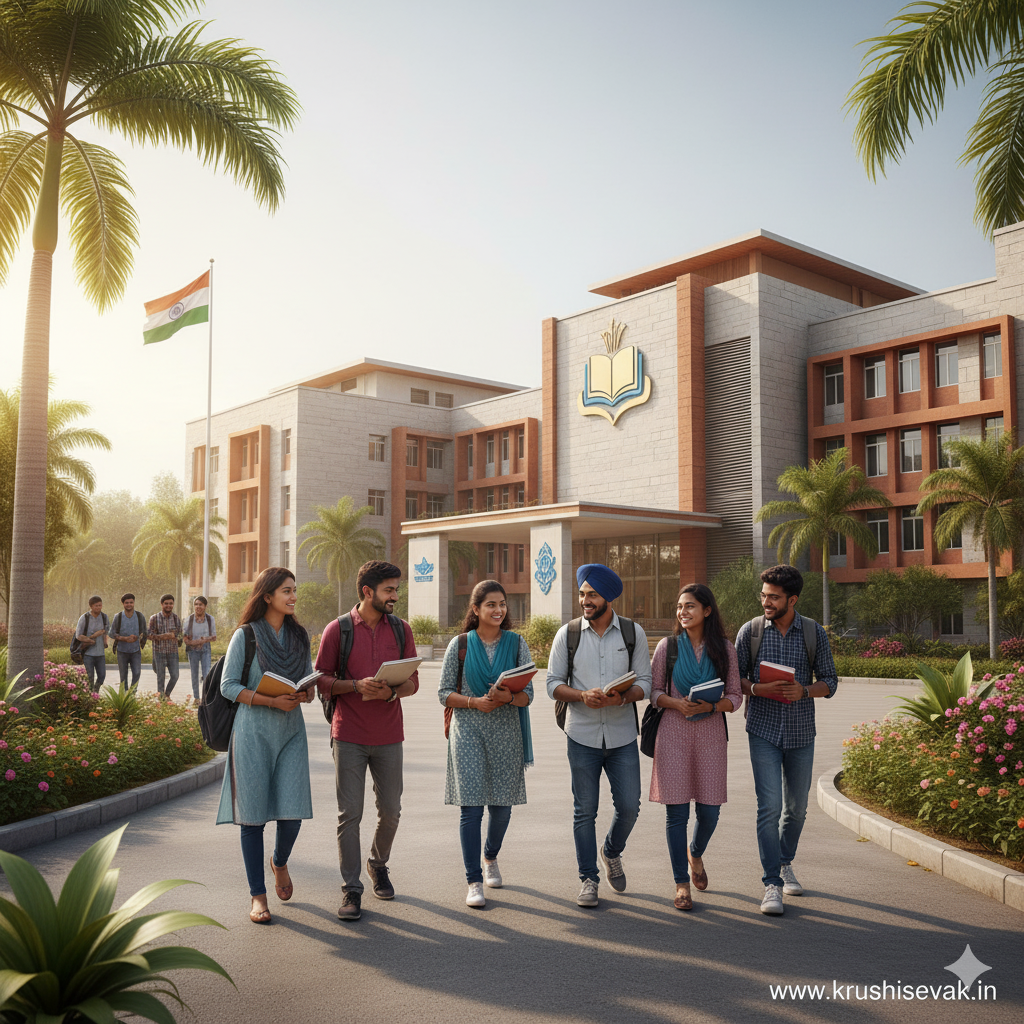

The Government of Maharashtra, through its dedicated Minority Development Department, implements a diverse framework of welfare programs. These initiatives actively support the socio-economic, educational, and structural development of the state’s notified religious minority communities. These communities include Muslims, Buddhists, Christians, Sikhs, Parsis, Jains, and Jews.
The key objectives behind these development programs are to reduce academic dropout rates, offer robust social security nets, lower structural barriers for marginalized regions, and provide access to low-interest economic capital for budding entrepreneurs.
1. Educational Support and Scholarship Programs
Higher and technical education can place a significant financial strain on low-income families. To balance this, the Minority Development Department oversees multiple financial aid frameworks split across different academic directories.
A. Professional and Technical Courses Scheme (DTE & DMER)
This initiative supports students who secure admissions into recognized, high-tier technical and professional streams. These streams include Engineering, Technology, Architecture, Pharmacy, Management, and diverse health science branches like MBBS, BDS, BAMS, BHMS, and B.Sc. Nursing.
- Financial Scope: The state provides financial assistance covering either the actual institutional tuition and examination fees or a maximum cap of ₹50,000 per academic year, whichever is lower.
- Operational Parameters: The benefits apply directly to students who secure admission through the standard Centralized Admission Process (CAP), national-level competitive entrance tests, or clear merit evaluation based on Higher Secondary Certificate (HSC) score parameters.
B. Traditional Higher Education Tracks (DHE)
Formally known as the State Minority Scholarship Part II under the Directorate of Higher Education, this framework targets students pursuing non-professional graduation or post-graduation. This includes courses in the fields of Arts, Commerce, Science, Law, and Education (B.Ed./M.Ed.).
- Financial Scope: This structural model covers the actual annual course fee demanded by the registered institution up to a localized cap of ₹5,000 per annum.
- Operational Parameters: Due to regional budget distribution rules, this funding window operates on a strictly monitored state quota system, admitting approximately 2,000 fresh academic candidates per active financial year cycle based on localized merit.
C. Post-Matric Maintenance Support
For students transitioning from secondary education into junior colleges (Class 11 and 12), ITIs, and technical diplomas, the Post-Matric Scholarship provides structural support.
- Financial Scope: Beyond direct tuition fee waivers, the scheme dispenses monthly maintenance allowances ranging from ₹230 to ₹1,200 per month depending on whether the beneficiary is a day scholar or residing in an approved institutional hostel. It also includes dedicated allowances for textbooks and educational materials.
- Operational Parameters: It acts as a safety net specifically calibrated for households falling under lower income brackets, aiming to keep students from dropping out after completing their Class 10 certifications.
D. Foreign Higher Education Scholarship
This elite scheme addresses the financial gaps faced by highly meritorious minority students who secure confirmed admission offers from top-ranked global universities for postgraduate (Master’s) degrees or PhD research tracks abroad.
- Financial Scope: The department covers complete or partial overseas tuition fees, economy-class international air travel fares, and calculated monthly living stipends tailored to the destination country’s baseline living index.
- Operational Parameters: Candidates undergo strict screening by a specialized state-appointed selection committee that evaluates academic excellence, research viability, and institutional rankings.
2. Infrastructure, Skill Development, and Economic Initiatives
Socio-economic upliftment requires a dual focus on individual education and broader structural resources within minority-concentrated zones.
A. Pradhan Mantri Jan Vikas Karyakram (PMJVK)
Executed via joint center-state coordination allocations, PMJVK channels capital directly into designated Minority Concentrated Areas (MCAs) across Maharashtra. These are areas where the minority demographic population matches or exceeds specific baseline thresholds while lagging behind in development indicators.
- Infrastructure Targets: Funding is directed toward building additional classrooms, establishing laboratories, creating clean drinking water networks, setting up community health centers, and constructing working women’s hostels.
- Monitoring: Local district collectorates oversee project execution timelines to ensure public infrastructure assets are delivered directly within high-density minority residential zones.
B. Vocational Training Programs
Operating alongside the Maharashtra State Skill Development Society (MSSDS), the department finances free vocational training camps. These programs target unemployed youth and school dropouts, focusing on market-aligned skills like digital accounting, hardware networking, medical lab assistance, precision welding, and retail operations. The courses also provide formal job-placement assistance after certification.
C. Maulana Azad Minorities Financial Development Corporation (MAMFDC)
MAMFDC functions as the primary economic wing for micro-business development. It offers credit to individuals who cannot secure standard commercial banking loans due to a lack of collateral.
- Term Loans: Direct capital loans for purchasing inventory, machinery, or agricultural equipment to establish or scale micro-enterprises.
- Education Loans: Educational loans featuring nominal, highly subsidized interest rates to cover domestic or international studies.
3. General Eligibility Criteria
To maintain transparency and ensure resources reach those who need them most, applicants must satisfy a standardized set of eligibility criteria:
- Religious Status: The applicant must legally belong to one of the state’s recognized minority groups: Muslim, Buddhist, Christian, Sikh, Parsi, Jain, or Jew.
- State Domicile Status: The applicant must be a continuous, permanent resident of Maharashtra. Students from other states living in Maharashtra solely for temporary study are ineligible.
- Family Income Ceiling: For the primary DTE, DMER, and DHE higher education scholarships, the total combined annual family income from all valid sources must not exceed ₹8,00,000 (Eight Lakhs). For specific post-matric maintenance basic packages, the income floor is lower, capped strictly at ₹2,00,000 (Two Lakhs) annually.
- Academic Performance Matrix: New applicants must have secured at least 50% marks in their previous qualifying final board or university examination. Continuing students must maintain clear passing marks without active backlogs to secure annual renewal benefits.
- Institutional Alignment: The university or college must be recognized by its corresponding national and state regulatory councils, such as UGC, AICTE, FRA, or the Maharashtra University of Health Sciences (MUHS).
- Exclusivity Clause: An applicant can only claim benefits from one government scholarship scheme per academic year. Receiving parallel funds from central ministries (like the National Scholarship Portal) or other state welfare departments automatically disqualifies the application.
4. Required Documentation Checklist
To prevent automated system rejections or institutional delays during desk verification, keep clear, digital scans of the following documents ready:
- Aadhaar Identification: A clear scan of the applicant’s Aadhaar card. It must be actively linked to their current mobile number to complete biometric and OTP verifications.
- Domicile Certificate: A formal Domicile Certificate issued by a competent state authority, such as a Tehsildar or Sub-Divisional Officer.
- Official Income Verification: An authentic Income Certificate issued for the preceding financial year by an authorized revenue official. Private employer declarations or plain affidavits are generally not accepted.
- Minority Community Proof: A self-declaration format confirming minority status, or an official School Leaving Certificate (TC) that explicitly documents the applicant’s stated religion.
- Academic Record History: Consolidated mark sheets for Senior Secondary (SSC), Higher Secondary (HSC), or previous qualifying semester exams.
- Current Institutional Enrollment Proof: The current academic year’s official fee receipt alongside a fresh, signed Bonafide Certificate issued by the college head or registrar.
- Aadhaar-Seeded Bank Passbook: A clear scan of the first page of the applicant’s bank passbook. This must clearly show the account number, bank branch details, and the IFSC code. The account must be fully compliant with e-KYC norms and directly seeded with Aadhaar to receive Direct Benefit Transfers (DBT).
5. Step-by-Step Online Application Process
The Government of Maharashtra has consolidated its individual scholarship pipelines into a unified web portal called Aaple Sarkar MahaDBT. This platform automates matching, institutional routing, and fund delivery.
Step 1: Account Creation and Portal Registration
- Open your web browser and navigate directly to the official state portal at: mahadbt.maharashtra.gov.in.
- Locate the main right-hand navigation panel and select New Applicant Registration.
- Input the applicant’s legal name exactly as it appears on their SSC mark sheet and Aadhaar card. Create a unique username and a strong alphanumeric password.
- Provide an active mobile number and email ID, then click Send OTP. Input the verification codes sent to both channels to activate the profile login credentials.
Step 2: Aadhaar Authentication and Profile Population
- Return to the portal homepage, click Applicant Login, and sign in using your new username and password.
- The system will prompt you for an Aadhaar validation choice. Select OTP-Based Verification for a faster setup.
- Input your 12-digit Aadhaar number and trigger the security code. Enter the OTP sent to your Aadhaar-linked mobile phone. This will automatically pull your verified name, date of birth, gender, and photograph from the UIDAI database into your profile.
Step 3: Complete Personal and Structural Profile Tabs
- Personal Info: Fill in secondary contact details, permanent residential addresses, and specific family structural details.
- Domicile and Income: State whether you hold a valid Maharashtra domicile. Input your income certificate number, the designation of the issuing officer, and the exact annual income figure.
- Caste/Minority Focus: Under the category selection dropdown, select General/Open. Then, locate the minority-specific query box, check Yes, and select your specific religious community from the options provided.
Step 4: Academic History and Current Course Inputs
- Complete the Past Qualification section by entering your academic history sequentially, starting from SSC up to your most recent completed term. Input board names, seat numbers, passing years, and exact marks received.
- Navigate to the Current Course tab. Select the correct district and taluka where your college operates, choose your university affiliation, and select your specific course from the populated menu.
- Specify your admission path (such as CAP round allocation or direct merit enrollment), enter your unique application ID, and input the exact date of your admission confirmation.
- Indicate whether you are enrolled as a Day Scholar or a Hosteller to ensure accurate calculation of any maintenance allowances.
Step 5: Document Upload and Scheme Submission
- The MahaDBT portal automatically generates specific upload slots based on your profile answers.
- Convert all requested documents (Income Certificate, Domicile, Mark sheets, Fee Receipts, and Bonafide Certificates) into clean PDF or JPEG files. Ensure they comply with the system’s size rules (typically between 150 KB and 1 MB) and remain clear and legible.
- Once all files are uploaded, click on the All Schemes tab on the left dashboard menu.
- Set the primary department filter to Minority Development Department.
- Read through the filtered options and click Apply next to the specific program that matches your course level (such as the DTE, DMER, or DHE scholarship variant).
- Take a moment to review your complete application profile for accuracy. Check the declaration box to accept the terms, then click Submit. Save a digital copy or print the receipt page containing your unique Application ID for tracking.
6. Post-Submission Review and Fund Allocation Workflow
Once submitted, applications move through an automated multi-stage review process to verify eligibility and prevent duplicate claims:
- Stage 1: Institutional Level Verification: The designated scrutiny clerk or principal of your college reviews your uploaded digital documents against their physical admissions registry. If everything aligns, they digitally forward the file to the regional office.
- Stage 2: Regional Directorate Desk Audit: The Joint Director or Regional Desk Officer reviews the application to verify income validity, check regional quota limits, and confirm compliance with state guidelines.
- Stage 3: Fund Release Management: Once approved, the system queues the application for fund release. The state treasury directly transfers the approved financial benefit to your Aadhaar-seeded bank account via Direct Benefit Transfer (DBT).
Tracking Your Application Status
You can check the status of your application at any time by logging into the MahaDBT portal and navigating to the My Applied Schemes section. The system uses specific tracking labels:
- Under Scrutiny: Your application is currently awaiting review at either the college or regional department level.
- Approved: Your application has passed all verification checks, and funds are scheduled for release.
- Reverted / Incomplete: The reviewer noted an issue, such as a blurry document upload or an incorrect certificate number. If this occurs, the portal will open a correction window. You must quickly fix the issue and resubmit your application to keep your place in the processing queue.
Assistance and Support
If you run into technical issues like biometric verification failures, login problems, or unexpected delays in fund delivery, you can file a formal support ticket using the portal’s built-in Grievance Redressal tab. Alternatively, you can contact the dedicated state welfare helpline at 1800-2670-007 for direct assistance.