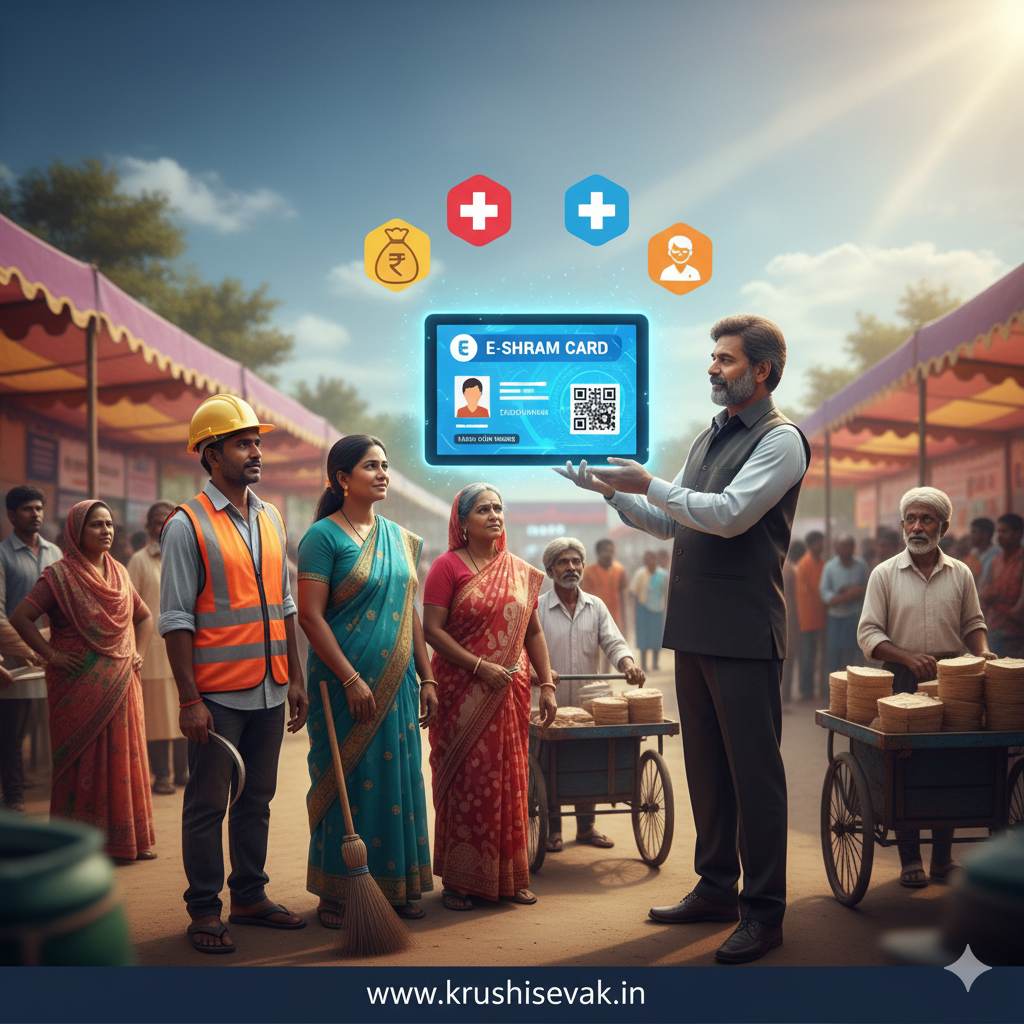

The E-Shram Card Scheme stands as one of the most comprehensive social engineering and welfare initiatives launched by the Government of India under the aegis of the Ministry of Labour and Employment. Unveiled with the specific intent of building a robust, centralized registry, the program establishes the National Database of Unorganised Workers (NDUW). For decades, India’s economic narrative has been deeply defined by its vast unorganized workforce—a massive, fragmented population of daily wage earners, agricultural laborers, street vendors, and migrant workers who form the backbone of the nation’s infrastructure, yet historically remained invisible to structured state social security nets.
Before the inception of the E-Shram platform, the primary roadblock to delivering targeted state welfare was the complete lack of verifiable data. Because these workers shifted frequently between occupations, geographical locations, and seasonal employers, the state could not systematically map their demographics, skills, or operational numbers. The E-Shram portal directly bridges this critical systemic gap by registering unorganized workers using an Aadhaar-seeded identity architecture.
Upon successful registration, every worker is issued a unique, permanent 12-digit Universal Account Number (UAN) embedded within an official E-Shram Card. This identity document functions as a portable lifetime credential, validating the worker’s status across all Indian states and union territories. Operating under a unified digital framework, the E-Shram platform serves as a single-window clearing house. It translates data into direct, actionable governance, ensuring that social security benefits, accident insurance policies, healthcare access, and disaster-relief financial assistance can be routed straight to the most marginalized layers of the national workforce without administrative delays or structural leaks.
Defining the Unorganized Worker: Target Audience
To contextualize the scope of the scheme, it is necessary to examine who constitutes an unorganized sector worker under the operational guidelines of the Ministry of Labour and Employment. The scheme defines an unorganized worker as any citizen who functions as a home-based earner, a self-employed individual, or a casual wage laborer operating outside regular institutional payroll networks. Crucially, the target worker must not be a registered member of established statutory welfare funds like the Employees’ Provident Fund Organisation (EPFO) or the Employees’ State Insurance Corporation (ESIC).
The spectrum of occupations encompassed by the E-Shram database is exceptionally wide, touching almost every manual and informal labor market in India:
- Agricultural and Allied Workers: Small and marginal farmers, landless agricultural laborers, sharecroppers, fishermen, animal husbandry workers, dairy workers, and casual plantation laborers.
- Construction and Infrastructure Labor: Brick kiln workers, stone quarriers, road construction laborers, masons, carpenters, house painters, plumbers, and manual earth-movers.
- Urban Services and Street Economy: Street vendors, vegetable and fruit sellers, ragpickers, domestic helpers, maids, cobblers, rickshaw pullers, auto-rickshaw drivers, and delivery partners working within the modern gig economy.
- Artisans and Traditional Handcrafts: Weavers, potters, blacksmiths, goldsmiths, tailors, leather workers, and independent garment stitching operators.
- Community Support Workers: Accredited Social Health Activists (ASHA workers), Anganwadi helpers, mid-day meal cooks, and community sanitation sweepers.
Core Benefits of the E-Shram Card
The E-Shram card is far more than an identity proof; it serves as a gateway to multiple financial, protective, and developmental advantages designed to uplift the socio-economic status of informal workers.
1. Universal Portability of Social Security
The primary structural advantage of the E-Shram card is its complete geographic and institutional portability. Historically, when a construction worker migrated from a rural village in Bihar to an urban site in Maharashtra, they lost access to localized state welfare schemes, subsidized food rations, and medical benefits. Because the E-Shram card utilizes a centralized, Aadhaar-linked Universal Account Number (UAN), the worker’s dynamic data remains permanently accessible to federal and state tracking platforms. This ensures that wherever the worker travels across India for employment, their accumulated identity, credentials, and entitlement claims move along with them seamlessly.
2. Comprehensive Accidental Insurance Cover
Registered E-Shram cardholders are automatically integrated into state-backed personal accident insurance frameworks, specifically mapped alongside initiatives like the Pradhan Mantri Suraksha Bima Yojana (PMSBY).
- Accidental Death Benefits: In the unfortunate event of the cardholder’s demise due to a work-related or external accident, the nominee listed in the worker’s profile receives a structural financial payout of Rupees Two Lakhs.
- Permanent Total Disability Cover: If an accident results in a total, irreversible loss of limbs, sight, or complete occupational capability, the beneficiary is granted a matching insurance payout of Rupees Two Lakhs.
- Partial Disability Support: For instances involving partial but permanent structural disability due to an accident, the worker is entitled to financial compensation amounting to Rupees One Lakh.
3. Integrated Integration with Prime Government Welfare Schemes
The E-Shram database acts as the single primary baseline for the cross-routing of workers into twelve distinct, premium central government welfare programs. Instead of requiring workers to repeatedly submit physical eligibility documents across different ministerial blocks, the E-Shram card acts as a pre-verified certificate. Cardholders receive direct priority access and streamlined onboarding into programs such as:
- Ayushman Bharat (Pradhan Mantri Jan Arogya Yojana – PM-JAY): Providing cash-free secondary and tertiary healthcare hospital coverage up to Rupees Five Lakhs per family annually.
- Pradhan Mantri Awas Yojana (PMAY-G/U): Offering structural financial subsidies to help construct permanent, secure housing units for landless and economically vulnerable individuals.
- Pradhan Mantri Shram Yogi Maandhan (PM-SYM): Facilitating direct entry into voluntary pension frameworks that guarantee a monthly pension of Rupees Three Thousand after the worker attains the age of 60.
- Pradhan Mantri Ujjwala Yojana: Facilitating free liquid petroleum gas (LPG) kitchen connections to smoke-free household environments.
4. Precision Financial Routing in Times of National Crises
The deep vulnerabilities of the unorganized workforce were exposed during historic public health disruptions and sudden economic lockdowns. In scenarios involving future national emergencies, pandemics, natural disasters, or severe regional economic disruptions, the central government utilizes the E-Shram registry as its core directory for emergency direct cash transfers. Because the card data includes verified, active bank accounts mapped directly via the National Payments Corporation of India (NPCI) system, the state can instantly inject economic relief funds straight into the pockets of affected workers, entirely avoiding bureaucratic middle-tier delays or administrative blockages.
5. Access to Skill Development and Employment Linkages
The E-Shram platform is directly integrated with modern digital employment portals like the National Career Service (NCS) and the Skill India Digital architecture. By classifying workers precisely using the National Classification of Occupations (NCO) codes, the system maps the exact current skill level and work experience of every registrant. This enables the government to design targeted regional upskilling and vocational training bootcamps. Furthermore, verified private and public employers looking for specific local trade talents can look into anonymous regional aggregates to offer regular, fair-wage employment opportunities directly to the registered workforce.
Detailed Eligibility Criteria
To maintain database integrity and ensure that public resources are channeled strictly to the genuinely unorganized sector, the Ministry of Labour and Employment enforces unambiguous, strict eligibility thresholds.
1. Age Parameters
An applicant must fall strictly within the active workforce age bracket. The system allows registrations for individuals who are between 16 and 59 years of age. Upon reaching the threshold of 60 years, the database profile stabilizes, and the worker smoothly becomes eligible to transition into linked old-age pension structures without needing to re-register.
2. Occupational Classification
The primary requirement is that the applicant must be actively engaged in gainful employment within an unorganized sector job role. They can be a daily wage earner, piece-rate worker, or independent micro-entrepreneur running small-scale street operations.
3. Statutory Exclusion Clauses
The scheme strictly excludes individuals who are already protected by formal corporate or state-sponsored employee benefit networks. An individual is deemed completely ineligible if:
- They maintain an active, contributing account under the Employees’ Provident Fund Organisation (EPFO).
- They are covered under the healthcare and social safety infrastructure of the Employees’ State Insurance Corporation (ESIC).
- They draw structural retirement or employment benefits from the National Pension System (NPS) funded through regular government-backed employer matching models.
4. Income Tax Thresholds
While there is no fixed lower monthly wage ceiling to register on the E-Shram platform, the applicant must not belong to the organized affluent tax bracket. Specifically, the applicant must not be an active income tax payer filing regular returns with the Department of Revenue. The scheme is curated specifically for individuals whose earnings remain within informal subsistence levels.
Essential Documents and Information Required
The E-Shram registration platform is designed around a lean documentation philosophy, ensuring that workers do not face major paper-based barriers. However, specific core vectors must be prepared before starting the application process.
1. Primary Identification Vectors
- Aadhaar Card Number: The baseline unique identifier for the entire registration pipeline. All demographic details—including full legal name, date of birth, and biological gender—are drawn directly from the Aadhaar card via secure electronic Know Your Customer (e-KYC) matching protocols.
- Aadhaar-Linked Mobile Number: To complete self-registration independently from home, the applicant must possess a functional mobile number actively linked to their Aadhaar card. This number is essential for validating identity via real-time One-Time Passwords (OTPs) generated by the Unique Identification Authority of India (UIDAI).
2. Financial and Banking Coordinates
- Active Bank Account Details: The applicant must provide their explicit bank savings account number alongside the exact Indian Financial System Code (IFSC) of the specific bank branch. The bank account must be actively seeded and mapped with the applicant’s Aadhaar card on the NPCI gateway to ensure error-free Direct Benefit Transfer (DBT) deliveries.
3. Occupational Details
- Primary Work Description: The applicant must clearly state their main source of livelihood (e.g., “Maison,” “Tailor,” or “Agricultural Laborer”). The system maps this description against the uniform National Classification of Occupations (NCO) registry.
- Skill Certificates (Optional): If the worker has undergone formal vocational training through a state program like the Pradhan Mantri Kaushal Vikas Yojana (PMKVY), they can provide their skill certificate details, though this is purely optional.
4. Additional Support Inputs
- Nominee Information: Details regarding a designated legal nominee—including their legal name, clear date of birth, and exact familial relationship to the cardholder—must be provided to ensure the seamless execution of accident insurance claims if required.
- Educational Qualification Details (Optional): Basic indicators of formal education levels (e.g., illiterate, primary school, matriculation) can be selected via a simple drop-down system without requiring physical mark sheets.
Step-by-Step Online Self-Application Process
The self-registration module on the official E-Shram system is built to be simple and user-friendly, allowing anyone with a basic smartphone or computer to register without paying any processing fees.
- Step 1: Navigating to the Official Portal: Open a secure internet browser and go directly to the designated official e-Shram portal at eshram.gov.in. On the homepage, locate the prominent link labeled “Register on e-Shram” and click it to open the dedicated Self-Registration engine.
- Step 2: Initiating the Session Validation: The system will display the initial login interface. Enter the active mobile number that is securely linked to your Aadhaar card. Input the alphanumeric Captcha code exactly as displayed on the screen. Select the appropriate “No” checkboxes indicating that you are not a member of EPFO or ESIC, then click on the “Send OTP” button.
- Step 3: Authenticating the Entry Session: A secure, time-sensitive One-Time Password will be delivered to your mobile phone via the SMS gateway. Enter this code into the designated verification field and click “Submit.”
- Step 4: Providing Aadhaar Data for e-KYC: The system will prompt you to enter your complete 12-digit Aadhaar Card number. Select the check box confirming your explicit consent for Aadhaar-based cryptographic authentication. Ensure that the “OTP” verification method is selected, enter the new security Captcha code, and click “Submit.”
- Step 5: Verifying Identity via Identity Gateway: The UIDAI systems will process the request and dispatch a secure e-KYC validation OTP to the registered mobile number. Carefully input this OTP and click on the “Validate” button.
- Step 6: Reviewing Auto-Populated Personal Details: Once authenticated, the portal screen will securely fetch and display your personal demographic information directly from the official Aadhaar registry, showing your photograph, legal name, date of birth, gender, and residential address. Review these details for accuracy, select the declaration check box, and click “Continue to Enter Other Details.”
- Step 7: Filling out Personal Profile Parameters: A detailed input form will appear, broken down into sequential informational tabs. In the Personal Information module, provide your active email address (if available), specify your current marital status, enter your father’s or husband’s full legal name, and declare your social category (General, OBC, SC, or ST). Complete this section by filling out the complete name, date of birth, and relationship coordinates of your chosen family nominee, then click “Save and Continue.”
- Step 8: Inputting Residential and Migration Parameters: In the Residential Details tab, specify your current state and native district. Enter your complete physical location address, clearly separating house numbers, locality paths, state blocks, and local Pincodes. Declare how many years you have resided at this specific physical location, and indicate whether you are a migrant worker moving across state borders. Click “Save and Continue.”
- Step 9: Declaring Educational and Monthly Income Brackets: Under the Education & Income tab, choose your highest level of educational qualification from the drop-down menu. If you wish, you can upload a soft copy of your education certificate, though this is not mandatory. Select your monthly income bracket from the provided range options and click “Save and Continue.”
- Step 10: Specifying Occupational Roles and Skill Details: In the Occupation & Skills tab, enter your main trade. As you start typing, the system’s smart autocomplete feature will suggest standard matching titles from the National Classification of Occupations (NCO) list. Enter your total working experience in this specific trade in terms of years. If you possess a secondary or alternative trade skill, input those details as well, then click “Save and Continue.”
- Step 11: Entering Direct Benefit Transfer Bank Parameters: In the Bank Details tab, fill in your operational bank savings account number, and re-type it carefully in the confirmation box to avoid typing errors. Enter the full legal name of the account holder exactly as printed on your bank passbook, and input the bank branch’s unique IFSC code. Click the search icon next to the IFSC field to let the system automatically verify and fill in the official bank name and branch location, then click “Save and Continue.”
- Step 12: Previewing the Comprehensive Profile and Final Submission: The portal will display a comprehensive preview page containing all the data you entered across the various modules. Carefully read through every section to verify that the names, numbers, account details, and dates match your physical records exactly. If any errors are spotted, click the “Edit” button to make corrections. If everything is completely accurate, check the final confirmation box to accept the terms and conditions of the scheme, and click the final “Submit” button.
Downloading the E-Shram Card
Upon clicking the final submit button, the registration system processes the application in real time and instantly generates your personalized E-Shram Card on the screen. The digital card features your photograph, full name, father’s name, date of birth, gender, native district, and primary occupation. Most importantly, it clearly displays your unique 12-digit Universal Account Number (UAN) along with an encrypted quick-response (QR) code for instant field validation by state inspectors.
To secure a portable copy of the card, simply click on the prominent “Download UAN Card” button displayed directly above the card graphic. The system will immediately generate a high-resolution, print-ready PDF version of the card and save it to your device. You can store this digital file safely on your smartphone or print a physical copy to carry with you as a permanent identity document.
Alternative Assisted Application Channels (CSC Networks)
For citizens who do not have access to a personal smartphone, a reliable internet connection, or digital literacy, the government provides an assisted offline registration framework through its massive grassroots network of Common Service Centers (CSCs).
- Visiting a Local CSC: The worker can walk into any authorized Common Service Center or State Seva Kendra (SSK) operating across rural and semi-urban areas.
- Biometric Authentication: If a worker’s mobile number is not linked to their Aadhaar card, the CSC operator can bypass the mobile OTP verification step by utilizing biometric hardware devices. The worker simply places their finger on an electronic scanner or undergoes an iris scan to complete the secure e-KYC process.
- Completely Free of Charge: It is a strict mandate from the Ministry of Labour and Employment that the entire registration and issuance process for the E-Shram card is completely free for all unorganized workers. The government directly pays the processing and administrative fees to the CSC operators. Workers are not required to pay any money for their initial registration or for printing their physical UAN card.
Conclusion
The E-Shram Card Scheme represents a monumental step forward in India’s ongoing efforts to formalize its informal economy and extend social justice to its most vulnerable workers. By replacing fragmented, paper-based tracking systems with a modern, unified, Aadhaar-seeded identity platform, the initiative provides structural visibility and legal recognition to millions of unorganized laborers.
As the centralized database continues to expand and deepen its integrations with vital national safety nets, skill ecosystems, and financial platforms, the E-Shram card will remain a foundational asset for the working-class population. It empowers once-invisible workers with a portable identity, robust accident insurance, and direct, unhindered access to comprehensive state welfare, laying a solid foundation for equitable and inclusive national growth.