
In an era defined by rapid technological advancements and shifting economic demands, bridging the gap between academic education and industry-ready skills is more critical than ever. The Pradhan Mantri Kaushal Vikas Yojana (PMKVY), executed by the Ministry of Skill Development and Entrepreneurship (MSDE) via the National Skill Development Corporation (NSDC), stands as India’s flagship skill-training initiative.
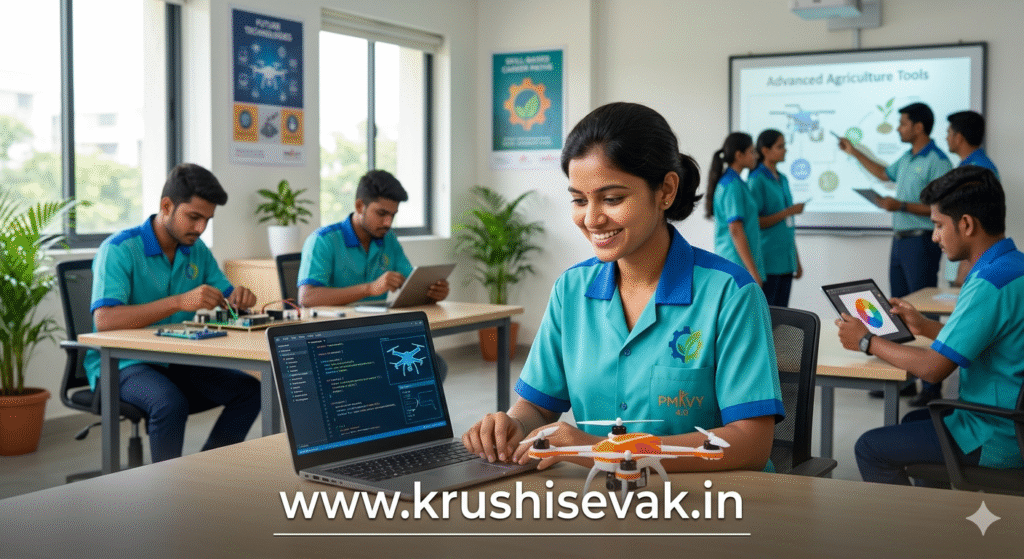
Operating in its highly advanced PMKVY 4.0 phase, the scheme has shifted gears to align with modern industrial frameworks, featuring New-Age courses like drone piloting, AI, 3D printing, and robotics alongside traditional artisanal trades. By offering fully government-funded (free) certified training programs, the initiative empowers unemployed youth, school dropouts, and working professionals to secure sustainable livelihoods.
This comprehensive guide covers everything you need to know about the PM Kaushal Vikas Yojana 2026 apply process, core components, eligibility conditions, and career outcomes.
1. Key Objectives of PMKVY 4.0 in 2026
The PM Kaushal Vikas Yojana 2026 is designed around systemic efficiency, flexibility, and direct industry integration. Its principal targets include:
- Standardizing Industrial Skills: Aligning all training curriculum directly with the National Skills Qualification Framework (NSQF) to ensure standardized certification recognized globally.
- Incentivizing New-Age Technologies: Introducing advanced technical training modules to future-proof the Indian workforce against automated industrial shifts.
- Promoting Inclusivity: Ensuring equal, zero-cost access to skill ecosystems across rural districts, keeping women, marginalized communities, and persons with disabilities (PwD) at the forefront.
- Driving Entrepreneurship: Seamlessly linking successfully certified candidates with startup schemes and credit options like the PM Mudra Yojana and PM Vishwakarma.
2. Core Implementation Components
The training architecture under the scheme is divided into two operational training components tailored to different applicant requirements:
A. Short-Term Training (STT)
This pathway is designed primarily for fresh job-seekers, school dropouts, or college graduates lacking specialized job skills.
- Duration: Courses generally span between 150 to 600 hours (roughly 2 to 6 months of daily 4–6 hour modules).
- Focus Area: Offers intensive classroom instruction combined with practical laboratory hours across sectors like IT-ITeS, Healthcare, Electronics, Apparel, and Logistics.
- Additional Skills: Beyond technical domain knowledge, STT comprehensively incorporates training in soft skills, digital literacy, financial systems, and basic entrepreneurship.
B. Recognition of Prior Learning (RPL)
RPL targets individuals who possess informal work experience (such as carpenters, masons, retail workers, traditional artisans, or auto mechanics) but lack formal, government-backed educational certifications.
- Duration: Typically ranges between 12 to 80 hours, functioning primarily as a short bridging course.
- Focus Area: Assesses existing skill levels, fills execution knowledge gaps, exposes workers to modern tools/safety standards, and awards them a valid NSQF certificate, instantly increasing their corporate market value.
3. Sectors and Course Categories Available
PMKVY 4.0 covers more than 36distinct industrial sectors with over 5,000 distinct job roles ranging from NSQF Levels 1 to 7. Prominent sectors experiencing high corporate hiring demand include:
- Technology & Digital: Cloud Computing, Data Analytics Associate, AI Prompt Engineering, Cyber Security, and Hardware Repair.
- Healthcare Services: General Duty Assistant (GDA), Home Health Aide, Emergency Medical Technician.
- Automation & Engineering: Drone Pilot, EV Service Technician, Industrial Automation Specialist, CNC Machine Operator.
- Apparel & Hospitality: Fashion Designer, Commercial Cook, Customer Service Executive, Front Office Associate.
- Agriculture & Green Energy: Solar Panel Installation Technician, Organic Farmer, Micro-Irrigation Technician.
4. Eligibility Criteria for Applicants
Before initiating the PM Kaushal Vikas Yojana 2026 apply process, make sure you meet the foundational eligibility requirements:
| Metric | Condition / Requirement Details |
|---|---|
| Nationality | Must be a legal citizen of India. |
| Age Limit | Generally between 15 to 45 years (extended up to 59 years for specific traditional or upskilling modules). |
| Academic Background | Varies by job role. Minimum entries accept Class 5th, 8th, or 10th pass. Advanced courses require ITI, Diploma, or Graduation. |
| Employment Status | Unemployed youth, school/college dropouts, or working professionals looking to upskill/reskill. |
| Prior Enrollment | The applicant must not be actively enrolled in any parallel PMKVY training program. |
5. Step-by-Step Guide: PM Kaushal Vikas Yojana 2026 Apply Process
The application pipeline has transitioned completely to a digital setup managed via the central Skill India Digital Hub (SIDH). Follow this exact step-by-step methodology to enroll.
Step 1: Portal Registration and Profile Creation
- Open your web browser and navigate to the official portal: Skill India Digital Hub (or download the official SIDH mobile app from the Google Play Store or Apple App Store).
- Click on the “Sign Up” or “Register” option located at the top-right corner of the interface.
- Enter your active mobile number. A secure 6-digit One-Time Password (OTP) will be sent instantly. Enter it to verify.
- Input your legal details exactly as they appear on your state records: Full name, Date of Birth, Gender, District, and highest educational qualification.
- Provide your Aadhaar Number to complete the mandatory e-KYC integration.
Step 2: Selecting the Right Course and Industry Sector
- Once logged into the dashboard, click on the “Skill Courses” tab.
- Use the interactive filters to narrow down your choices based on your preferred Sector (e.g., IT-ITeS, Healthcare) or Location/District.
- Carefully review the descriptive information card for each listed job role. Check the NSQF Level, total required training hours, minimum entry qualification, and projected average wages.
Step 3: Finding and Selecting an Authenticated Training Center
- After choosing your specific course, the portal will display a list of nearest verified training centers—such as a Pradhan Mantri Kaushal Kendra (PMKK) or an NSDC-affiliated center.
- Select a convenient center location and click “Enrol”.
- Alternatively, you can directly visit your chosen center physically to complete your registration request manually on their offline terminal.
- Aadhaar Card (Must be actively linked to your current mobile number).
- Educational Certificates / Marksheets proving your eligibility for the specific role (e.g., 10th, 12th, or Degree).
- Bank Passbook / Cancelled Cheque (The bank account must be fully Aadhaar-seeded for receiving any direct government stipends).
- Recent Passport-Sized Photographs.
- Once your application batch is approved, your classes will commence at the designated training center.
- Attendance Rule: Candidates must maintain a mandatory minimum of 70% attendance verified via an Aadhaar-Enabled Biometric Attendance System (AEBAS) to qualify for final exams. Skipping biometric sign-ins means you will be barred from examinations.
- At the conclusion of your training hours, an independent third-party assessment will be conducted by specialized assessors from the corresponding Sector Skill Council (SSC).
- The exam features both a digital theoretical paper and a practical demonstration of skills.
- Results sync automatically to the Skill India Digital Hub within 7 to 15 days of completion. Upon passing, your verified Digital Certificate and Skill India Card are generated and synced directly to your DigiLocker account.
- Conveyance & Boarding Support: Trainees traveling from remote rural pockets or special category districts receive direct financial allowances for travel, lodging, and boarding costs.
- Post-Placement Financial Stipend: Certified candidates who successfully transition into corporate employment get a short-term post-placement monetary stipend to manage early urban living expenses.
- Accidental Insurance: All enrolled students are secured via a complimentary, government-paid accidental insurance policy for the complete active duration of their course.
- Placement Assistance: Every certified training center operates a dedicated placement cell. They map your completed digital profile to corporate job openings listed on the National Career Service (NCS) portal and coordinate direct campus placement drives with private employers.
- Level 1 Support: Reach out directly to your assigned Training Center Coordinator or Center Head to fix biometric attendance logging issues.
- Level 2 Support: Contact the national central Skill India Customer Toll-Free Helpline at 8800-055-555 or the NSDC TP Helpdesk at 1800-123-9626.
- Level 3 Support: For unresolved administrative delays exceeding 30 days, submit an official ticket via the central public grievance system (CPGRAMS).